A nation celebrates
p. 33 · Read in the full issue
Focus On Vanuatu
Fifteen years after independence, Vanuatu has come a long way. But there are still problems that need to be ironed out
By Patrick Decloitre
As it celebrates its 15th
independence anniversary,
Vanuatu has become a typical example of a situa tion found in many coun tries of the region : population growth
problems, leadership struggles and a
dependence on foreign donors.
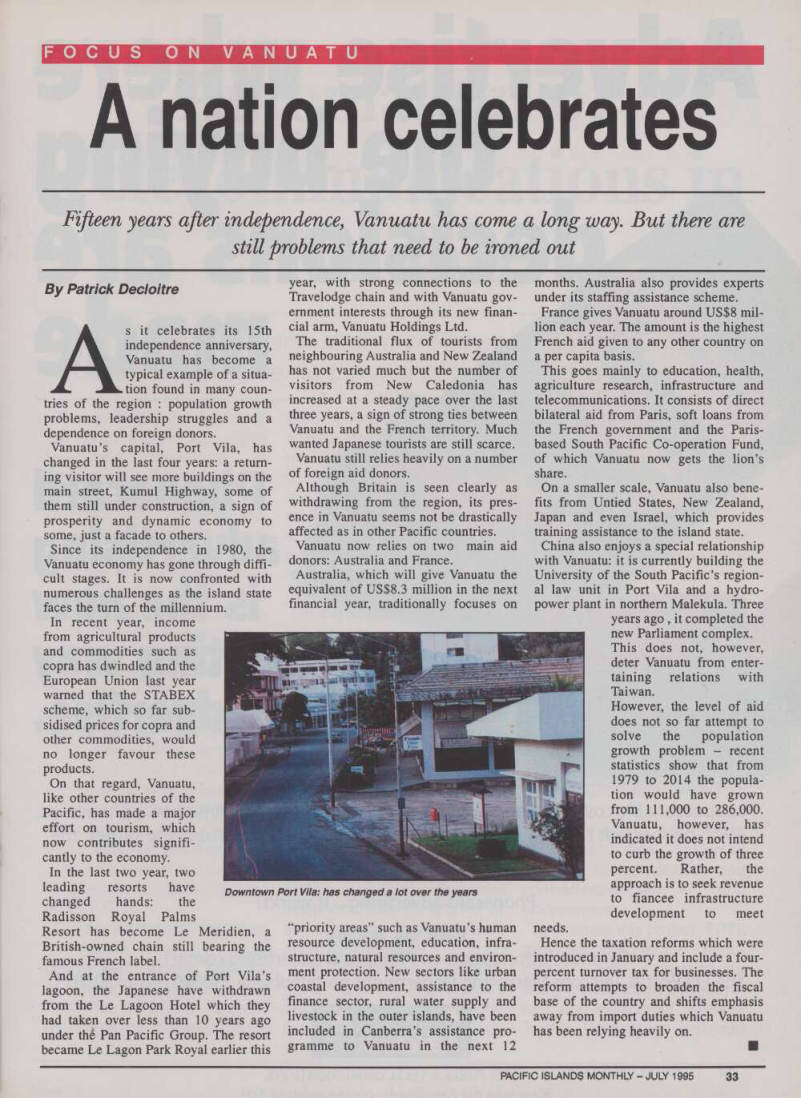
Vanuatu’s capital, Port Vila, has changed in the last four years: a return ing visitor will see more buildings on the main street, Kumul Highway, some of them still under construction, a sign of prosperity and dynamic economy to some, just a facade to others.
Since its independence in 1980, the Vanuatu economy has gone through diffi cult stages. It is now confronted with numerous challenges as the island state faces the turn of the millennium.
In recent year, income from agricultural products and commodities such as copra has dwindled and the European Union last year warned that the STABEX scheme, which so far sub sidised prices for copra and other commodities, would no longer favour these products.
On that regard, Vanuatu, like other countries of the Pacific, has made a major effort on tourism, which now contributes signifi cantly to the economy.
In the last two year, two leading resorts have changed hands: the Radisson Royal Palms
Resort has become Le Meridien, a British-owned chain still bearing the famous French label.
And at the entrance of Port Vila’s lagoon, the Japanese have withdrawn from the Le Lagoon Hotel which they had taken over less than 10 years ago under thd Pan Pacific Group. The resort became Le Lagon Park Royal earlier this
year, with strong connections to the Travelodge chain and with Vanuatu gov ernment interests through its new finan cial arm, Vanuatu Holdings Ltd.
The traditional flux of tourists from neighbouring Australia and New Zealand has not varied much but the number of visitors from New Caledonia has increased at a steady pace over the last three years, a sign of strong ties between Vanuatu and the French territory. Much wanted Japanese tourists are still scarce.
Vanuatu still relies heavily on a number of foreign aid donors.
Although Britain is seen clearly as withdrawing from the region, its pres ence in Vanuatu seems not be drastically affected as in other Pacific countries.
Vanuatu now relies on two main aid donors: Australia and France.
Australia, which will give Vanuatu the equivalent of US$B.3 million in the next financial year, traditionally focuses on
“priority areas” such as Vanuatu’s human resource development, education, infra structure, natural resources and environ ment protection. New sectors like urban coastal development, assistance to the finance sector, rural water supply and livestock in the outer islands, have been included in Canberra’s assistance pro gramme to Vanuatu in the next 12
months. Australia also provides experts under its staffing assistance scheme.
France gives Vanuatu around US$B mil lion each year. The amount is the highest French aid given to any other country on a per capita basis.
This goes mainly to education, health, agriculture research, infrastructure and telecommunications. It consists of direct bilateral aid from Paris, soft loans from the French government and the Paris based South Pacific Co-operation Fund, of which Vanuatu now gets the lion’s share.
On a smaller scale, Vanuatu also bene fits from Untied States, New Zealand, Japan and even Israel, which provides training assistance to the island state.
China also enjoys a special relationship with Vanuatu; it is currently building the University of the South Pacific’s region al law unit in Port Vila and a hydro power plant in northern Malekula. Three
years ago , it completed the new Parliament complex.
This does not, however, deter Vanuatu from enter taining relations with Taiwan.
However, the level of aid does not so far attempt to solve the population growth problem - recent statistics show that from 1979 to 2014 the popula tion would have grown from 111,000 to 286,000.
Vanuatu, however, has indicated it does not intend to curb the growth of three percent. Rather, the approach is to seek revenue to fiancee infrastructure development to meet
needs.
Hence the taxation reforms which were introduced in January and include a four percent turnover tax for businesses. The reform attempts to broaden the fiscal base of the country and shifts emphasis away from import duties which Vanuatu has been relying heavily on.
Downtown Port Vila: has changed a lot over the years