Hobby leads
pp. 10-11 · Read in the full issue
Obituary
Hobby leads to death of billionaire
Larry Hillblom, the H’ in DHL and a keen flyer, was not so lucky when his seaplane lunged into
shark-infested waters
By David North
Larry Hillblom’s death, like his life and wealth, was dramatic.
Probably the richest man in the American islands, maybe in the insular Pacific, he crashed into the sea and may have been consumed by sharks after an ill fated attempt to fly from his home on Saipan to nearby Pagan Island. Apparently dying with him in his seaplane was a
prominent Saipan politician, Jesus Mafnas, and Hillblom’s pilot, Robert Long.
We say apparently because at this writ ing the bodies of Mafnas and Long had been recovered from the sea and identified but not that of Hillblom, 52. He is regard ed as missing and presumed dead, though it is theoretically possible that he floated away on a life-raft undetected in the mas
sive search and rescue mission that fol lowed news of his non-return from Pagan.
Hillblom (pronounced hill-bloom) was a strange combination of left-wing politi cal rebel and highly successful entrepre neur. He was best known as the “H” of DHL, the world-wide air courier company he helped start in the late 19605.
Unlike many who strike it rich and then lose their wealth, Hillblom kept building
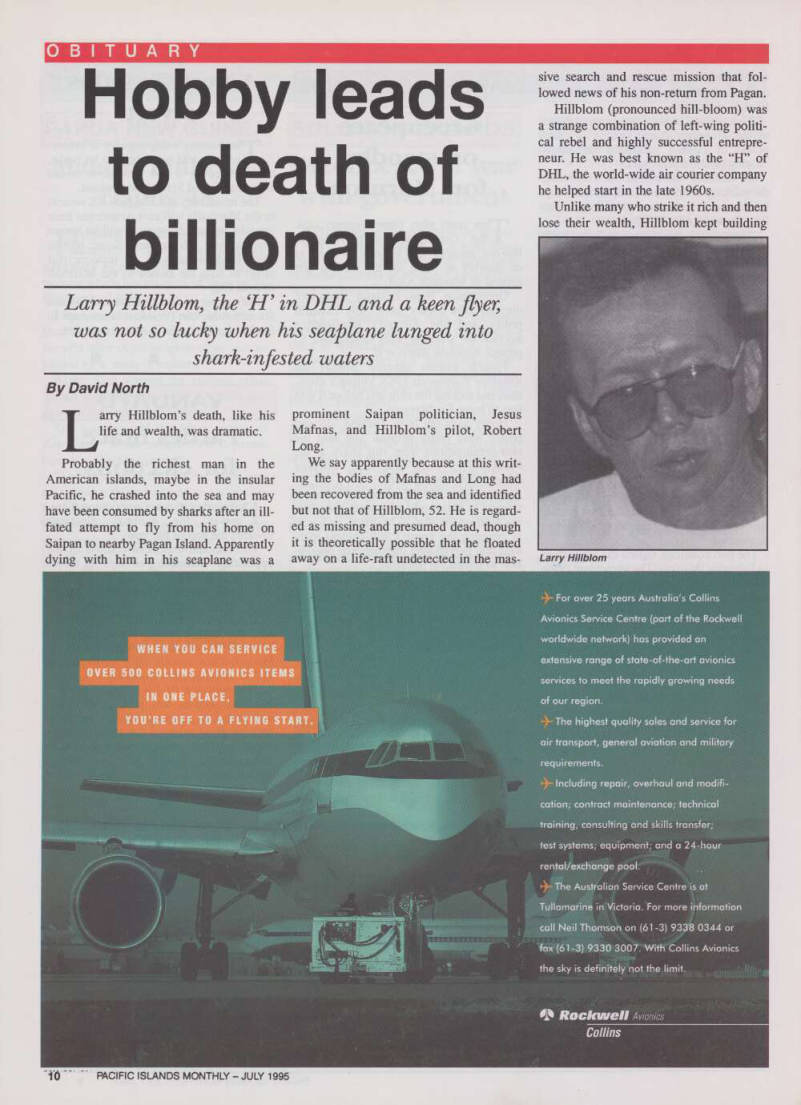
Larry Hillblom
his wealth - and economic activity in the islands- until the day of his death. The newspapers in the Commonwealth of the Northern Marianas Islands routinely referred to him as a billionaire. The New York Times obituary quoted Forbes Magazine estimate of a net worth of $3OO million.
Early on Sunday morning, May 21, the trio took off from Saipan for Pagan, some 300 kilometres to the north. The Saipan speculation was that Hillblom was check ing out still another island economic opportunity. Pagan, site of an active vol cano, apparently has a massive supply of volcanic sand, a potentially useful building material.
On the way the flyers ran into bad weather. Both Hillblom and Mafnas used their cellular phones to call back to Saipan to arrange for people to meet them when the seaplane returned. When their absence was noted, a sea and air rescue mission
was organised.
Two bodies were found - one was Mafnas and the other was at first identified as Hillblom. Subsequently someone noticed the body carried a tattoo “Bob” on the shoulder and that the face looked more like Long.
The local papers, perhaps out of respect for the dead or for fear of frightening the tourists (the main source of CNMTs income), avoided mentioning the apparent cause of the confusion. But the reason was clear to sources on Saipan; the recovered bodies apparently had been mauled by sharks. Hillblom may have been consumed
by them.
Hillblom had a life-long interest in air planes. He had been part-owner of Continental Airlines and of the local feed er, “Air Mike”, as well. In 1993 he was nearly killed when the Cessna he was piloting crashed on CNMTs Tinian Island.
He lost his eye in the accident and spent the next 12 months recovering from the accident and the resulting surgical recon struction of his face.
Hillblom was a law student at the University of California at Berkeley when it was a hotbed of agitation against the US War in Vietnam. He carried a strong anti- Washington radical view for the rest of his life. He was beloved in Micronesia for his strong stands on behalf of people of the islands and was known to have funded var ious protests against Washington over the years.
He also was one of the first US entre preneurs to take advantage of warmer rela
tions between Vietnam and the US and was working on resort complexes in both the former Saigon and in Danang at the time of his death.
Hillblom played an active role in CNMI politics and secured for himself a special judgeship on the territory’s Supreme Court. He rarely heard cases but he carried the title of judge.
Hillblom was not bom rich but he apparently had a genius for recognising an economic opportunity, capitalising on it and then moving on to other opportunities.
While living in Hawaii in the late 19605, he saw an economic niche. Ships moving from Hawaii to the mainland went through a tedious, expensive customs-clearance process once they reached the mainland.
This could be speeded considerably if the necessary customs documents could get to the mainland before the ships arrived.
So he and two friends started an air courier service between Honolulu and San Francisco and DHL was bom. DHL is now the world’s leading international courier service and Hillblom continued to own a major share (of the privately held compa ny) at his death. He went on to buy and build other airlines, resorts and television cable systems. The corporation through which much of this was done is the United Micronesia Development Association.
In dollar terms, he was one of the prime beneficiaries of CNMI’s peculiar tax sys tem. One pays taxes on the basis of main land rules (in lieu of federal income taxes) and then a huge percentage of the tax is returned to the individual.
Despite his wealth and his show-place home Saipan, he was a man of simple tastes, was routinely seen in jeans and a T shirt. He never married and it is expected that much of his wealth will go to a chari table founding in the medical field.
In retrospect, the reviews are mixed - a man of enormous intelligence, energy, cre ativity and skills, yet there was some unease about all this political and econom ic power bundled into one man, clearly a very large frog in small pond. “There were many who felt that his was a baleful influ ence,” one observer commented.
In addition to the gruesome question of how Hillblom met his fate, two other mys teries persist: Why did a billionaire use a
50-year-old seaplane? The plane’s manu
facturer, Republican Aviation, was long out of business and the plane was report edly damaged in a typhoon. And who will secure control of Hillblom’s financial
empire? ■