In the red
pp. 46-47 · Read in the full issue

Economy
By Patrick Decloitre
Vanuatu-based Head of the United Nation’s Economic and Social Commission for Asia and the Pacific (ESCAP), Savenaca Siwatibau, last April painted a grim pic ture of the Pacific island countries’ economies, saying some of them were “going backwards” in terms of develop ment.
Speaking on April 18, after the offi cial launching of ESCAP’s 1993 economic and social survey in Asia and
the Pacific (which covers 19 countries), Siwatibau said in the past year, some Pacific island economies have had slow economic growth rates, lower than
their population’s.
“In terms of development, this is going backwards. The resources have not been used wisely and the quality of investment hasn’t been very good,” he said.
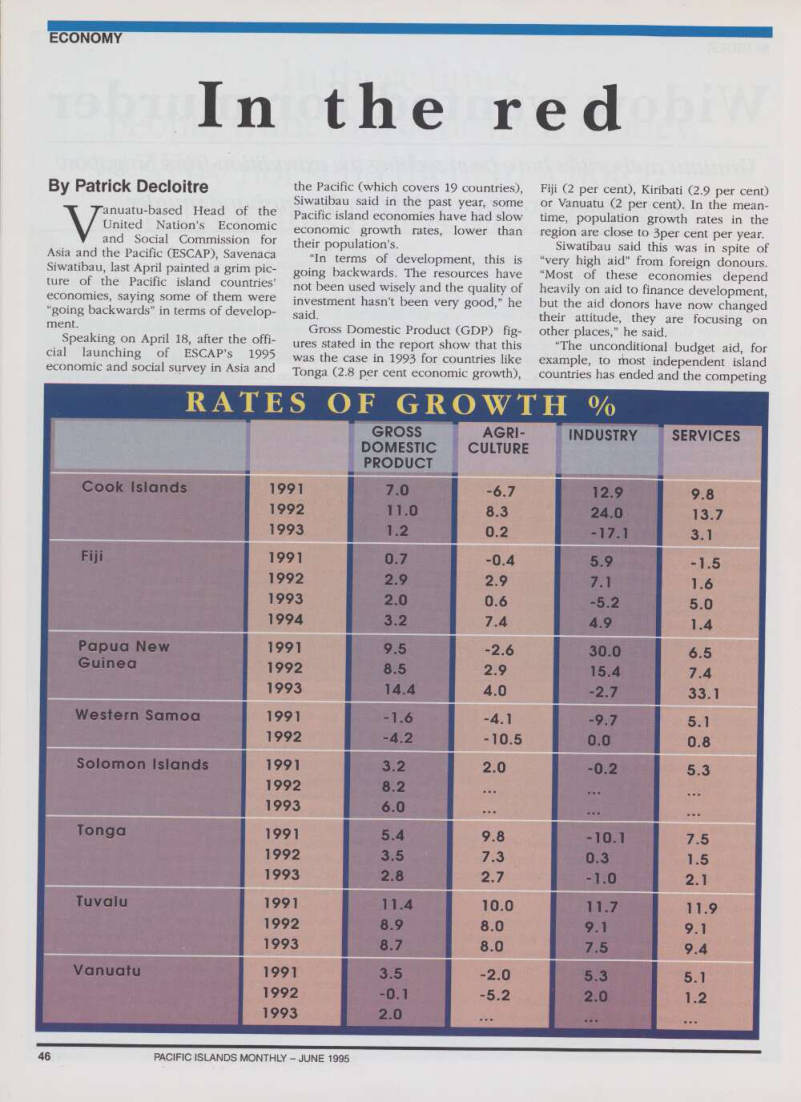
Gross Domestic Product (GDP) fig ures stated in the report show that this was the case in 1993 for countries like Tonga (2.8 per cent economic growth),
Fiji (2 per cent), Kiribati (2.9 per cent) or Vanuatu (2 per cent). In the mean time, population growth rates in the region are close to 3per cent per year.
Siwatibau said this was in spite of “very high aid” from foreign donours.
“Most of these economies depend heavily on aid to finance development, but the aid donors have now changed their attitude, they are focusing on other places,” he said.
“The unconditional budget aid, for example, to ihost independent island countries has ended and the competing
Rates Of Growth %
7 .
Gross
Domestic
Product
m
Agri-
Culture
' Industry
' Services
Cook Islands 1991 7.0 -6.7 12.9 9.8 1992 11.0 8.3 24.0 13.7 1993 1.2 0.2 -17.1 3.1 Fiji 1991 0.7 -0.4 5.9 -1.5 1992 2.9 2.9 7.1 1.6 1993 2.0 0.6 -5.2 5.0 1994 3.2 7.4 4.9 1.4 Papua New 1991 9.5 -2.6 30.0 6.5 Guinea 1992 8.5 2.9 15.4 7.4 1993 14.4 4.0 -2.7 33.1 Western Samoa 1991 -1.6 -4.1 -9.7 5.1 1992 -4.2 -10.5 0.0 0.8 Solomon Islands 1991 3.2 2.0 -0.2 5.3 1992 8.2 ... 1993 6.0 ... ,,,
Tonga
1991 5.4 9.8 -10.1 7.5 1992 3.5 7.3 0.3 1.5 1993 2.8 2.7 -1.0 2.1 Tuvalu 1991 11.4 10.0 11.7 11.9 1992 8.9 8.0 9.1 9.1 1993 8.7 8.0 7.5 9.4 Vanuatu 1991 3.5 -2.0 5.3 5.1 1992 -0.1 -5.2 2.0 1.2 1993 2.0
demand for the limited aid resources from various claimants around the globe make it unlikely that such aid will be restored in the foreseeable future,” the 1995 ESCAP report further stresses.
Siwatibau added these advantages in the form of foreign aid and special trade agreements to Pacific island coun tries were going to be “slowly
disappearing”.
“After the GATT’s Uruguay round which has brought down the trade bar riers, special advantages under trade agreements with Pacific island coun tries like Lome IV or South Pacific Regional and Trade and Economic Cooperation Agreement (SPARTECA) are going to be eroded. There is a need to compete more fiercely, we have to
Siwatibau said to be more competitive, gov ernments of the region should look at their exchange rates, work in their efficiency by deregu lating and privatizing public service sectors.
export more,” Siwatibau said.
The ESCAP report says amongst Pacific island countries, Papua New Guinea was a “heavyweight in terms of its economic size,” which determines largely the performance of the whole region. But reviewing some countries in the Pacific region, Siwatibau said Papua New Guinea was “unable to control its expenditure”. “They have a problem with their balance of pay ments, despite export earnings and large mineral resources. There are about 60,000 school-leavers every year, but only 5000 to 6,000 jobs are created in the meantime,” he said. Statistically, however, PNG achieved 14.4 per cent GDP in 1993. The UN report attributes this strong growth to the good perfor mance of their service sector which grew by 33 per cent.
About Solomon Islands (6 per cent GDP in 1993), Siwatibau said they had a “very shortsighted policy” in exploit ing timber and fish at an “unsustainable rate”.
He outlined what he saw as “good examples” of “niche markets” to be
taken by countries of the Pacific region, such as the lucrative squash pumpkin exports to Japan from Tonga, Vanuatu or New Caledonia, the young black pearl industry in the Cook Islands or the garment industry in Fiji, which has earned this island state some 100 mil lion US dollars in the past five years.
The ESCAP head said Melanesian countries, unlike Polynesia and Micronesia, have resources to make them financially and economically independent, but they did not manage their affairs well.
Siwatibau said to be more competi tive, governments of the region should look at their exchange rates, work in their efficiency by deregulating and pri vatising sectors in the public service.
“This is an extremely challenging sit uation. Those (countries) who are prepared to gear themselves are going to do well, but those who are not will face a continuing decrease in their social standards. It’s not too late yet, but steps have to be taken now,” he
analysed.
Note: data for 1994 are estimates. (Source: 1995 ESCAP report, based on International Monetary Fund, International Financial Statistics, vol XLVII, N°lo - October 1994-; Asian Development Bank, Key Indicators of Developing Asian and Pacific Countries, 1994 - Oxford University Press, 1994 - and Asian Development Outlook, 19944 - Oxford University Press, 1994 - and national sources). ■