for Solomon Airlines
pp. 41-42 · Read in the full issue
It’s full throttle ahead for Solomon Airlines
Pacific island owned airlines have been flying 3 6 through some turbulent 6 times. Some are barely keeping 3 k & themselves above water while others are trying to manoeuvre back 3 to profitable altitudes. r Solomon Airlines is no exception F to the rule.
Nearly 12 months ago financial ® strains nearly crashed the organ- 3 b isation but a timely “part-time” 3 v lease negotiation with Qantas rejuvenated the company.
Also timely was the appointment
of former Qantas executive Jim „ AC . , Bradfield as general manager. t> A c- u • ... t Bradfield is confident that with u . . . his experience in a successful . ■ . . u . . , airline (Qantas) which has time , . , , , . . and again helped small regional . c , . . . airlines, Solomon Airlines should , , t . , make hasty recovery and be a , , . . .. . r profitable airline by the end of 1995. The deal with Qantas allows e , ... . .
Solomon Airlines to lease a 737- An c r\ . • , , 300 from Qantas thrice weekly an( j s h ar i n g the seats on flights between Brisbane and Honiara.
Seat-sharing deals with Air
Pacific, Air Niugini and Air Vanuatu, enabled Solomon Airlines to arrest its monthly loss of $400,000 in 1993. The Solomons government tried to res cue the company by ploughing generous sums into the company.
This did not help much as the company after a momentary stable period started a sharp descend.
Like any other island country, Solomon Islands desperately wanted a flag carrier. To materi alise this aim it started overseas services in 1992 with a 737-200 and later graduated
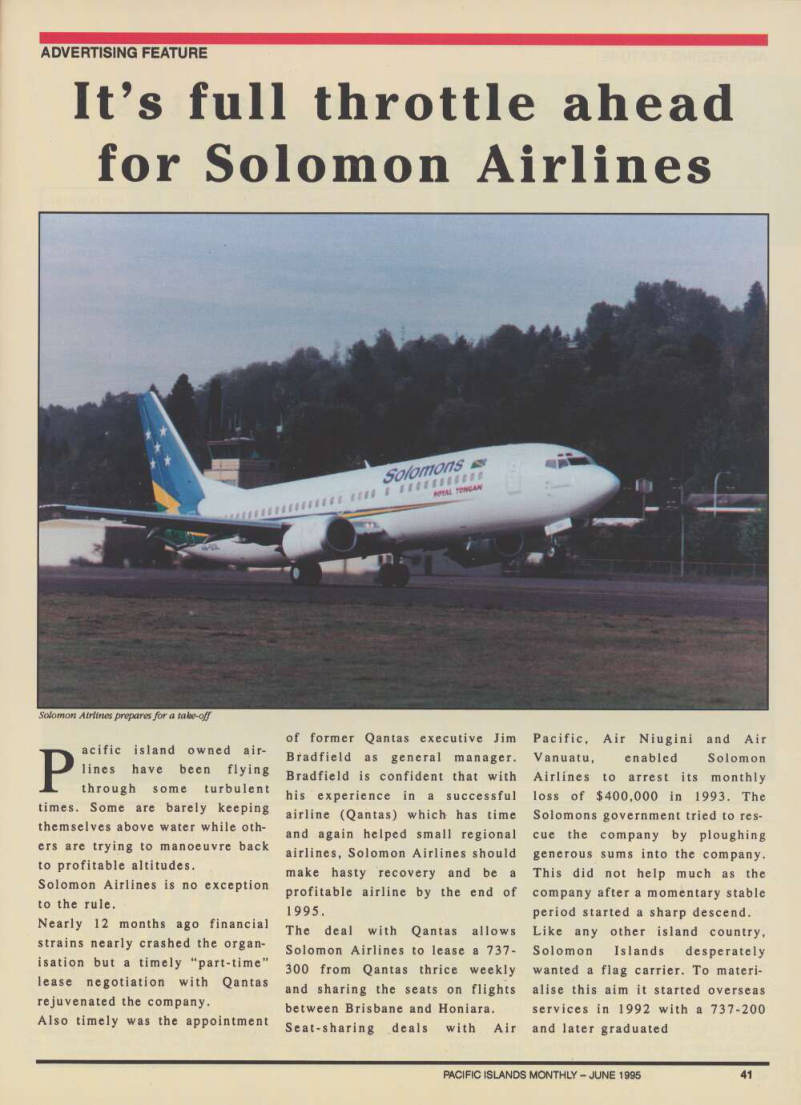
Solomon Airlines prepares for a take-off
continued from P. 41
to a 737-400 to increase the fre quency of flights to traditional tourist sources like New Zealand and Australia. However, this plan backfired because the market demand was far less then the fre quency of flights.
This is when Royal Tonga entered the scene and arranged to utilise the aircraft several times a week.
The arrangement was short term and ceased in early 1994 leaving
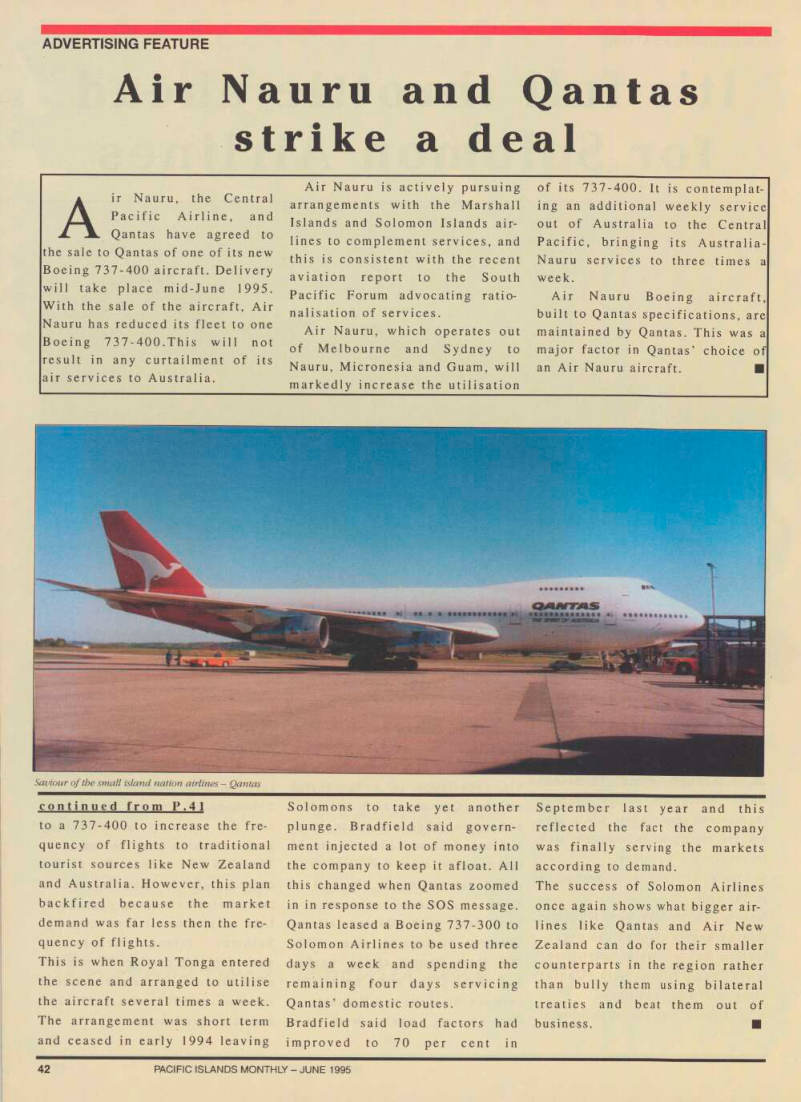
Solomons to take yet another plunge. Bradfield said govern ment injected a lot of money into the company to keep it afloat. All this changed when Qantas zoomed in in response to the SOS message.
Qantas leased a Boeing 737-300 to Solomon Airlines to be used three days a week and spending the
remaining four days servicing
Qantas’ domestic routes.
Bradfield said load factors had improved to 70 per cent in
September last year and this reflected the fact the company was finally serving the markets according to demand.
The success of Solomon Airlines once again shows what bigger air lines like Qantas and Air New Zealand can do for their smaller counterparts in the region rather than bully them using bilateral treaties and beat them out of business. ■