PATA and the Pacific
pp. 34-36 · Read in the full issue
Advertising Feature
There were close to 350 partici pants at the PATA (Pacific Asia Travel Association) meeting in Fiji.
Many had little or no idea about the existence of the South Pacific as a tourist destination. That is why the first PATA Chapters World Congress held at Nadi at the Sheraton hotel
was significant.
At a time when visitor arrivals are booming and projections are highly favourable, the seventh PATA con gress was timely. And the representation of varying countries, 30 to be exact, and the participants with impressive positions in the trav el industry boosted the timeliness.
The attendance of travel agents from the traditional markets of New Zealand and Australia would help the influx of visitors from these markets while the attendance of their coun terparts from Europe and American would allow the island nations to advertise themselves as tourist desti nations rather then stop-overs enroute to other destinations like Australia and New Zealand. The latter group’s presence meant the island nations would be assisted in their efforts to break into these markets including the Asian markets.
While the conference was held in Fiji, other nations like Tonga, Cook Islands and the Solomons took
advantage by being there and telling
delegates about their countries.
It is no secret that for developing countries to become viable tourist destinations, PATA is a force to reck on with.
Fiji’s Prime Minister Sitiveni Rabuka said this of PATA: “Since its creation over 40 years ago, the PATA image has been one of innovation
and visionary thinking. PATA has been at the forefront in assisting developing countries understand and work with the travel industry.”
PATA spearheaded the need for environmental conservation years before it became a global concern.
Apart from developing Fiji as an international quality destination through its local chapter, PATA was instrumental in the restoration of Fiji’s first capital, Levuka. In 1984 PATA conducted a study of Levuka and came up with a grant for the restora tion for this historic town which still retains many fine 19th Century build ings.
Another example of PATA’s lead ing role in the tourism industry was highlighted when the Solomon Islands asked it for technical assis tance to draw up a Tourism Act. The Act will govern various operations in the industry such as diving, tours and hotel accommodation.
The PATA Chapters congress gave people in the islands’ travel industry the opportunity to learn from many
of the region’s most influential per sonalities and at the same time giving them a first-hand experience of the island-style hospitality.
Air Pacific’s chief executive Andrew Drysdale, who became the first islander to become chairman of PATA, hailed the Congress as a mile stone for the Pacific.
He said the direct contact of high profile decision makers in the travel industry with the services offered locally enhanced their understanding of the type of destination the Pacific was.
Drysdale said the participants, hav ing seen Fiji, would be able to tell more about it to potential travellers .
In fact, Drysdale’s appointment itself means that the small Pacific islands would have a higher profile within PATA, which is an enormous organisation and help boost tourism.
The chairman of the Fiji Chapter of PATA, Mick Beddoes of Rosie Tours, expressed views similar to Drysdale.
At a time when more people are rushing to island shores for holidays coupled with the fact that PATA saw it fit to hold a vital congress in Fiji means that the South Pacific will experience a boom similar to the one seen in the Seventies.
But Fiji’s Tourism Minister Filipe Bole warned that while it was possi ble to double or even triple arrival figures, the question that needed to be asked was whether it was wise in light of conservation of culture and environment concerns.
Bole said Fiji should not attract quantity but quality. The reason behind this being to preserve old cul tures and the environment from excessive development.
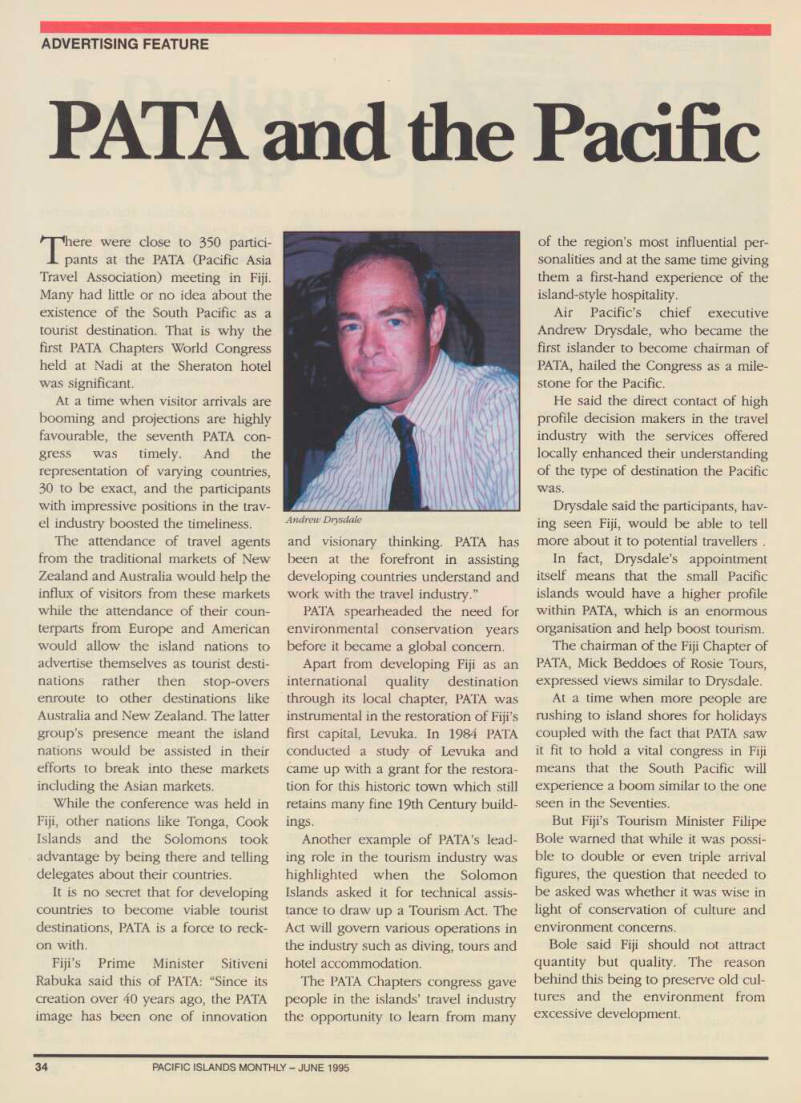
Andrew Drysdale
This concept would demand a lot of strategic planning so as not to
offend the frequently changing
demands of the tourists.
As PATA president and chief exec utive officer Lakshman Ratnapala said, tourist destinations need to change with the demands. This would allow the tourism industry to thrive with time and continue to attract tourists.
Ratnapala said PATA must not only be ready for change, but it should be the association’s obligation to pre pare members and chapters to be ready to face the challenges of
change.
“Our member and chapters cannot do business the way we used to sim ply because our business is not what it used to be. The environment in which we do business is not what it used to be. The environment in which we do business is changing much too rapidly for some of us, dri ven by numerous factors - political changes, liberalisation of trade, migration of labour and manage ment, technological advances and the growing speed of communications resulting in a much faster cross-fertil isation of ideas and expertise that the world has ever seen, since the emer gence of modern civilisation as we know it today.”
This view drives home the idea that island nations can no longer afford to rely on bilateral agreements with neighbouring big brothers like Australia and New Zealand. They have to make independent attempts to break into new markets and explore future possibilities of sourc ing tourists.
This type of missionary work can be assisted by PATA which has pledged to gather information from around the world and share it with its members and chapters.
Island nations which are seriously
considering establishing sustainable
tourist industries should act now because according to PATA execu tives the time is right.
In fact, serious policies on tourism now could open floodgates for investment and prevent regional air lines from crashing because of financial strains. ■
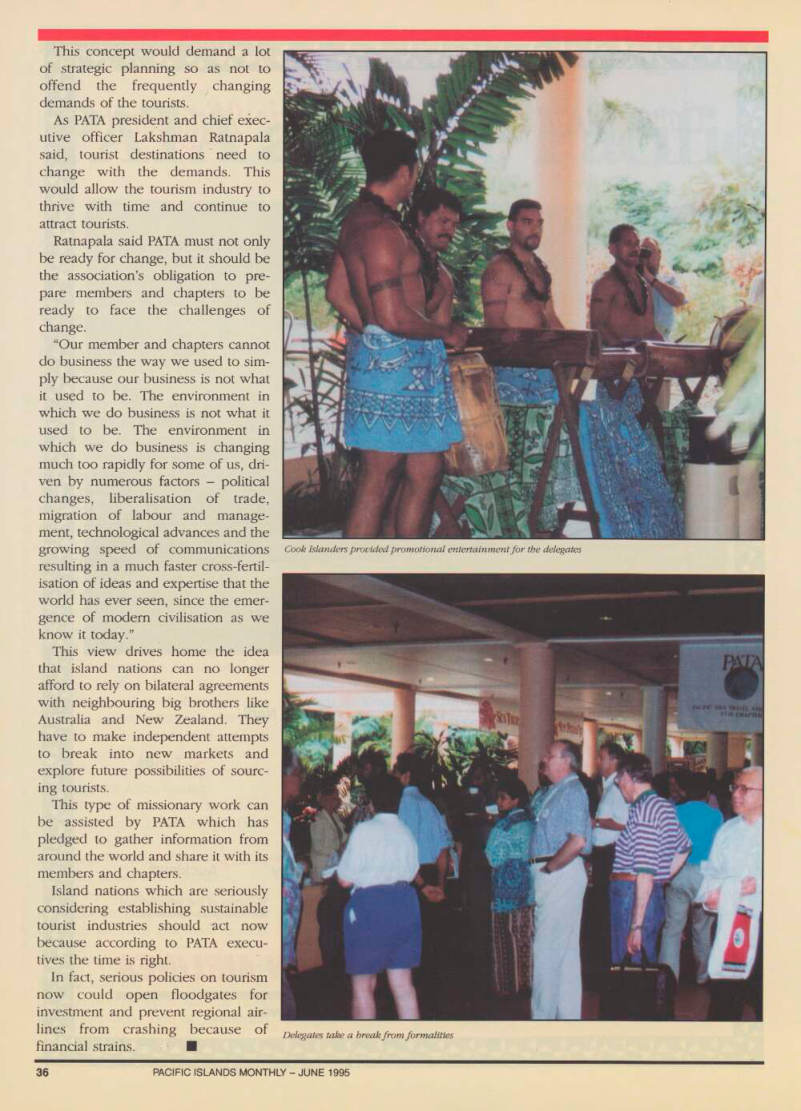
Cook Islanders provided promotional entertainment for the delegates
Delegates take a break from formalities