Dealing
p. 32 · Read in the full issue
Women
Dealing with domestic violence
By Yunus Rashid
A Senator in Fiji says he is tempted to rape when he reads articles by a female lawyer writing about women issues. A magistrate discharges six men who allegedly gang rape a juve nile because he thinks the girl “looked hefty” and another says another woman deserved to be raped because she was in the company of drunk men. A man hacks to death his wife and five young children because he is jealous.
These are but just a few examples of the gross violation of the rights of women in Fiji which claims to uphold basic human rights.
This problem is not confined to Fiji.
A perusal of media reports from around the region and the world will show that almost every day women are abused and the male-dominated system sits by and watches.
Generally all men agree that women should not be abused - even those who actually abuse women and children but not many are willing to stand up and do something about it for fear that they may branded as feminists.
In a time like this, women have no option but to take matters into their own hands.
This is exactly what the Fiji Women’s Crisis Centre, based in the capital Suva, is doing.
When the centre started over 10years-ago, peoples perception of it was that of a place where plots were hatched to break families and take revenge on men who scorn women.
But since then and now, that percep tion has changed through active education programmes through the media and other avenues. People are
beginning to take notice of the fact that the violation of women’s rights is a real issue in our community. It is no longer seen as a problem confined to the Western world which took the lead in highlighting the plight of women.
The result of this awakening has been that more women have been able to have their husbands convicted for assault and while a lot is left to be desired, some magistrates and judges now see rape as a crime in league with murder and manslaughter.
Having influenced public opinion in Fiji on issues concerning women the centre is now venturing into a new con cept of training women on how to continue the work creating more public awareness of the “women’s cause”.
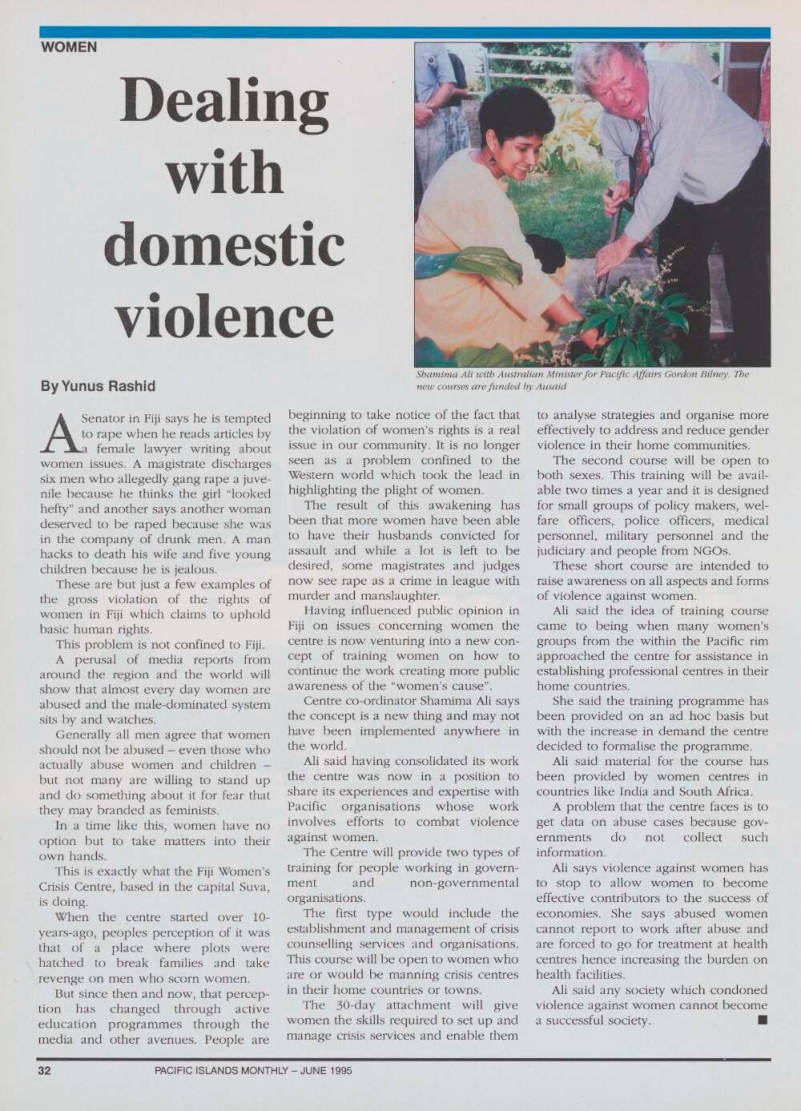
Centre co-ordinator Shamima Ali says the concept is a new thing and may not have been implemented anywhere in the world.
Ali said having consolidated its work the centre was now in a position to share its experiences and expertise with Pacific organisations whose work involves efforts to combat violence against women.
The Centre will provide two types of training for people working in govern ment and non-governmental organisations.
The first type would include the establishment and management of crisis counselling services and organisations.
This course will be open to women who are or would be manning crisis centres in their home countries or towns.
The 30-day attachment will give women the skills required to set up and manage crisis services and enable them
to analyse strategies and organise more effectively to address and reduce gender violence in their home communities.
The second course will be open to both sexes. This training will be avail able two times a year and it is designed for small groups of policy makers, wel fare officers, police officers, medical personnel, military personnel and the judiciary and people from NGOs.
These short course are intended to raise awareness on all aspects and forms of violence against women.
Ali said the idea of training course came to being when many women’s groups from the within the Pacific rim approached the centre for assistance in establishing professional centres in their home countries.
She said the training programme has been provided on an ad hoc basis but with the increase in demand the centre decided to formalise the programme.
Ali said material for the course has been provided by women centres in countries like India and South Africa.
A problem that the centre faces is to get data on abuse cases because gov ernments do not collect such information.
Ali says violence against women has to stop to allow women to become effective contributors to the success of economies. She says abused women cannot report to work after abuse and are forced to go for treatment at health centres hence increasing the burden on health facilities.
Ali said any society which condoned violence against women cannot become a successful society. ■
Shamima Ali with Australian Minister for Pacific Affairs Gordon Bilney. The new courses are funded by Ausaid