answer?
pp. 28-29 · Read in the full issue
Conflict
Who has the answer?
By Martin Tiffany
Threats by Maori activists to scare off foreign investment has brought the strongest reaction so far from the New Zealand government.
Lawyer and activistist Annette Sykes warned at a press conference on May 3 that Maori would burn forests and destroy hydro dams if overseas invest ment continued without consultation with tangata whenua (traditional land owners).
Mike Smith, best known for his attempt to destroy an Auckland landmark - the pine tree on One Tree Hill - said there could be more crimes against prop erty if Maori sovereignty was ignored and their resources continued to be eroded.
And veteran land campaigner Tame Iti warned foreign investors to move aside.
“We’re going to govern the country.”
The threats made to coincide with the Asian Development Bank conference held in Auckland in May, have sparked police into warning they may invoke the little-used sedition law to prosecute the Maori activists.
Kiwi Prime Minister Jim Bolger called the activists a “group of loonies” at a press conference on May 4. He said the group were unrepresentative of young Maori people, were self-appointed and had decided they wanted to be “radical revolutionaries”.
“Anarchy is anarchy, no matter what is used to justify it, and New Zealand will have only one sovereign state that will be
elected by the people,” said Bolger.
The threats and name-calling are just another chapter in the saga in the Maori
fight for sovereignty against the govern ment. A fight which if not handled properly could be long and could turn nasty. So far the nastiest it has turned has been a few confrontations between land occupiers and police and a number of arrests.
“Anarchy is anarchy , no matter what is used to jus tify it, and New Zealand will have only one sover eign state that will be elected by the people ”
Maori are now in it for the long haul and want a result, the government have been floundering, they have not come out with firm action and at times look a bit lost - unsure how to handle the situa tion. During the various land occupations by Maori in recent months the govern ment has not taken a firm hand and told Maori to leave and let the Waitangi Tribunal make a ruling on the land.
The Waitangi Tribunal is a body of 17 members set up to rule on Maori land claims.
In the case of the old Tamaki Girls College site in Auckland, Maori land
occupiers have scared off a Chinese Christian group who wanted to buy the site. Maori say the site was given by them to the Anglican church for educational purposes in the 1840 s and say the gov ernment has no right to sell it.
On May 6 an auction of privately owned land in Wanganui was called off after Maori protesters laid claim to the land. Also in Wanganui the occupation of Motua Gardens continues as Maori say they are preparing to settle in for winter.
The gardens are seen by Maori as a major triumph against the government who threatened to throw them off the land but backed down - acting as a catalyst for further occupation and action.
There has been much criticism of gov ernment over Motua Gardens, many saying the failure to do anything was a sign of weakness. New Zealand MPs are saying the government needs to distin guish between genuine Maori claims and Maori nationalists.
The first firm action the government has taken is Bolger’s “loony, anarchy” attack and the threats of sedition charges by Assistant Police Commissioner Brian Duncan. Then there is Bolger’s dismissals of the radicals saying they are not repre sentative of the rest of Maori.
But while Maori have had some in fighting over some of the radicals’ action
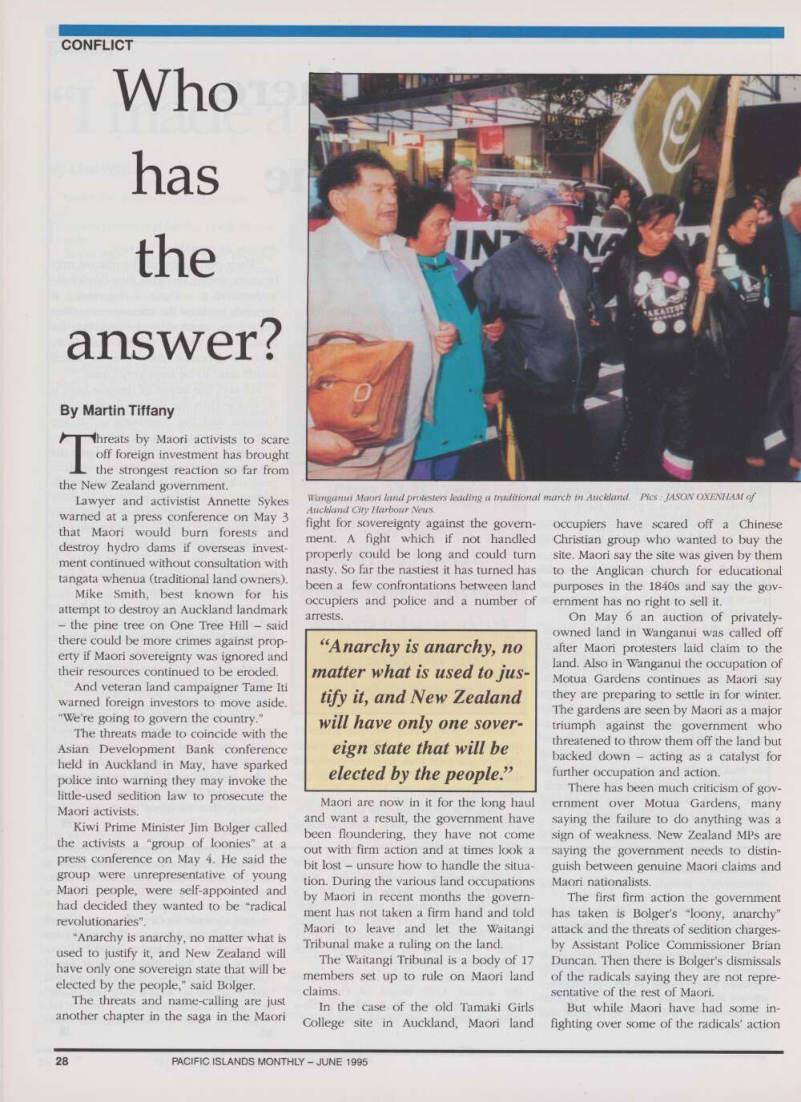
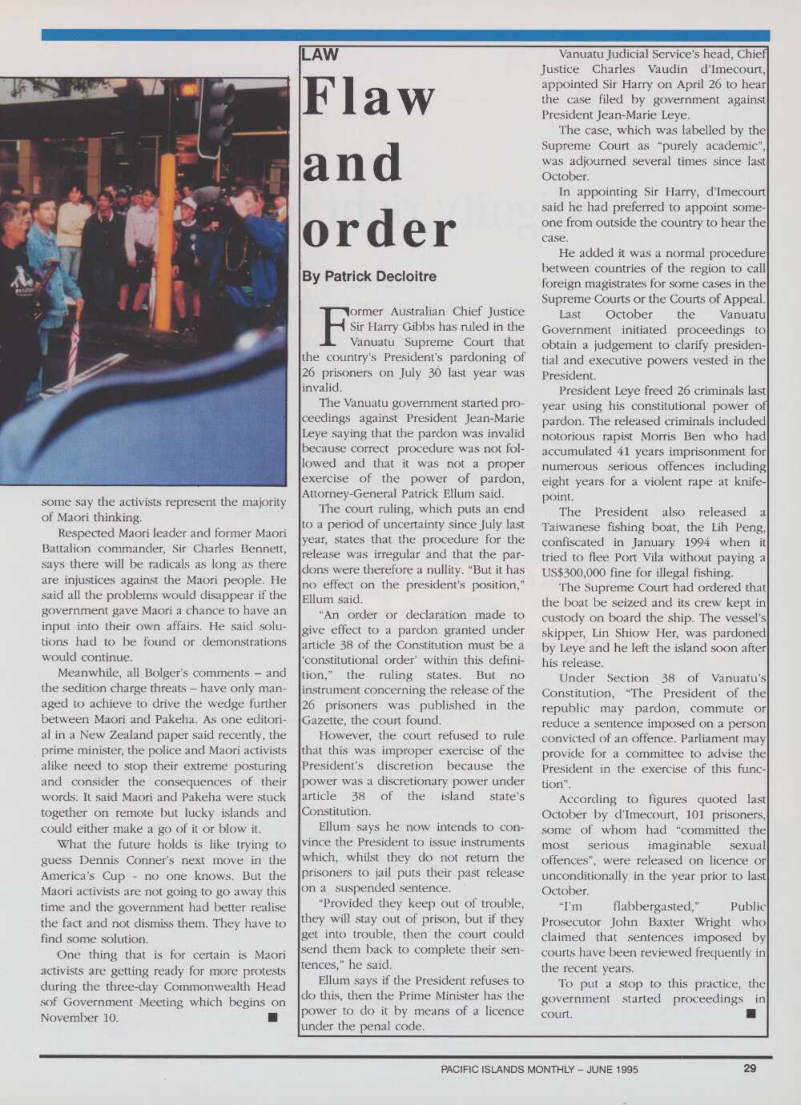
Wanganui Maori land protesters leading a traditional march in Auckland. Pics: JASON OXENHAM of Auckland City Harbour News.
some say the activists represent the majority of Maori thinking.
Respected Maori leader and former Maori Battalion commander, Sir Charles Bennett, says there will be radicals as long as there are injustices against the Maori people. He said all the problems would disappear if the government gave Maori a chance to have an input into their own affairs. He said solu tions had to be found or demonstrations would continue.
Meanwhile, all Bolger’s comments - and the sedition charge threats - have only man aged to achieve to drive the wedge further between Maori and Pakeha. As one editori al in a New Zealand paper said recently, the prime minister, the police and Maori activists alike need to stop their extreme posturing and consider the consequences of their words. It said Maori and Pakeha were stuck together on remote but lucky islands and could either make a go of it or blow it.
What the future holds is like trying to guess Dennis Conner’s next move in the America’s Cup - no one knows. But the Maori activists are not going to go away this time and the government had better realise the fact and not dismiss them. They have to find some solution.
One thing that is for certain is Maori activists are getting ready for more protests during the three-day Commonwealth Head sof Government Meeting which begins on November 10. ■