“I made a mistake”: Sir Geoff
pp. 26-27 · Read in the full issue
Scandal
By Lisa Williams
PM admits to being human.
It was no mean feat for the Cook Islands leader.
In the midst of heavy criticism over the current economic slump in the Cooks and calls from opposition MPs to step down, he faced up to economic and political reality after months of hedging and the public relations exercise of not comment ing in the interests of sensitive national issues.
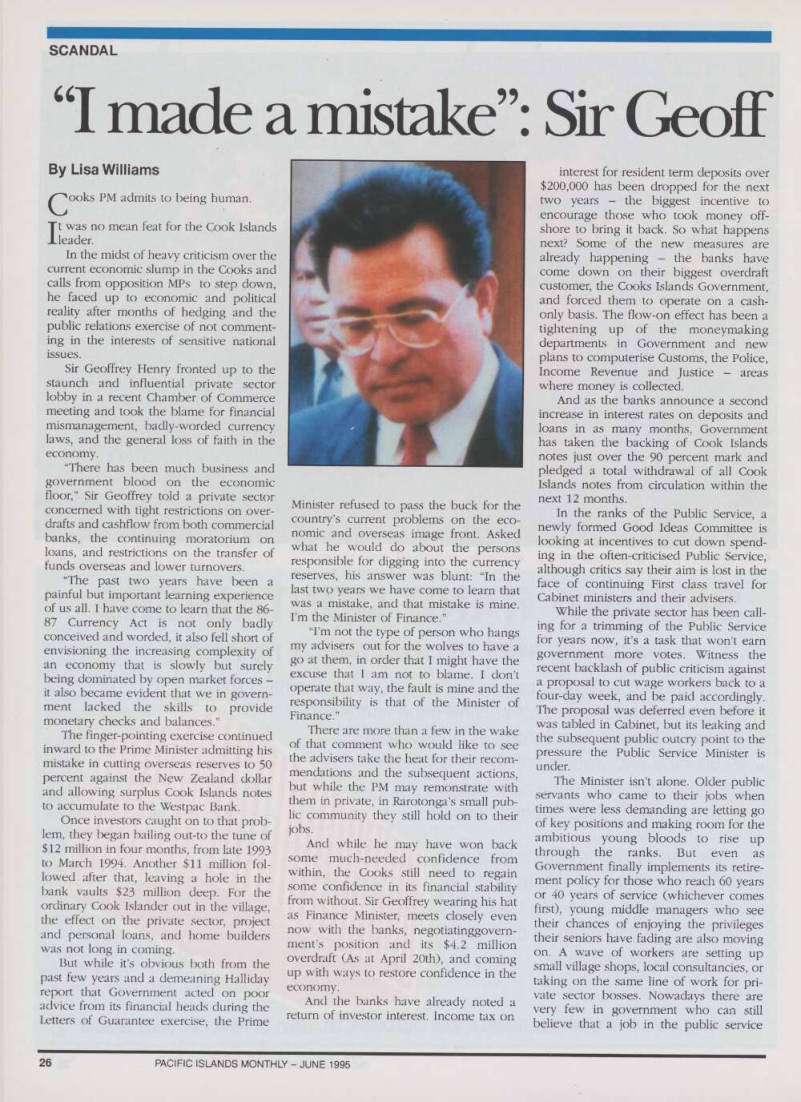
Sir Geoffrey Henry fronted up to the staunch and influential private sector lobby in a recent Chamber of Commerce meeting and took the blame for financial mismanagement, badly-worded currency laws, and the general loss of faith in the economy.
“There has been much business and government blood on the economic floor,” Sir Geoffrey told a private sector concerned with tight restrictions on over drafts and cashflow from both commercial banks, the continuing moratorium on loans, and restrictions on the transfer of funds overseas and lower turnovers.
“The past two years have been a painful but important learning experience of us all. I have come to learn that the 86- 87 Currency Act is not only badly conceived and worded, it also fell short of envisioning the increasing complexity of an economy that is slowly but surely being dominated by open market forces it also became evident that we in govern ment lacked the skills to provide monetary checks and balances.”
The finger-pointing exercise continued inward to the Prime Minister admitting his mistake in cutting overseas reserves to 50 percent against the New Zealand dollar and allowing surplus Cook Islands notes to accumulate to the Westpac Bank.
Once investors caught on to that prob lem, they began bailing out-to the tune of $l2 million in four months, from late 1993 to March 1994. Another $ll million fol lowed after that, leaving a hole in the bank vaults $23 million deep. For the ordinary Cook Islander out in the village, the effect on the private sector, project and personal loans, and home builders was not long in coming.
But while it’s obvious lx)th from the past few years and a demeaning Halliday report that Government acted on poor advice from its financial heads during the Letters of Guarantee exercise, the Prime
Minister refused to pass the buck for the country’s current problems on the eco nomic and overseas image front. Asked what he would do about the persons responsible for digging into the currency reserves, his answer was blunt: “In the last two years we have come to learn that was a mistake, and that mistake is mine.
I’m the Minister of Finance.”
“I’m not the type of person who hangs my advisers out for the wolves to have a go at them, in order that I might have the excuse that I am not to blame. I don’t operate that way, the fault is mine and the responsibility is that of the Minister of Finance.”
There are more than a few in the wake of that comment who would like to see the advisers take the heat for their recom mendations and the subsequent actions, but while the PM may remonstrate with them in private, in Rarotonga’s small pub lic community they still hold on to their jobs.
And while he may have won back some much-needed confidence from within, the Cooks still need to regain some confidence in its financial stability from without. Sir Geoffrey wearing his hat as Finance Minister, meets closely even now with the banks, negotiatinggovern ment’s position and its $4.2 million overdraft (As at April 20th), and coming up with ways to restore confidence in the economy.
And the banks have already noted a return of investor interest. Income tax on
interest for resident term deposits over $200,000 has been dropped for the next two years - the biggest incentive to encourage those who took money off shore to bring it back. So what happens next? Some of the new measures are already happening - the banks have come down on their biggest overdraft customer, the Cooks Islands Government, and forced them to operate on a cash only basis. The flow-on effect has been a tightening up of the moneymaking departments in Government and new plans to computerise Customs, the Police, Income Revenue and Justice - areas where money is collected.
And as the banks announce a second increase in interest rates on deposits and loans in as many months, Government has taken the backing of Cook Islands notes just over the 90 percent mark and pledged a total withdrawal of all Cook Islands notes from circulation within the next 12 months.
In the ranks of the Public Service, a newly formed Good Ideas Committee is looking at incentives to cut down spend ing in the often-criticised Public Service, although critics say their aim is lost in the face of continuing First class travel for Cabinet ministers and their advisers.
While the private sector has been call ing for a trimming of the Public Service for years now, it’s a task that won’t earn government more votes. Witness the recent backlash of public criticism against a proposal to cut wage workers back to a four-day week, and be paid accordingly.
The proposal was deferred even before it was tabled in Cabinet, but its leaking and the subsequent public outcry point to the pressure the Public Service Minister is under.
The Minister isn’t alone. Older public servants who came to their jobs when times were less demanding are letting go of key positions and making room for the ambitious young bloods to rise up through the ranks. But even as Government finally implements its retire ment policy for those who reach 60 years or 40 years of service (whichever comes first), young middle managers who see their chances of enjoying the privileges their seniors have fading are also moving on. A wave of workers are setting up small village shops, local consultancies, or taking on the same line of work for pri vate sector bosses. Nowadays there are very few in government who can still believe that a job in the public service
continued from P. 26
represents a lifelong career or financial security.
But at another level, the shaking up could well be a breath of fresh air for the Cooks.
Just as the Prime Minister’s admission sealed the new closer relationship between Government and the private sec tor, it’s also put the onus on workers to start reassessing their long-term goals and career plans.
Sir Geoffrey admits the pressure is on for Government as well to look more closely at its dependence on Tourism for Cook Islands industry, and the depen dence of tourism on lots of sunshine, cheap airfares and good newspaper head lines - something the Cooks hasn’t been seeing much of lately.
His aims to diversify came up again in the annual ADB Board of Governors meeting, held last month (May) in New Zealand. While trying to tie down more
loan money for development projects on ADB concessional rates, he was seek ing financial support for the country’s manganese mining potential.
And so while Sir Geoffrey works on all the issues that add up to the crucial item of restoring confidence in the Cook Islands, those left without work or failed businesses because of the downturn will have to make do with a poignant “sorry” from the Prime Minister.
Because for now, that’s all they’re going to get. ■