The land of sour
pp. 9-11 · Read in the full issue
Politics
The land of sour milk and bitter honey
Fiji is a land of frustrated people. Indigenous Fijians want political supremacy in their land and Indians want equal political rights,There is no love lost between these two major races of a so-called multiracial country. Amid such a scenario, a committee has been appointed to review the 1990 Constitution. YUNUS RASHID reports on why such a review cannot guarantee political stability.
Call it white washing and you have hit the nail on the head. It may be a pessimistic attitude towards the review of Fiji’s racially biased Constitution but it is a formidable pes simism - born from the experiences of the two military coups in 1987.
Many realists who normally carry the pessimistic bug ask how a review of the
Constitution can possibly create an envi ronment of racial and cultural tolerance and harmony? How can a document establish a multiracial society when the society itself is not ready for any type of collaboration?
A conducive Constitution would be one where indigenous Fijians and the strong population of Indians and other
races have equal representation in Parliament. The 1970 Constitution which was thrown out after the first coup on May 14, 1987, was such a document.
Cross-voting was allowed and a facade of
harmony reigned.
Facade because when the coalition of the newly-born and labour-oriented Fiji worker-Party and the Indian-dominated
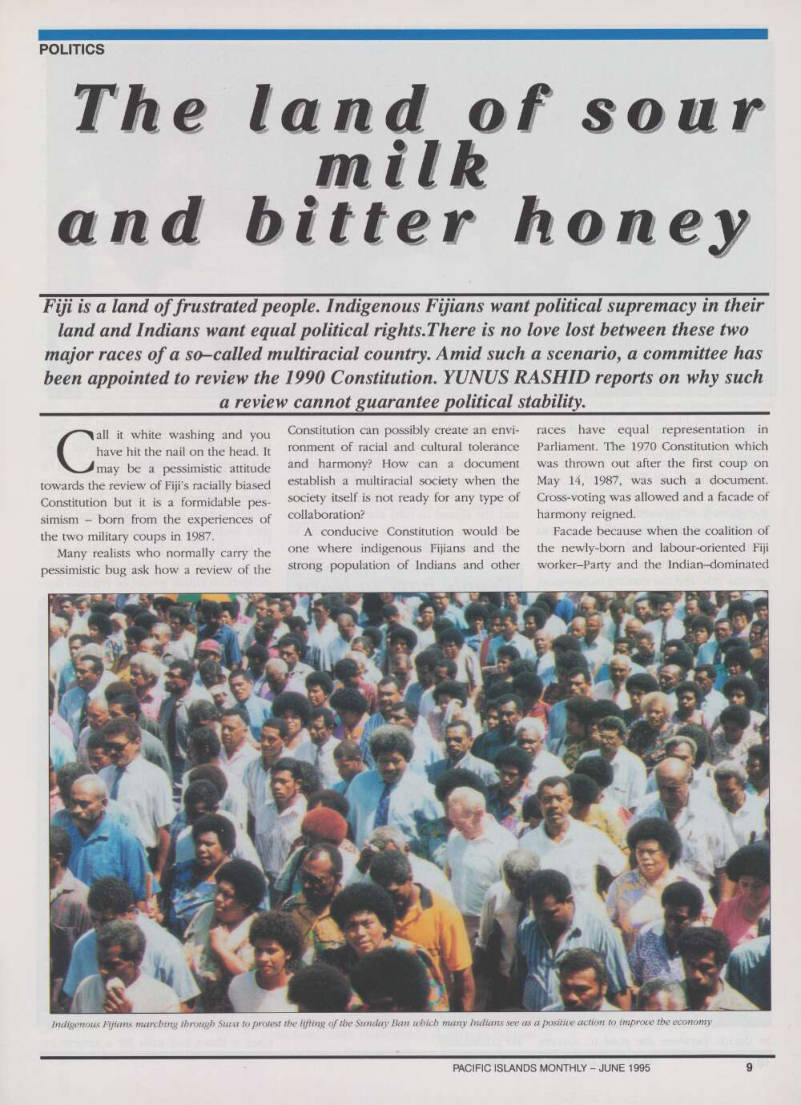
Indigenous Fijians marching through Suva to protest the lifting of the Sunday Ban which many Indians see as a positive action to improve the economy
National Federation Party swept into power, the indigenous people were out raged. They asked why a group of Indians should rule the Taukei in their own land? The Fijian Prime Minister of the short-lived government, Dr Timoci Bavadra, who has since died, was seen as a puppet in the hands of Indians.
The fall of Ratu Sir Kamisese Mara’s 16-year rule and the coming to power of a common Fijian was a bad omen as far as the Fijians were concerned. Suddenly, out of nowhere, Taukei mushroomed and took to the streets. Buildings burst into flames and hundreds of Fijian prisoners were let loose on the streets as a sign of protest.
What was simmering under the guise of multiracialism surfaced as blatant racism.
The Bavadra government was removed from Parliament at gun point, loaded into an army truck and taken for a ride to destination unknown. This was when the most sensational rumours start ed to fly. The Indian MPs, said some, were going to be separated from the few Fijian MPs and stranded on Mokogai, a former leprosy centre. Others said they would be taken to sea and drowned.
Funny as it may seem these rumours testified to the absence of trust despite a
century-old co-existence.
So where did Fiji go wrong? Why the animosity and distrust? And above all why is Fiji today standing at a junction unable to decide between the road to success
and the road to destruction?
The simple answer, even though acad emics and many politicians would disagree, is that Indians failed to appreci ate and understand the Fijian way of life and the Fijians in turn always looked at Indians as the migrant race ready to usurp their indigenous rights. Worse still,
People have to learn to live in peace before any practical political solution can be found.
despite a long standing relationship, the vast majority still need the colonial mas ters’ language to communicate.
However, despite the emotions, peo ple of Fiji can be proud of the fact that local extremists are tame compared with those abroad.
Two bloodless coup and the rapid recovery of the economy to sustainable figures following those events are rays of hope. The experiences of the coups, as one old politician points out, has taught the people of Fiji that racial groupings will not succeed. The politician says that people are coming to terms with the fact that the concept of “richness in diversity” has to be accepted as a norm for a toler ant community.
What is lacking though is the goodwill to bridge the gap of racial distrust. And this is why the Constitution review , to be headed by Sir Paul Reeves a former governor-general of New Zealand, a country which is undergoing racial prob lems itself- is a white wash.
Any attempts to promote Indians polit ically to be on equal footing with indigenous Fijians would be rejected out right by the Taukei - let alone the idea that an Indian could become Prime Minister. The 1990 Constitution forbids this. The Taukei cannot be blamed because it was only recently that they were brain washed into thinking “Fiji for Fijians”. Unless, of course, Prime Minister Sitiveni Rabuka’s idea that all Fiji citizens be called Fijians is adopted.
In the rigmarole to find a solution only one politician has spoken with far sight edness and wisdom. He is the Leader of the Opposition, Jai Ram Reddy, who has time and again reminded the country that racial hostilities would have to go if the future generations were to live in peace.
During a political rally in a Suva suburb, he said the country’s political crisis could be resolved quickly but would not be because he said the Fijians rightfully held some fears about Indians and vice -versa.
He said a peaceful atmosphere had to
prevail before any practical political solu
tion could be found.
Reddy’s views are justified because using the 1990 Constitution, which recog nises it flaws and calls for a review by
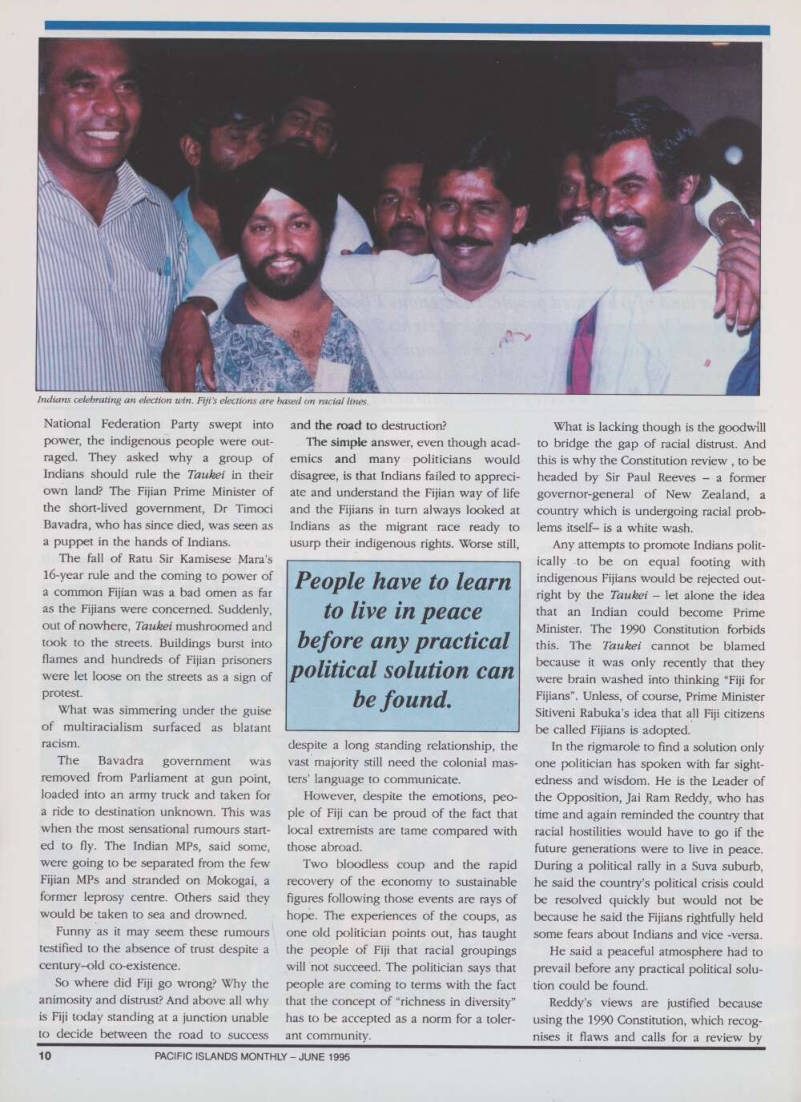
Indians celebrating an election win. Fiji’s elections are based on racial lines.
1997, segregated people into racial groups. This failed. People know that they need each other to build a solid mul tiracial foundation - a society which is conducive to all and tolerant.
As for those who blame the 1990 Constitution for the economic problems of the country, it can only be said that they have not monitored closely the steady decline in investor confidence.
There are many countries in the world which have Constitutions which violate fundamental human rights yet they have thriving economies. So why should Fiji be any different?
In fact, the Constitution is not the cause of Fiji’s poor economy. What is to be blamed is the government of the day.
It has been making inconsistent deci sions, has unruly Cabinet ministers and fails to take a firm stand against extrem ists. Then there are the landowners who block off properties and demand incredi ble compensation. See PIM April “Who’s running the gov’t”).
Because the problem of racism is deep rooted in the parliamentary circles, it has seeped through into the civil service.
People are promoted for being a particu lar race and not for being productive and deserving.
Since the problem has surfaced in all
sectors of Fiji’s community, it may be wise for government to just extend the review time clause in the 1990 Constitution. The first step is to get the people to live harmoniously and co-oper ate towards the betterment of the country so that the second step of a democratic Constitution would fall in place automat ically.
The political upheavals of 1987 have shown that a multiracial society can be established using a democratic
Constitution like the 1970 one, but such a society would be impossible to maintain in the face of racism.
The second step would be to collec tively build the economy to an extent where unemployment (with the excep
tion of voluntary unemployment)
becomes unknown and everyone is con tent with life. The simple logic, as a University of the South Pacific economist explains, behind this is that when people have money they don’t worry too much about politics. ■
Ratu Sir Kamisese Mara
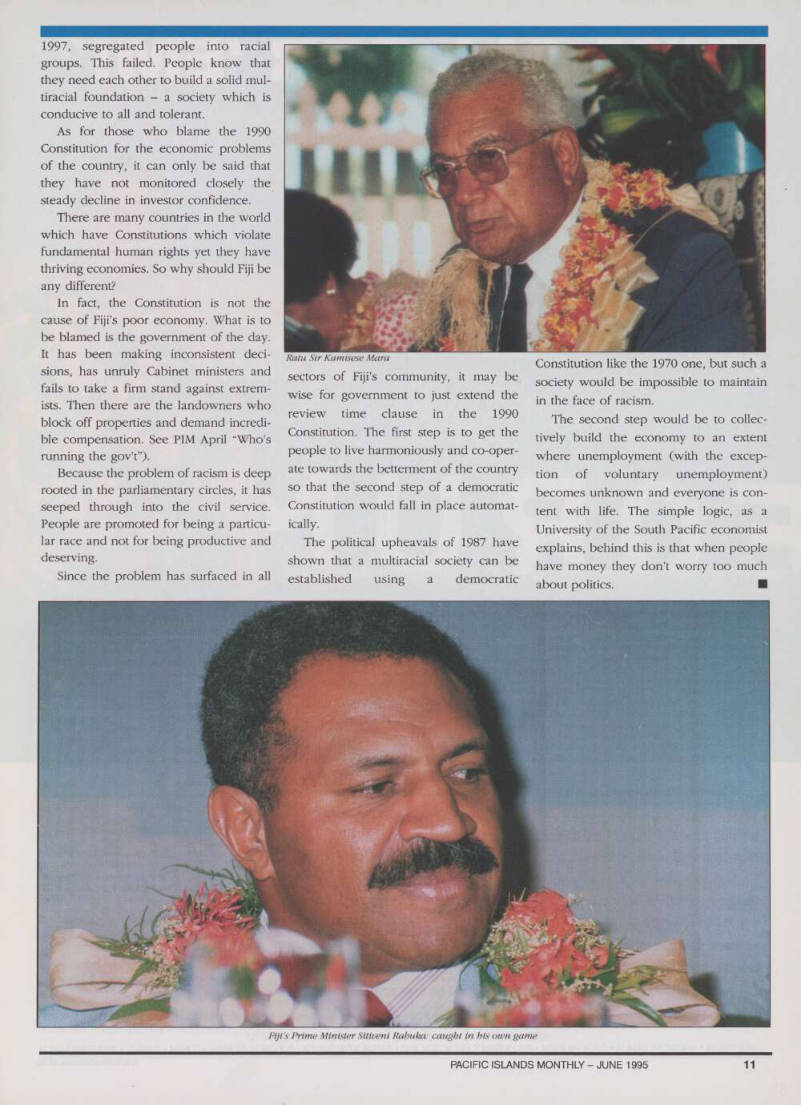
Fiji’s Prime Minister Sitiveni Rabuka: caught in his own game