winning
pp. 48-49 · Read in the full issue
Sports
All Blacks winning streak
By Shailendra Singh
AT the 1992 Hong Kong International Sevens final, Fiji sprung Mesake Rasari on an unsuspecting New Zealand side. The long-striding giant was impossible to stop and scored a hat trick in Fiji’s 22-6 win.
Rasari will go down as one of the greatest players in the history of the tournament with that unforgettable performance. At this year’s final, New Zealand got its own back.
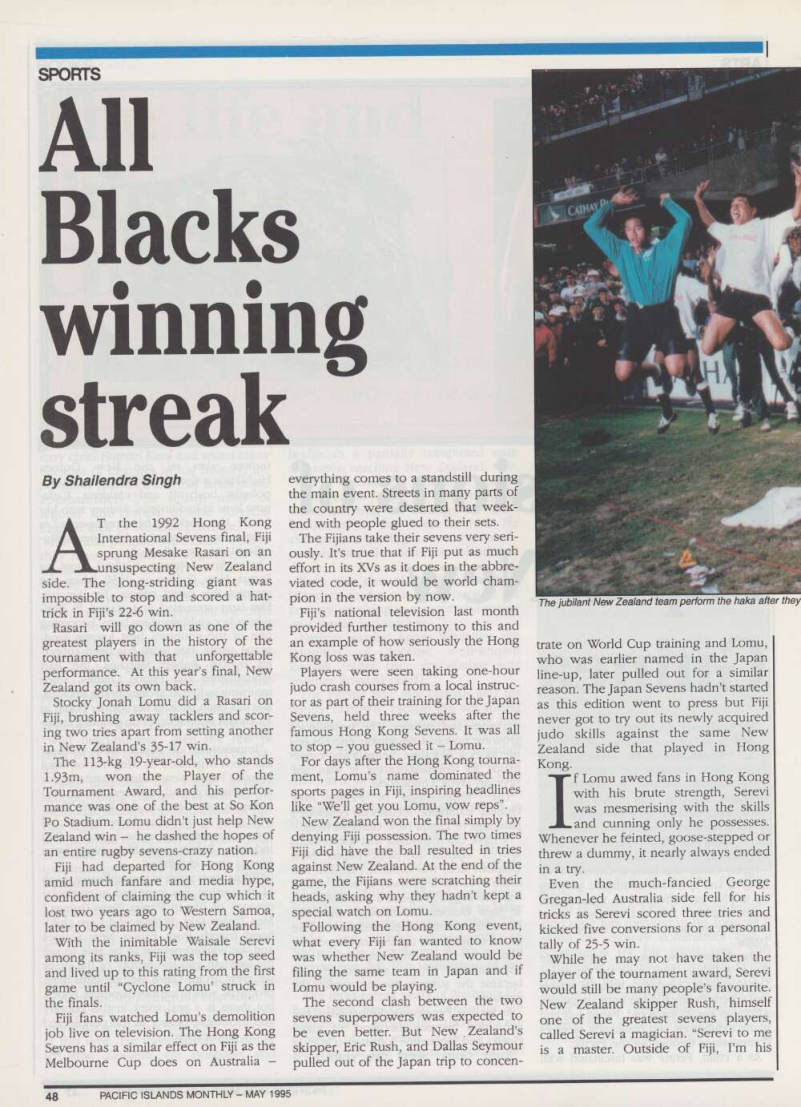
Stocky Jonah Lomu did a Rasari on Fiji, brushing away tacklers and scor ing two tries apart from setting another in New Zealand’s 35-17 win.
The 113-kg 19-year-old, who stands 1.93 m, won the Player of the Tournament Award, and his perfor mance was one of the best at So Kon Po Stadium. Lomu didn’t just help New Zealand win he dashed the hopes of an entire rugby sevens-crazy nation.
Fiji had departed for Hong Kong amid much fanfare and media hype, confident of claiming the cup which it lost two years ago to Western Samoa, later to be claimed by New Zealand.
With the inimitable Waisale Serevi among its ranks, Fiji was the top seed and lived up to this rating from the first game until “Cyclone Lomu’ struck in the finals.
Fiji fans watched Lomu’s demolition job live on television. The Hong Kong Sevens has a similar effect on Fiji as the Melbourne Cup does on Australia -
everything comes to a standstill during the main event. Streets in many parts of the country were deserted that week end with people glued to their sets.
The Fijians take their sevens very seri ously. It’s true that if Fiji put as much effort in its XVs as it does in the abbre viated code, it would be world cham pion in the version by now.
Fiji’s national television last month provided further testimony to this and an example of how seriously the Hong Kong loss was taken.
Players were seen taking one-hour judo crash courses from a local instruc tor as part of their training for the Japan Sevens, held three weeks after the famous Hong Kong Sevens. It was all to stop - you guessed it - Lomu.
For days after the Hong Kong tourna ment, Lomu’s name dominated the sports pages in Fiji, inspiring headlines like “We’ll get you Lomu, vow reps”.
New Zealand won the final simply by denying Fiji possession. The two times Fiji did have the ball resulted in tries against New Zealand. At the end of the game, the Fijians were scratching their heads, asking why they hadn’t kept a special watch on Lomu.
Following the Hong Kong event, what every Fiji fan wanted to know was whether New Zealand would be filing the same team in Japan and if Lomu would be playing.
The second clash between the two sevens superpowers was expected to be even better. But New Zealand’s skipper, Eric Rush, and Dallas Seymour pulled out of the Japan trip to concen-
trate on World Cup training and Lomu, who was earlier named in the Japan line-up, later pulled out for a similar reason. The Japan Sevens hadn’t started as this edition went to press but Fiji never got to try out its newly acquired judo skills against the same New Zealand side that played in Hong Kong.
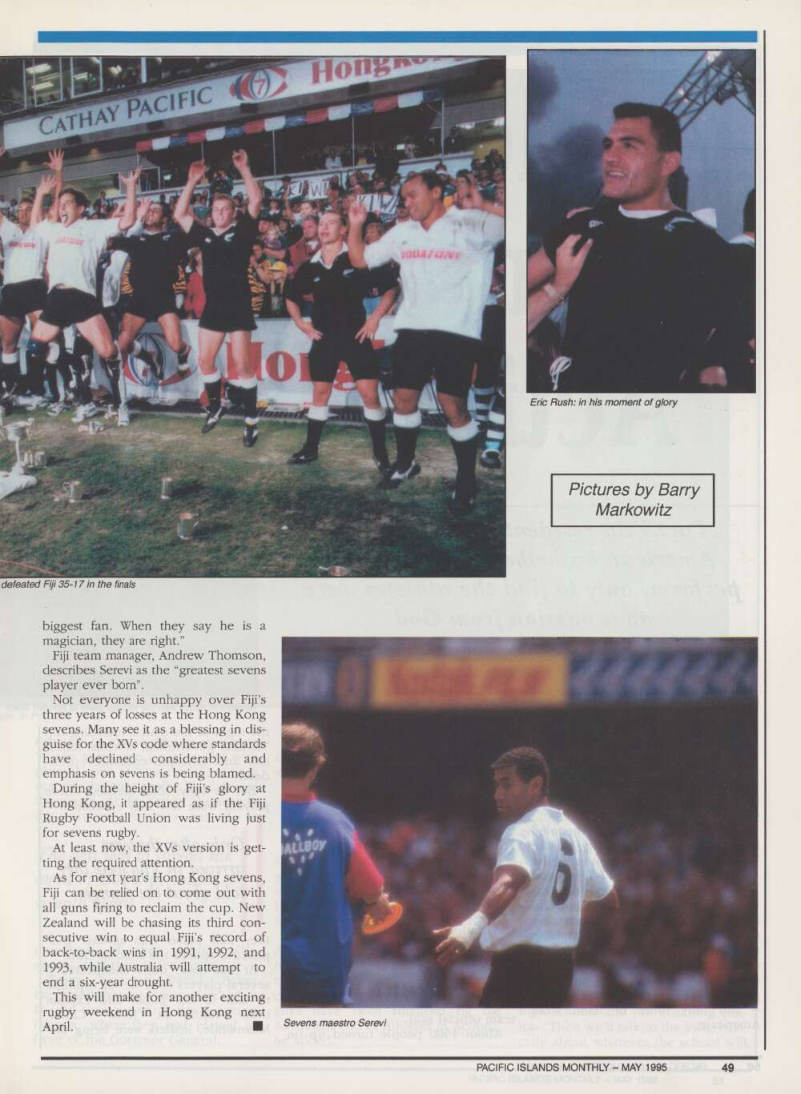
If Lomu awed fans in Hong Kong with his brute strength, Serevi was mesmerising with the skills and cunning only he possesses.
Whenever he feinted, goose-stepped or threw a dummy, it nearly always ended in a try.
Even the much-fancied George Gregan-led Australia side fell for his tricks as Serevi scored three tries and kicked five conversions for a personal tally of 25-5 win.
While he may not have taken the player of the tournament award, Serevi would still be many people’s favourite.
New Zealand skipper Rush, himself one of the greatest sevens players, called Serevi a magician. “Serevi to me is a master. Outside of Fiji, I’m his
The jubilant New Zealand team perform the haka after they
biggest fan. When they say he is a magician, they are right.”
Fiji team manager, Andrew Thomson, describes Serevi as the “greatest sevens player ever born”.
Not everyone is unhappy over Fiji’s three years of losses at the Hong Kong sevens. Many see it as a blessing in dis guise for the XVs code where standards have declined considerably and emphasis on sevens is being blamed.
During the height of Fiji’s glory at Hong Kong, it appeared as if the Fiji Rugby Football Union was living just for sevens rugby.
At least now, the XVs version is get ting the required attention.
As for next year’s Hong Kong sevens, Fiji can be relied on to come out with all guns firing to reclaim the cup. New Zealand will be chasing its third con secutive win to equal Fiji’s record of back-to-back wins in 1991, 1992, and 1993, while Australia will attempt to end a six-year drought.
This will make for another exciting rugby weekend in Hong Kong next April. ■
defeated Fiji 35-17 in the finals
Eric Rush: in his moment of glory
Pictures by Barry Markowitz
Sevens maestro Serevi