When the earth trembled
pp. 44-45 · Read in the full issue
Earthquake
By Alan Ah Mu
Our Western Samoan correspondent recounts his experience as he weathered the island's worst
quake
It was a scary end to the working week. Shortly after 11am on Friday, April 7, the earth shook - and kept on shaking - longer and stronger than tremors in Western Samoa have in the past.
“Did you feel that?” a friend from the Western Samoa Rugby League Association asked on the phone. “It’s
an earthquake.”
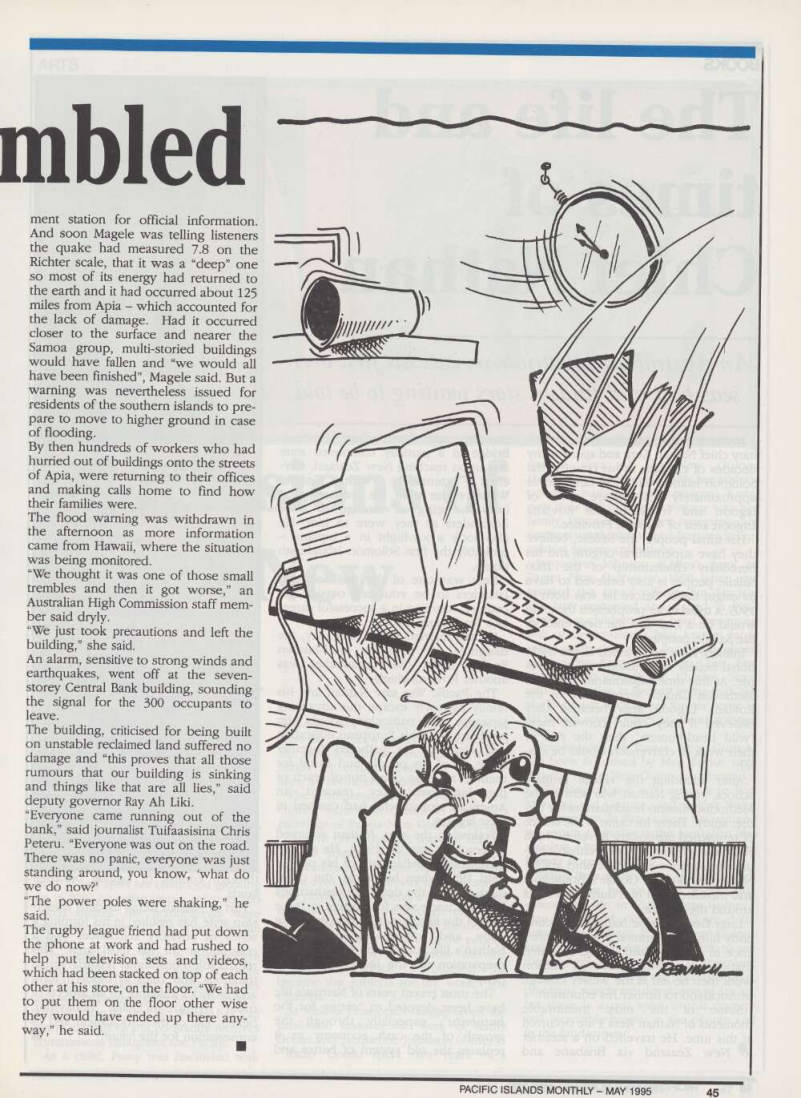
I had already gathered that and was sliding down my chair and seeking shelter under the desk as was drilled to me in earthquake-prone Wellington years ago.
My friend and I were discussing anoth er earthquake of sorts, the one hitting the rugby league world and the real likelihood of Western Samoa joining Rupert Murdoch’s super league.
“I’ve got to go mate, I’ll talk to you later,” he said quickly.
“Okay, bye.” But I didn’t put the receiv er in its slot because that was on the desk. It lay beside me as I answered my partner’s terrified voice calling out.
She had been abruptly shaken awake and quickly grasped that the world had just become a dangerous place to be in.
“Come here,” I called and soon she and our two-year-old boy were under the desk too and in a quivering voice she wondered aloud how our three-year old at kindergarten was doing.
That was another worry to add to the fear of the roof collapsing and crushing us under the desk and the expensive computer on top.
The lid on the pot of freshly boiled bananas slid off and clattered loudly to the floor. The sound added to our ter ror. Fear was briefly replaced by anger at the terror the quake was causing in my loved ones and I swore under my breath.
It felt like the earthquake had lasted a full five minutes but the main shock had actually lasted only about 20 sec onds at the most, according to the
assistant superintendent at meteorolog
ical service, Faatoia Magele.
A talkback host on private radio came back on air, saying “... let’s leave it to the man above (God),” then adding, as if annoyed, “I wonder where He’s gone to.”
Many radios were tuned to the govern
merit station for official information.
And soon Magele was telling listeners the quake had measured 7.8 on the Richter scale, that it was a “deep” one so most of its energy had returned to the earth and it had occurred about 125 miles from Apia - which accounted for the lack of damage. Had it occurred closer to the surface and nearer the Samoa group, multi-storied buildings would have fallen and “we would all have been finished”, Magele said. But a warning was nevertheless issued for residents of the southern islands to pre pare to move to higher ground in case
of flooding.
By then hundreds of workers who had hurried out of buildings onto the streets of Apia, were returning to their offices and making calls home to find how their families were.
The flood warning was withdrawn in the afternoon as more information came from Hawaii, where the situation was being monitored.
“We thought it was one of those small trembles and then it got worse,” an Australian High Commission staff mem ber said dryly.
“We just took precautions and left the building,” she said.
An alarm, sensitive to strong winds and earthquakes, went off at the seven storey Central Bank building, sounding the signal for the 300 occupants to leave.
The building, criticised for being built on unstable reclaimed land suffered no damage and “this proves that all those rumours that our building is sinking and things like that are all lies,” said deputy governor Ray Ah Liki.
“Everyone came running out of the bank,” said journalist Tuifaasisina Chris Peteru. “Everyone was out on the road.
There was no panic, everyone was just standing around, you know, ‘what do we do now?’
“The power poles were shaking,” he said.
The rugby league friend had put down the phone at work and had rushed to help put television sets and videos, which had been stacked on top of each other at his store, on the floor. “We had to put them on the floor other wise they would have ended up there any way,” he said.