Immigration
pp. 34-36 · Read in the full issue
Cover Stories
vs
Aid
Australia's dilemma as it continues to pour millions into the islands without much hope of
them ever attaining self-sufficiency
By Roman Grynberg
Since the independence of most of the Pacific island states, the issue of immigration rights to Australia and New Zealand has been sitting on the back burner of diplomatic relations between the former colonial powers and the island states. In 1983, the now famous Jackson Report on the future of Australia International Development Agency (AIDAB) put the matter on the front burn er by suggesting that Australia would be better advised to allow Pacific islanders to sell their labour services in Australia than to pour Asl37 million (plus $350 million for Papua New Guinea) in aid from Australia.
Quietly, at most forum meetings, lead ers from the Polynesian and Micronesian states have endorsed and pushed this proposal. The Polynesian and Micronesian countries earn most of their foreign exchange from remittances from Pacific Islanders living abroad and will not be able to maintain their low stan dards of living if there is no increase in emigration.
The Australian response to the island request for preferential access to their labour market has been a deafening silence, which many in the islands have construed as a throw-back to the days of the “White Australia Policy” where only Europeans were permitted to migrate to Australia.
However, in the last few months, the immigration issue appears to have resur faced under pressure from a number of
sources. First, there is palpable aid fatigue evident among donors in the islands gen erally - a sense that given the failure of the islands to develop an investment cli mate that would stimulate investment, all that aid was doing was propping up political structures that refused to reform and deal with their problems.
Second, there is the sense that the 15year-old SPARTECA treaty has failed to develop trade between Australia and the islands as expected. With the exception of garments from Fiji, there has been almost no success in diversifying visible trade away from gold, coffee and tea. In volume, non-mineral trade from the islands to Australia has decreased since SPARTECA was signed in 1981.
All this has led the Australian Minister for Pacific Islands, Gordon Bilney, to openly talk of a SPARTECA- Mark 11. With the decline in Australian tariffs caused by the closure of the Uruguay Round of GATT and Australia’s own trade liberali sation, the original SPARTECA is dimin ishing in value. So Bilney would like to find a new way of enhancing Australia’s relationship with the islands.
Australia and Fiji have begun discus sions about a new bilateral treaty arrange ment. Fiji has long viewed SPARTECA as a denigration of its status as the second largest island state. The idea of being lumped together with Tuvalu is increas ingly being viewed by Suva as a position unbecoming Fiji’s importance. Moreover, in the past five years Fiji has abandoned any pretence of a multilateral regional approach to its relations and has moved to what it formally refers to as “bilateral ism”.
But what has in part pushed Fiji in this direction has been the PACTRA treaty between PNG and Australia, and what Suva perceives as the benefits this sort of bilateral approach might offer. PACTRA, like the proposed bilateral Fiji Australia Treaty, is broad-based, encompassing far more than just trade issues. In reality though, after 20 years, PACTRA has offered little to PNG that is not available to it under SPARTECA.
Fiji and Australia have jointly conduct ed a study on the options for a bilateral treaty and that report, while probably purposely vague, has touched upon that most sensitive of issues - the rights of labour to move between the two coun tries.
There are many in Suva who see the clear benefit to Fiji of signing a new, spe cial treaty with Australia which over time will allow access of citizens to the Australian labour market. This would not only alleviate the political pressures for reform of the constitution from the Indian community but would provide a safety valve for unemployed indigenous Fijians.
Fiji is creating only 100 new jobs per year while 10,000-13,000 people are leav ing school each year. The benefits of labour migration are obvious to all labour surplus countries but the proposed treaty between Australia and Fiji is supposed to be reciprocal. And while Fiji may be more than happy to unload any number of Indian cane-farmers or unemployed Fijian youths on Sydney’s western sub urbs, it is by no means obvious that Fiji is psychologically prepared for Australians having migration rights to Fiji. The idea of 100,000 Australians deciding to take up residence in sunny Fiji may be no more pleasing to Fijians than the recent gov ernment proposal to bring thousands of Hong Kong Chinese businessmen to Fiji.
While the prospect of emigration from the Pacific islands to Australia is wel comed at almost every level in the islands, the benefits and support for these proposals in Australia are not obvious.
The most obvious supporters of the
migration option are people who are, or have been, critics of Australian aid policy.
These are people who have seen that Australia has poured hundreds of millions of dollars into the South Pacific to little sustainable effect. While Australian aid has increased living standards in the region - virtually the entire development budgets of most island states come from
aid - no one who would argue the living standard created by aid would continue the day after Australia
pulled the plug. But
the people advocating
increased immigration
rights are usually
retired career diplo
mats or AIDAB officials who no longer have anything to lose by speaking their mind. The problem is that because they are retired they have no political constituency and no clout.
Arrayed against those who are arguing for immigration rights is virtually the entire Canberra bureaucracy which has strong vested interests in maintaining the present situation. AIDAB itself would be the greatest loser if Pacific islanders were
given rights as this would undermine any jurisdiction for its aid budget in the region.
But in the constellation of power in Canberra, the grey mediocrities that determine aid policy inside AIDAB are bit players in comparison to the immigration consideration. It is not that the immigra tion is the unslayable dragon that so
‘The Australians have no discernible objective beyond the stability of PNG, and possibly the Solomon Islands . 5
many Pacific islanders think it is in terms of getting access to Australia. Rather it is the fear of upsetting the political consen sus that has developed in Australia over the past decade about a non-discrimina tory immigration policy. Leaving aside the New Zealanders, who have privileged access to migrate to Australia, no one is chosen on the basis of nationality.
Officially, Australia’s immigration policy
is now colour blind. If you have money
and/or skills and fit certain universal cri teria, Australia will let you in, irrespective of skin colour.
Australian Immigration has long defended this position against those who even suggest something as modest as a guest worker scheme or holiday work for Pacific Islanders to give them more skills to take home. The official “non-racist”
position of the Australian Immigration Department happens to fit the deep-seated con cerns of many politicians in Australia.
At one level there is legitimate fear that free migration from the islands will result in the
creation of a Pacific island under-class, much as already exists in the poorer sub urbs of Auckland. There racial conflicts exist not only between New Zealanders of European and Pacific island origin but also between Samoans and Tongans and other Pacific Islanders. At another level Australian politicians are frightened of any Immigration policy changes towards Pacific Islanders. They see enormous potential for a racist backlash against
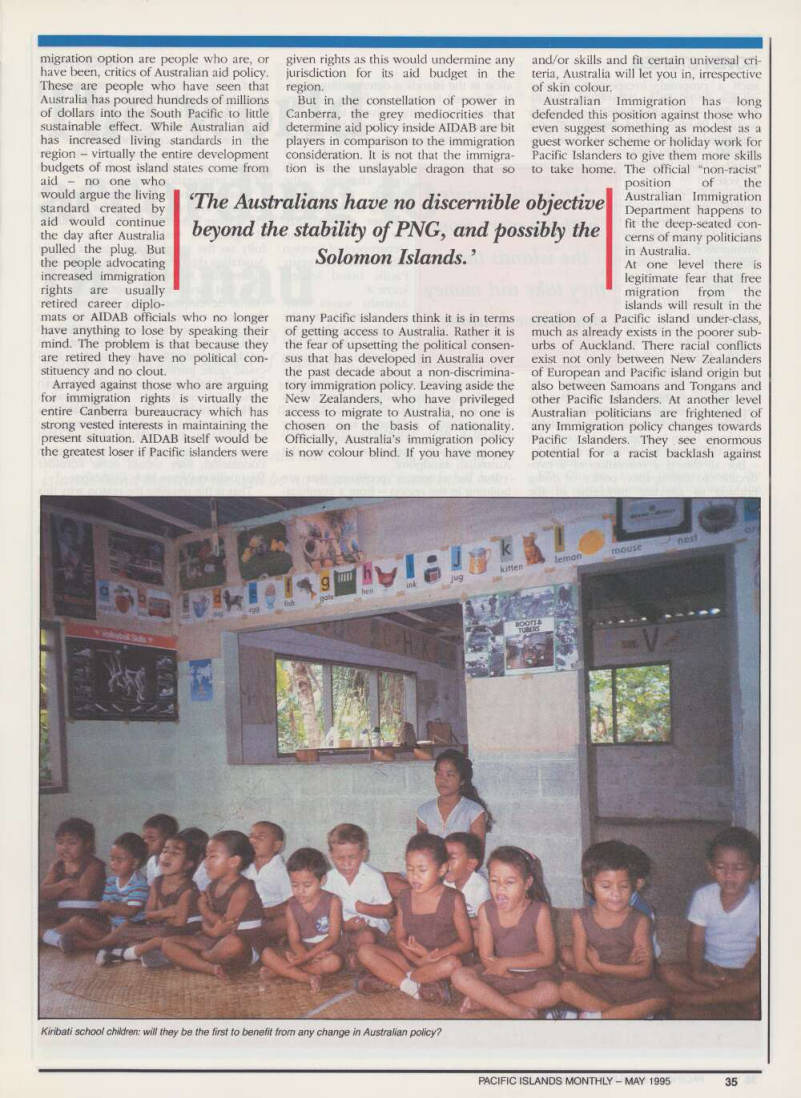
Kiribati school children: will they be the first to benefit from any change in Australian policy?
such a proposal, irrespective of how modest it might be. To allow Pacific Islanders even short-term work rights would involve a decision of the Australian Cabinet that could cost any
politician dearly while winning him virtually no votes.
In the past few months, there has been a number of develop ments that indicate the immigration issue will not just go away, despite the best efforts of the Australian Immigration Department. It has recently prepared a report on the issue of Pacific Islander migra tion. The expected hap
pened and Immigration opposed any concession whatsoever on the issue. Its report concluded that the provision of aid and investment remained more suitable responses (than immigration concessions) to the difficulties facing Pacific countries.
But all this is a reiteration of a twodecade-old Immigration policy of doing nothing to alleviate problems of the islands, except throwing more money and “policy dialogue” consultants at them. The problem is the economic situ-
‘Australia wants
nothing more from
the islands than they take aid money and leave it alone. *
ation in the islands is deteriorating rapidly. Trapped between declining aid from donors, diminishing private investment, decreasing trade preference because of GATT, rising populations- and govern-
ments unable or unwilling to deal with the changes, the islands are rapidly sinking into economic disaster and AIDAB, the Australian Department of Foreign Affairs and even many Pacific island leaders know it.
Australia wants noth ing more from the island states than that they take the Australian aid money and leave it alone. The
Australians have no discernible or obvi ous objective beyond the stability of PNG and possibly the Solomon Islands.
Diplomatically, politically and certainly economically, most of the western Pacific is completely irrelevant from the Australian standpoint.
But the economic pressures that are building in the region - from a combina tion of domestic economic mismanage ment and post-Gold War structural changes - will, in the early part of the
next century, create pressures that will destabilise “Australia’s Lake”, as Australian officials so colourfully refer to the Pacific region. The Australian govern ment is clearly concerned, despite the almost religious recital by the Immigration Department of its rejection of any immigration concessions.
What some of the larger countries such as Tonga are openly asking for and what Fiji is more covertly wanting in its bilater al agreement with Australia is not yet fully on the international agenda. While Australian diplomats and aid officials may differentiate between those island coun tries that have realistic options for eco nomic development (like Fiji) and those that do not (like Tuvalu and Kiribati), the real reason Fiji and Tonga are unlikely to gain any special immigration agreement in the foreseeable future is that PNG could quite justifiably argue it, by virtue of its colonial ties, has more rights than either Fiji or Tonga. While Australian politicians might, immediately following a federal election, be able to summon the courage to allow 60,000 Kiribati and Tuvalu citizens some form of migration concession, they would never consider four million Papua New Guineans.
That is the ultimate the reason why this solution to Australia’s aid dilemma and the islands’ population pressure will take so long to resolve. ■