Keeping sight
p. 46 · Read in the full issue
Opinion
of that vision
The road to success for island nations in the Pacific Century
No developed countries have more inter est in seeing the island nations of the Pacific achieve sustainable economic growth and lift the living standards of their peoples than New Zealand and Australia.
Their dilemma is how to support and encourage that growth without playing an unpalatable Big Brother role. Both know that anything smacking of heavying their neigh bours will be counter-productive.
Encouraging then that not only have organisations like the World Bank taken an interest in the plight of the island nations, but they have begun to acknowledge what they have to do.
As Forum Finance ministers said after their inaugural meeting in Suva in a state ment on February 21; “We recognised that we were meeting against the background of a rapidly changing international environ ment, profound social and economic chal lenges (and) the need to promote sustain able development and the importance of positioning ourselves for the growth of the Pacific into the 21st century.
The ministers went on to acknowledge the need for long-term strategic vision, strin gent expenditure controls, reducing the state’s involvement in the economy and pri vatising some services.
It was music to New Zealand ears, under lining as it did a new World Bank report that noted the island states “need to change course and rely on a more effective private and public investment-oriented growth strat egy”- The report was less damning than the bank’s last one, in 1993, which highlighted “The Pacific Paradox” - the failure to increase real per capita incomes during the previous decade despite good natural and human resources, high levels of aid and pru dent economic management.
While recognising the island nations’ diffi culties, the new report identified some opportunities as well, realistically spelling
out practical ways in which they can build a more resilient economic base by: * diversifying their public-sector economies further into tourism and ser vices; and * obtaining higher returns from their nat ural resources, fisheries and forestry.
From a New Zealand perspective, the most satisfying aspect of the Finance minis ters’ meeting was the indication the island states are veering away from some of the so called “innovative and imaginative” sugges tions they toyed with to boost their economies in recent years.
Ideas of making islands of the Pacific dumping grounds for nuclear and industrial waste that developed nations of the West understandably do not want are more crazy than innovative.
Lucrative as they may appear, the islands and their peoples will surely rue the day if they are adopted. There would be no better way of ruining the region’s potential to increase the number of tourists who are attracted by its pollution-free environment, not to mention die risk such projects would provide to the local people.
Similarly it is to be hoped island govern ments will eschew thoughts that economic salvation lies in such avenues as offshore banking centres, tax havens or casinos. All involve unacceptable risks of attracting shonky businessmen and criminals to a region that has had its fair share of shady characters over the years.
It does appear from last year’s Brisbane Forum and the Suva meeting that Pacific island leaders are increasingly aware that conventional economic development is the way out of their plight.
The question being asked by ministers and officials in Wellington (and no doubt in Canberra) is what they can do to help. For, while they retain a commitment to provid ing aid, assistance funds are increasingly lim ited by domestic pressures and, in the
absence of sound long-term domestic poli cies, they cannot provide a lasting solution anyway.
New Zealand is reluctant to prescribe a solution, but does feel it can lead by exam ple, having radically restructured its econo my over the past 10 years and now enjoying growth levels not reached for decades.
The key word, New Zealand’s Finance Minister, Bill Birch, told his Pacific colleagues, is ‘Vision”. You have to decide where you want to go before deciding how to get there.
If the goal is sustainable development and a better standard of living, the World Bank report points to some directions for the island nations. The main path, it says, is to increase the breadth and depth of trading relations by opening up their protected economies and enhancing their internation al competitiveness.
It will not be easy because it will require prudent fiscal management, reducing barri ers to trade and opening up to foreign invest ment, not by tax incentives but by improv ing the domestic enterprise environment.
This will attract the capital needed to devel op the tourism infrastructure and the fishing industries.
All the island states have to take a much more hard-nosed attitude towards their ocean resources, getting better returns from the fishing nations that exploit them and Fiji, the Solomon Islands, Vanuatu and Western Samoa have to re-examine their forestry poli cies to increase their income and preserve their forests.
Above all, the island states need to co operate much more than they do at present to maximise their limited manpower and financial resources.
What they ought to remember is that countries like New Zealand and Australia, and others further afield, are very well dis posed towards them. They have a lot of friends who wish them well and want to see them succeed in the coming Pacific century.
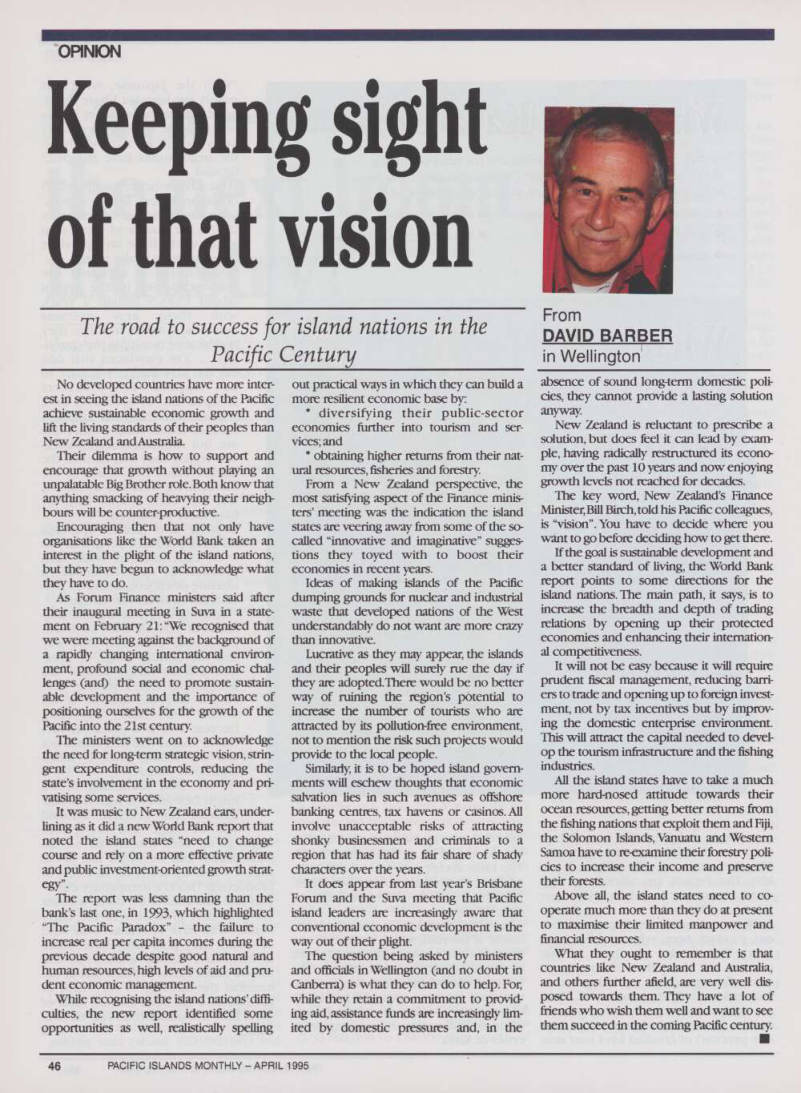
From
David Barber
in Wellington