regional
pp. 19-20 · Read in the full issue
Working out a
solution
Health officals from around the Pacific are intent on coming up with an answer to the chronic problems related to health services
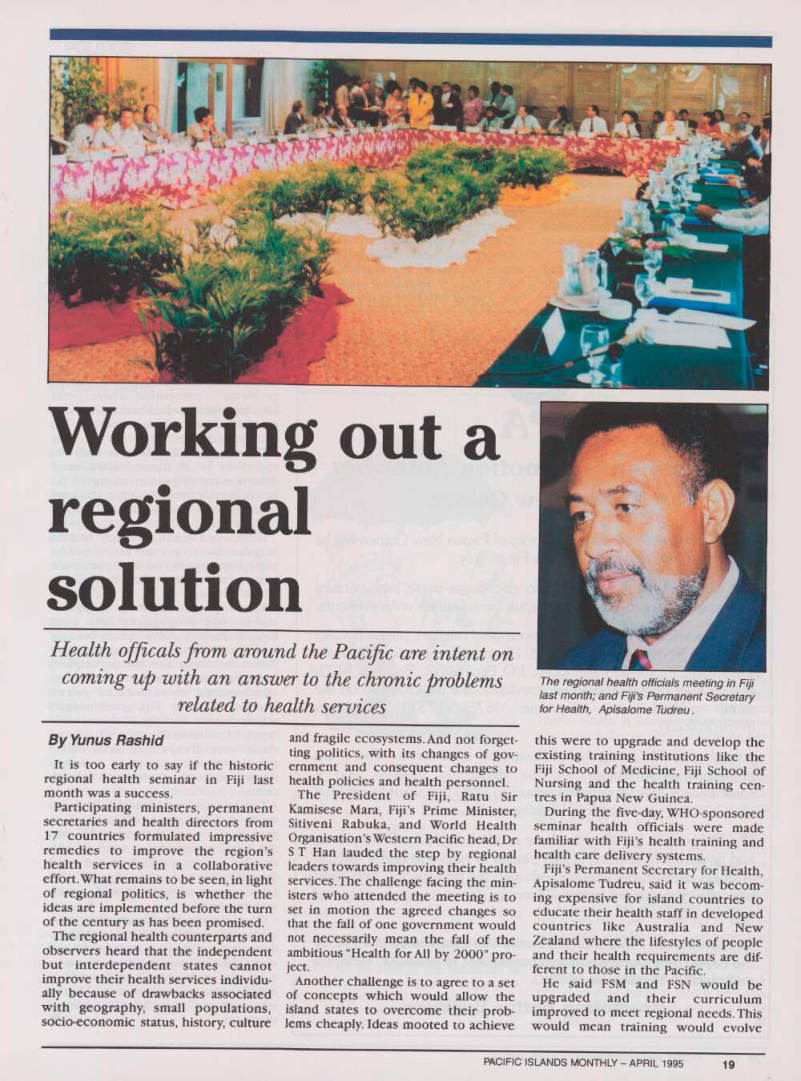
By Yunus Rashid It is too early to say if the historic regional health seminar in Fiji last month was a success.
Participating ministers, permanent secretaries and health directors from 17 countries formulated impressive remedies to improve the region s health services in a collaborative effort. What remains to be seen, in light of regional politics, is whether the ideas are implemented before the turn of the century as has been promised.
The regional health counterparts and observers heard that the independent but interdependent states cannot improve their health services individually because of drawbacks associated with geography, small populations, socio-economic status, history, culture
and fragile ecosystems. And not forgettin ß politics, with its changes of goveminent and consequent changes to health policies and health personnel.
The President of Fiji, Ratu Sir Kamisese Mara, Fiji’s Prime Minister, Sitiveni Rabuka, and World Health Organisation’s Western Pacific head, Dr ST Han lauded the step by regional leaders towards improving their health services. The challenge facing the ministers who attended the meeting is to set in motion the agreed changes so that the fall of one government would not necessarily mean the fall of the ambitious “Health for All by 2000” project.
Another challenge is to agree to a set of concepts which would allow the island states to overcome their problems cheaply. Ideas mooted to achieve
this were to upgrade and develop the existing training institutions like the Fiji School of Medicine, Fiji School of Nursing and the health training cen tres in Papua New Guinea.
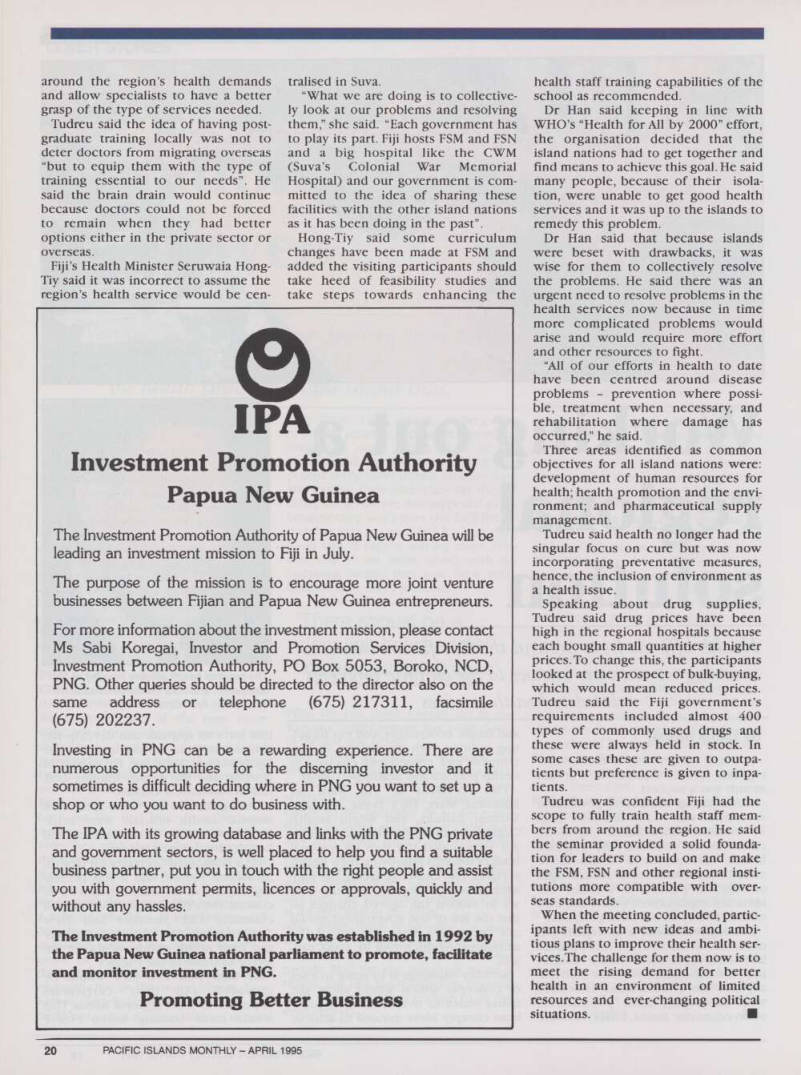
During the five-day WHO-sponsored seminar health officials were made familiar with Fiji’s health training and health care delivery systems, Fiji’s Permanent Secretary for Health, Apisalome Tudreu, said it was becom ing expensive for island countries to educate their health staff in developed countries like Australia and New Zealand where the lifestyles of people and their health requirements are dif ferent to those in the Pacific, He said FSM and FSN would be upgraded and their curriculum improved to meet regional needs. This would mean training would evolve
The regional health officials meeting in Fiji last month; and Fiji’s Permanent Secretary for Health, Apisalome Tudreu.
around the region’s health demands and allow specialists to have a better grasp of the type of services needed.
Tudreu said the idea of having post graduate training locally was not to deter doctors from migrating overseas “but to equip them with the type of training essential to our needs”. He said the brain drain would continue because doctors could not be forced to remain when they had better options either in the private sector or overseas.
Fiji’s Health Minister Seruwaia Hong- Tiy said it was incorrect to assume the region’s health service would be cen
tralised in Suva.
“What we are doing is to collective ly look at our problems and resolving them,” she said. “Each government has to play its part. Fiji hosts FSM and FSN and a big hospital like the CWM (Suva’s Colonial War Memorial Hospital) and our government is com mitted to the idea of sharing these facilities with the other island nations as it has been doing in the past”.
Hong-Tiy said some curriculum changes have been made at FSM and added the visiting participants should take heed of feasibility studies and take steps towards enhancing the
health staff training capabilities of the school as recommended.
Dr Han said keeping in line with WHO’s “Health for All by 2000” effort, the organisation decided that the island nations had to get together and find means to achieve this goal. He said many people, because of their isola tion, were unable to get good health services and it was up to the islands to remedy this problem.
Dr Han said that because islands were beset with drawbacks, it was wise for them to collectively resolve the problems. He said there was an urgent need to resolve problems in the health services now because in time more complicated problems would arise and would require more effort and other resources to fight.
“All of our efforts in health to date have been centred around disease problems - prevention where possi ble, treatment when necessary, and rehabilitation where damage has occurred,” he said.
Three areas identified as common objectives for all island nations were: development of human resources for health; health promotion and the envi ronment; and pharmaceutical supply management.
Tudreu said health no longer had the singular focus on cure but was now incorporating preventative measures, hence, the inclusion of environment as a health issue.
Speaking about drug supplies, Tudreu said drug prices have been high in the regional hospitals because each bought small quantities at higher prices. To change this, the participants looked at the prospect of bulk-buying, which would mean reduced prices.
Tudreu said the Fiji government’s requirements included almost 400 types of commonly used drugs and these were always held in stock. In some cases these are given to outpa tients but preference is given to inpa tients.
Tudreu was confident Fiji had the scope to fully train health staff mem bers from around the region. He said the seminar provided a solid founda tion for leaders to build on and make the FSM, FSN and other regional insti tutions more compatible with over seas standards.
When the meeting concluded, partic ipants left with new ideas and ambi tious plans to improve their health ser vices. The challenge for them now is to meet the rising demand for better health in an environment of limited resources and ever-changing political situations. ■