Access to the Pacific
p. 51 · Read in the full issue
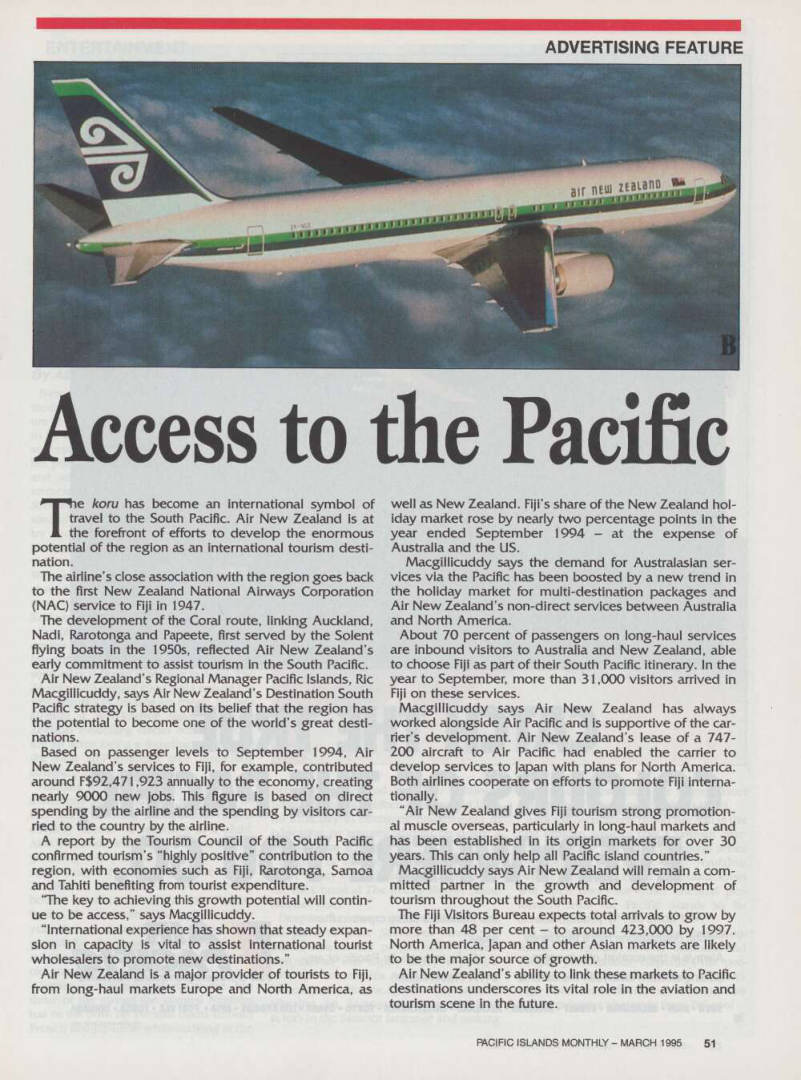
The koru has become an international symbol of travel to the South Pacific. Air New Zealand is at the forefront of efforts to develop the enormous potential of the region as an international tourism desti nation.
The airline’s close association with the region goes back to the first New Zealand National Airways Corporation (NAC) service to Fiji in 1947.
The development of the Coral route, linking Auckland, Nadi, Rarotonga and Papeete, first served by the Solent flying boats in the 19505, reflected Air New Zealand’s early commitment to assist tourism in the South Pacific.
Air New Zealand’s Regional Manager Pacific Islands, Ric Macgillicuddy, says Air New Zealand’s Destination South Pacific strategy is based on its belief that the region has the potential to become one of the world’s great desti nations.
Based on passenger levels to September 1994, Air New Zealand’s services to Fiji, for example, contributed around F 592,471,923 annually to the economy, creating nearly 9000 new jobs. This figure is based on direct spending by the airline and the spending by visitors car ried to the country by the airline.
A report by the Tourism Council of the South Pacific confirmed tourism’s “highly positive” contribution to the region, with economies such as Fiji, Rarotonga, Samoa and Tahiti benefiting from tourist expenditure.
“The key to achieving this growth potential will contin ue to be access,” says Macgillicuddy.
“International experience has shown that steady expan sion in capacity is vital to assist international tourist wholesalers to promote new destinations.”
Air New Zealand is a major provider of tourists to Fiji, from long-haul markets Europe and North America, as
well as New Zealand. Fiji’s share of the New Zealand hol iday market rose by nearly two percentage points in the year ended September 1994 - at the expense of Australia and the US.
Macgillicuddy says the demand for Australasian ser vices via the Pacific has been boosted by a new trend in the holiday market for multi-destination packages and Air New Zealand’s non-direct services between Australia and North America.
About 70 percent of passengers on long-haul services are inbound visitors to Australia and New Zealand, able to choose Fiji as part of their South Pacific itinerary. In the year to September, more than 31,000 visitors arrived in Fiji on these services.
Macgillicuddy says Air New Zealand has always worked alongside Air Pacific and is supportive of the car rier’s development. Air New Zealand’s lease of a 747- ZOO aircraft to Air Pacific had enabled the carrier to develop services to japan with plans for North America.
Both airlines cooperate on efforts to promote Fiji interna tionally.
“Air New Zealand gives Fiji tourism strong promotion al muscle overseas, particularly in long-haul markets and has been established in its origin markets for over 30 years. This can only help all Pacific island countries.”
Macgillicuddy says Air New Zealand will remain a com mitted partner in the growth and development of tourism throughout the South Pacific.
The Fiji Visitors Bureau expects total arrivals to grow by more than 48 per cent - to around 423,000 by 1997.
North America, japan and other Asian markets are likely to be the major source of growth.
Air New Zealand’s ability to link these markets to Pacific destinations underscores its vital role in the aviation and tourism scene in the future.