Those improved Saahs
pp. 45-47 · Read in the full issue
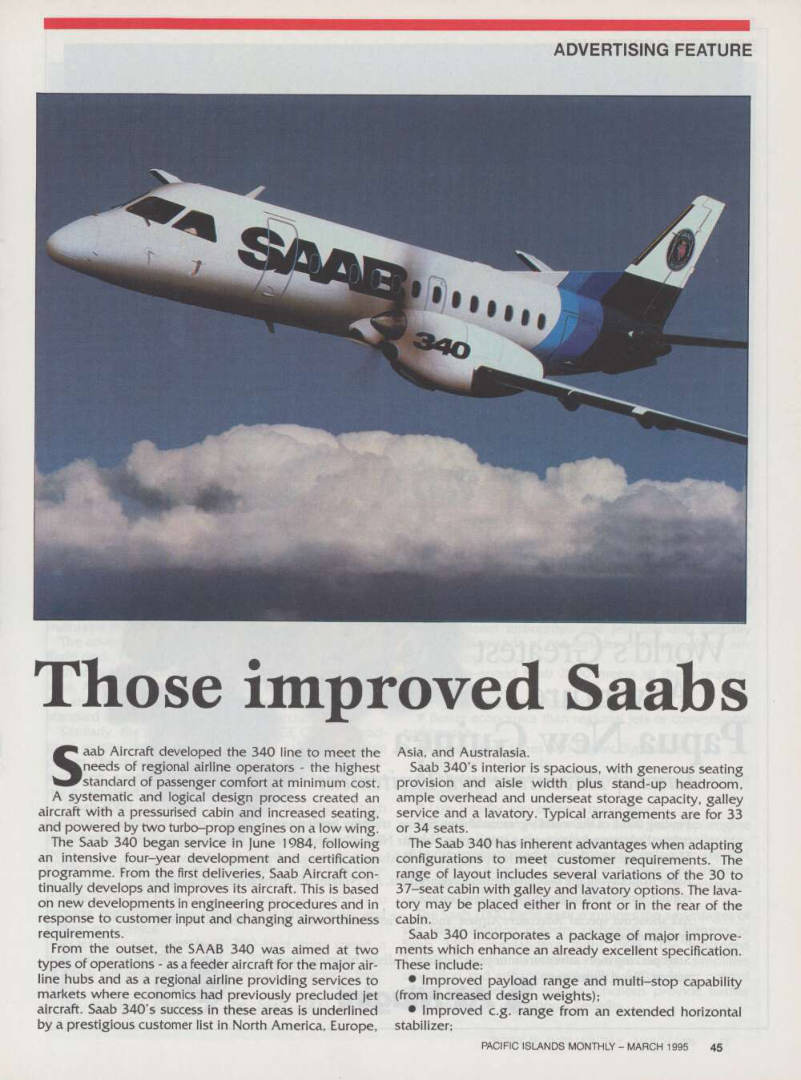

Saab Aircraft developed the 340 line to meet the needs of regional airline operators - the highest standard of passenger comfort at minimum cost.
A systematic and logical design process created an aircraft with a pressurised cabin and increased seating, and powered by two turbo-prop engines on a low wing.
The Saab 340 began service in June 1984, following an intensive four-year development and certification programme. From the first deliveries, Saab Aircraft con tinually develops and improves its aircraft. This is based on new developments in engineering procedures and in response to customer input and changing airworthiness requirements.
From the outset, the SAAB 340 was aimed at two types of operations - as a feeder aircraft for the major air line hubs and as a regional airline providing services to markets where economics had previously precluded jet aircraft. Saab 340’s success in these areas is underlined by a prestigious customer list in North America, Europe,
Asia, and Australasia.
Saab 340’s interior is spacious, with generous seating provision and aisle width plus stand-up headroom, ample overhead and underseat storage capacity, galley service and a lavatory. Typical arrangements are for 33 or 34 seats.
The Saab 340 has inherent advantages when adapting configurations to meet customer requirements. The range of layout includes several variations of the 30 to 37-seat cabin with galley and lavatory options. The lava tory may be placed either in front or in the rear of the cabin.
Saab 340 incorporates a package of major improve ments which enhance an already excellent specification.
These include: • Improved payload range and multi-stop capability (from increased design weights); • Improved c.g. range from an extended horizontal stabilizer;
• Reduced flight times without increases in fuel burn (from the upgraded GECT7-9B engine; • Improved “hot and high” payloads from the auto matic power reserve on takeoff; • Reduced cabin noise levels from acoustic dampers.
In all other respects, notably interior comfort, cockpit design and systems simplicity, the Saab 340 series maintains the excellent qualities of Saab.
The advanced technology of Saab 340 extends to the flight deck. The flight crew have a spacious working area with all control locations designed to reduce pilot work load. A modern all-digital avionics system with autopi lot and Electronic Flight Instrumentation System are standard equipment on all Saab 340 aircraft.
Similarly, the advanced technology GE CT7-9B turbo prop engine provides Saab 340 with safe and reliable power. The powerplant for the aircraft has low fuel con sumption, excellent maintainability and technical matu rity guaranteed by General Electric.
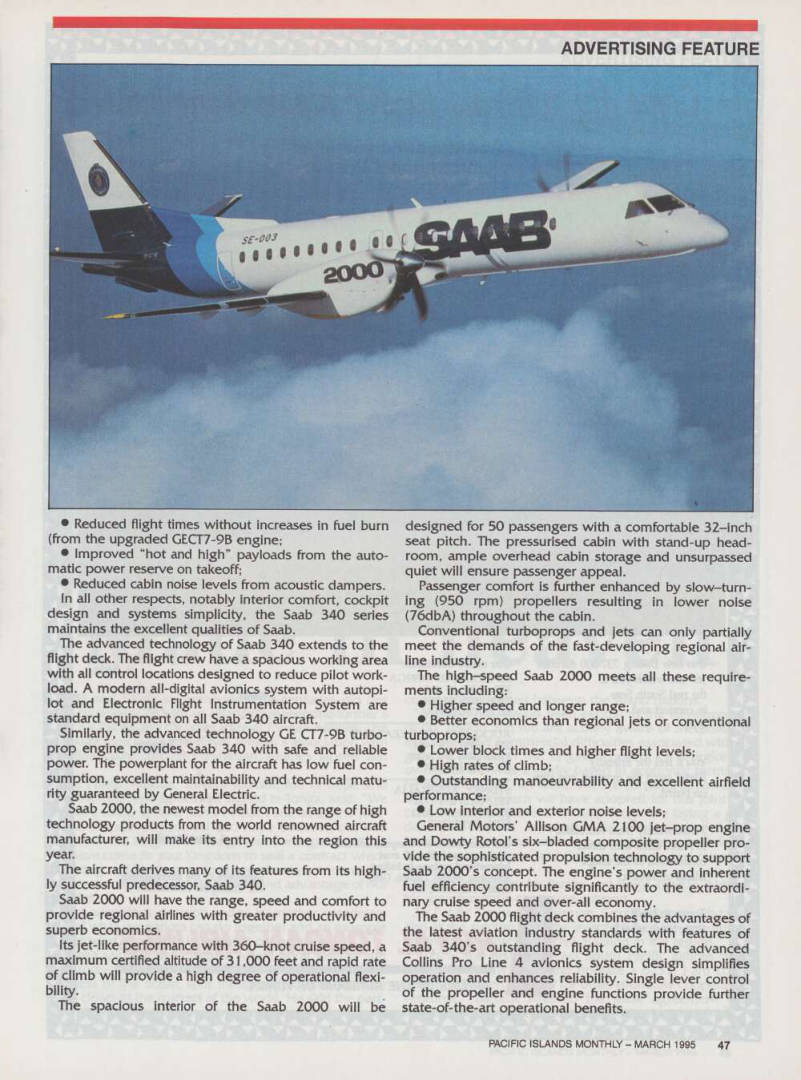
Saab 2000, the newest model from the range of high technology products from the world renowned aircraft manufacturer, will make its entry into the region this year.
The aircraft derives many of its features from its high ly successful predecessor, Saab 340.
Saab 2000 will have the range, speed and comfort to provide regional airlines with greater productivity and superb economics.
Its jet-like performance with 360-knot cruise speed, a maximum certified altitude of 31,000 feet and rapid rate of climb will provide a high degree of operational flexi bility.
The spacious interior of the Saab 2000 will be
designed for 50 passengers with a comfortable 32-Inch seat pitch. The pressurised cabin with stand-up head room, ample overhead cabin storage and unsurpassed quiet will ensure passenger appeal.
Passenger comfort is further enhanced by slow-turn ing (950 rpm) propellers resulting in lower noise (76dbA) throughout the cabin.
Conventional turboprops and jets can only partially meet the demands of the fast-developing regional air line industry.
The high-speed Saab 2000 meets all these require ments including: • Higher speed and longer range; • Better economics than regional jets or conventional turboprops; • Lower block times and higher flight levels; • High rates of climb; • Outstanding manoeuvrability and excellent airfield performance; • Low interior and exterior noise levels; General Motors’ Allison GMA 2100 jet—prop engine and Dowty Rotol’s six-bladed composite propeller pro vide the sophisticated propulsion technology to support Saab 2000’s concept. The engine’s power and inherent fuel efficiency contribute significantly to the extraordi nary cruise speed and over-all economy.
The Saab 2000 flight deck combines the advantages of the latest aviation industry standards with features of Saab 340’s outstanding flight deck. The advanced Collins Pro Line 4 avionics system design simplifies operation and enhances reliability. Single lever control of the propeller and engine functions provide further state-of-the-art operational benefits.