The Tongan explosion
pp. 39-40 · Read in the full issue
Entertainment
Sisters Vika and Linda Bull are definitely making inroads in the Australian and New Zealand music scene
By Warren Osmond
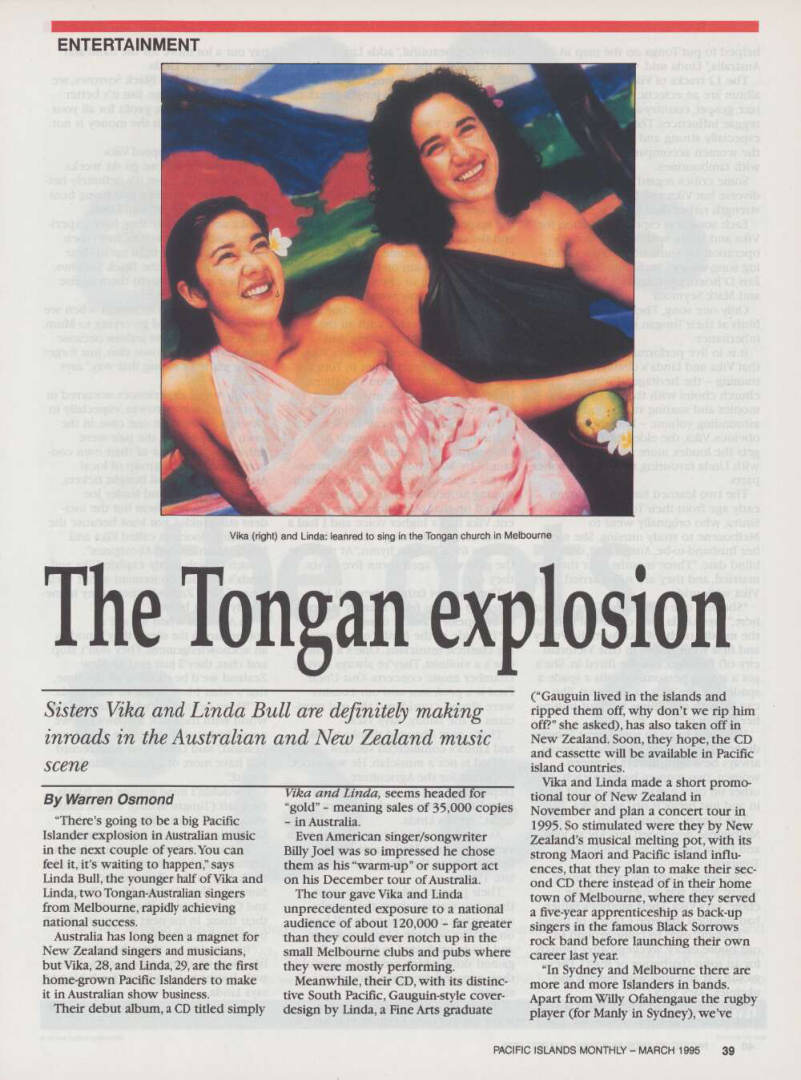
“There’s going to be a big Pacific Islander explosion in Australian music in the next couple of years. You can feel it, it’s waiting to happen,” says Linda Bull, the younger half of Vika and Linda, two Tongan-Australian singers from Melbourne, rapidly achieving national success.
Australia has long been a magnet for New Zealand singers and musicians, but Vika, 28, and Linda, 29, are the first home-grown Pacific Islanders to make it in Australian show business.
Their debut album, a CD titled simply
Vika and Linda, seems headed for “gold” - meaning sales of 35,000 copies - in Australia.
Even American singer/songwriter Billy Joel was so impressed he chose them as his “warm-up” or support act on his December tour of Australia.
The tour gave Vika and Linda unprecedented exposure to a national audience of about 120,000 - far greater than they could ever notch up in the small Melbourne clubs and pubs where
they were mostly performing.
Meanwhile, their CD, with its distinc tive South Pacific, Gauguin-style cover design by Linda, a Fine Arts graduate
(“Gauguin lived in the islands and ripped them off, why don’t we rip him off?” she asked), has also taken off in New Zealand. Soon, they hope, the CD and cassette will be available in Pacific island countries.
Vika and Linda made a short promo tional tour of New Zealand in November and plan a concert tour in 1995. So stimulated were they by New Zealand’s musical melting pot, with its strong Maori and Pacific island influ ences, that they plan to make their sec ond CD there instead of in their home town of Melbourne, where they served
a five-year apprenticeship as back-up
singers in the famous Black Sorrows rock band before launching their own career last year.
“In Sydney and Melbourne there are more and more Islanders in bands.
Apart from Willy Ofahengaue the rugby
player (for Manly in Sydney), we’ve
Vika (right) and Linda: leanred to sing in the Tongan church in Melbourne
helped to put Tonga on the map in Australia,” Linda said.
The 12 tracks of Vika and Linda’s first album are an eclectic mixture of rock, jazz, gospel, country-and-western, and reggae influences. The gospel strain is especially strong and in performances the women accompany themselves with tambourines.
Some critics regard the album as too diverse but Vika and Linda see this as a strength rather than a weakness.
Each song was especially written for Vika and Linda, with their active co operation, by some of Australia’s lead ing song-writers, including Paul Kelly, Eris O’Brien, Joe Camilleri, Wayne Burt and Mark Seymour.
Only one song, These Hands , directly hints at their Tongan roots and religious inheritance.
It is in live performances, though, that Vika and Linda’s distinctive musical training - the heritage of Tongan church choirs with their intricate har monies and soaring voices and at times astounding volume - becomes really obvious. Vika, the elder by 17 months, gets the louder, more assertive parts, with Linda favouring the sweeter, softer parts.
The two learned harmony from an early age from their Tongan mother, Siniva, who originally went to Melbourne to study nursing. She met her husband-to-be, Austin Bull, on a blind date. “Three months later they got married, and they are still married,” says Vika with pride.
“She was one of the first Tongans out here,” says Linda. “She came out bang in the middle of the White Australia Policy and first went to live in (the Victorian city of) Bendigo, but she fitted in. She’s got a strong personality, calls a spade a spade, but she’s also a diplomat. She can smooth out things without putting her foot in it.”
“We used to go to some great Tongan dinner dances,” says Vika. There would always be a fight, always between women, two women bashing each other up over a man. Mum would step in and just break it up,” says Vika.
The Tongan community in Melbourne developed quickly, so Vika and Linda grew up surrounded by Tongans.
“We went to church every Sunday, where Mum was a member of the choir,” says Vika.Their mother’s father had founded the Free Church of Tonga.
“Tongans used to come around to our house every weekend after church for an umu (barbeque or feast). They would eat and sing with guitars and ukeleles,” says Vika.
“Our cousins had a little band with ukeleles and tea-chest double bass, and
they were beautiful,” adds Linda.
As children, the two learned e lea
faka-Tonga (Tongan language).They
still understand but no longer speak it themselves.
They have visited Tonga twice - once with their parents when they were eight and six respectively, and again in 1989, when they took a holiday there, without their parents.
But it was their childhood visit, when they heard the powerful church choirs, the responsiveness of the congregation and the open displays of emotion, espe cially by Tongan women, which left the deepest impression on them.
“I hated going to church here in Melbourne. We only went to hang out with the kids really, but the church in Tonga was wonderful, with all the elders up the front, chanting and responding to the sermon,” says Vika.
“It would be great to get to Tonga again, but Vika and I won’t go there because they can sing much better than we can,” says Linda half-jokingly.
“We learned to sing our fist song in harmony in the Tongan church in Melbourne,” says Linda. “We were taught by Mum how to sing in harmo ny for a special event. We were already singing around the house and she picked up that our voices were differ ent. Vika had a higher voice and I had a lower one. So she taught us the har monies for a Tongan hymn.” At the time the girls were aged about five or six,
they say.
Their palagi father (they call him “Ozzie”) comes from a family steeped in European classical music.
“His side of the family, our cousins, are classical musicians. One’s a cellist, one’s a violinist. They’re always having chamber music concerts. Our Uncle Fred is a professor and our cousins were always considered the real musi cians in the family,” says Vika.
That’s now changed thanks to Vika and Linda’s commercial success.
“Dad is not a musician. He was stock inspector for the Agriculture Department but he used to sing us Bing Crosby songs to sleep every night,” recalls Linda.
As teenagers they began singing with various popular Melbourne bands before joining the Black Sorrows in the late 1980 s.
Their parents did not discourage them but warned them they might need other qualifications to fall back on, so Vika became a legal secretary and Linda graduated in Fine Art. Both gained skills which are clearly useful in their new, independent careers as singers.
“Financially, it’s harder now that we’re on our own because you have to
pay out a lot more for the band and expenses,” says Linda.
“Before, with the Black Sorrows, we just collected a wage. But it’s better because you get the profit for all your hard work, although the money is not
phenomenal.”
“Not yet!” interrupted Vika.
“Remember, we can go six weeks without working, but it’s definitely bet ter being on your own and being boss of your own money,” said Linda.
Vika and Linda say they have experi enced racism in Australia, from their kindergarten years right up to their years touring with the Black Sorrows.
But their mother taught them to rise above such prejudice.
“We copped a lot of racism when w r e were at school. We’d go crying to Mum.
She’d say they’re just jealous because they haven’t got brown skin, just forget it. She made us strong that way,” says Vika.
Their worst experiences occurred in Australian country towns, especially in Western Australia. In one case, in the town of Esperance, the pair were refused entry to one of their own con certs, along with a group of local Aboriginals who had bought tickets.
Black Sorrows band leader Joe Camilleri rescued them but the inci dent still rankles, not least because the offending doorman called Vika and Linda “Asian-looking Aborigines”.
Such ordeals partly explain Vika and Linda’s obvious excitement about their tour of New Zealand where they imme diately felt at home.
“In Australia when we see a Polynesian in the street they’ll nod as an acknowledgement.They don’t stop and chat, they’ll just nod. In New Zealand we’d be chatting all the time, that’s what I love about it,” said Linda.
“We’ve been everywhere around the world with the Black Sorrows but we never had such a reception as in New Zealand,” said Linda. “Our next record will have more of a Pacific islands sound.”
“I wouldn’t mind getting my hands on a lali (Tongan drum),” added Linda, who is also taken with the sound of Cook Islands pate or log-drumming.
“In Australia there’s Christine Anu, a Torres Strait Islander, who’s going to be really big. In New Zealand the Samoans, New Zealand Maori,Tongans, and Cook Islanders, they’re all doing their thing. In the next five years they’ll be really big,” says Vika.
“It’s good to see those big strong Islanders up there, strong and soft as well. I want to see a bit of fresh blood,” says Linda.