Chinese from Hong Kong would take care of the sluggish
pp. 22-23 · Read in the full issue
Cover Story
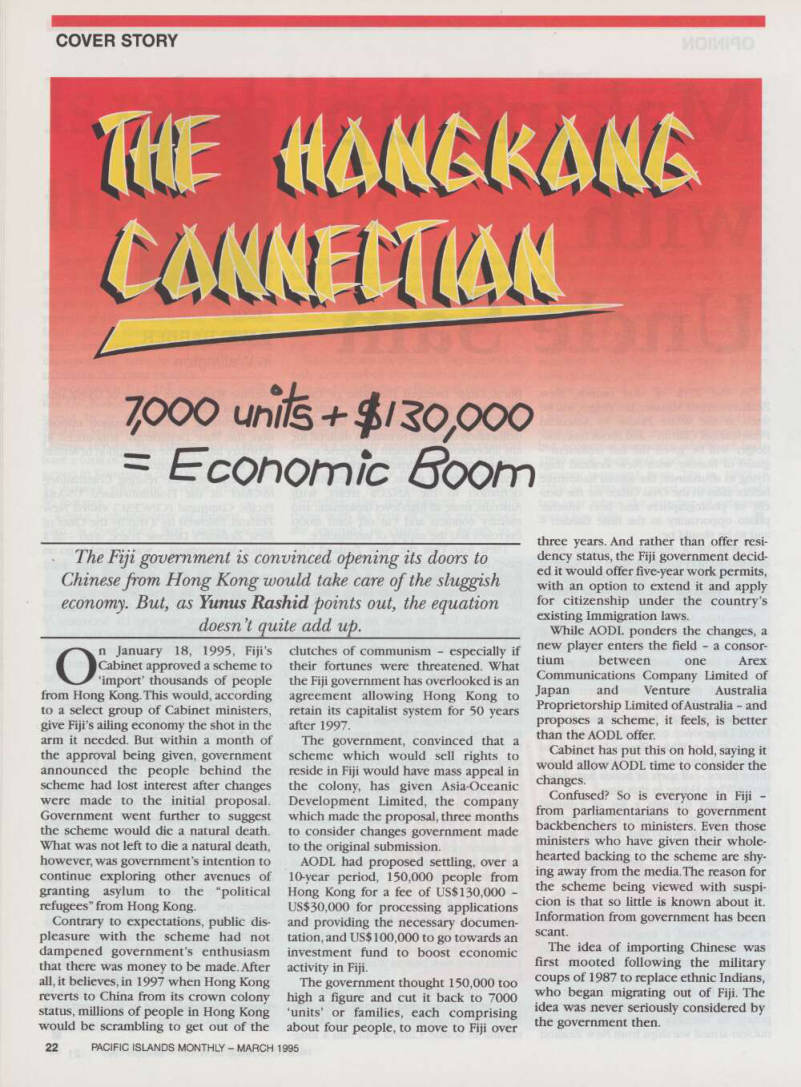
The Fiji government is convinced opening its doors to Chinese from Hong Kong would take care of the sluggish economy. But, as Yunus Rashid points out, the equation doesn’t quite add up.
On January 18, 1995, Fiji’s Cabinet approved a scheme to ‘import’ thousands of people from Hong Kong. This would, according to a select group of Cabinet ministers, give Fiji’s ailing economy the shot in the arm it needed. But within a month of the approval being given, government announced the people behind the scheme had lost interest after changes were made to the initial proposal.
Government went further to suggest the scheme would die a natural death.
What was not left to die a natural death, however, was government’s intention to continue exploring other avenues of granting asylum to the “political refugees” from Hong Kong.
Contrary to expectations, public dis pleasure with the scheme had not dampened government’s enthusiasm that there was money to be made. After all, it believes, in 1997 when Hong Kong reverts to China from its crown colony status, millions of people in Hong Kong would be scrambling to get out of the
clutches of communism - especially if their fortunes were threatened. What the Fiji government has overlooked is an agreement allowing Hong Kong to retain its capitalist system for 30 years after 1997.
The government, convinced that a scheme which would sell rights to reside in Fiji would have mass appeal in the colony, has given Asia-Oceanic Development Limited, the company which made the proposal, three months to consider changes government made to the original submission.
AODL had proposed settling, over a 10-year period, 130,000 people from Hong Kong for a fee of US$l3O,OOO - US$3O,OOO for processing applications and providing the necessary documen tation, and US$lOO,OOO to go towards an investment fund to boost economic activity in Fiji.
The government thought 150,000 too high a figure and cut it back to 7000 ‘units’ or families, each comprising about four people, to move to Fiji over
three years. And rather than offer resi dency status, the Fiji government decid ed it would offer five-year work permits, with an option to extend it and apply for citizenship under the country’s existing Immigration laws.
While AODL ponders the changes, a new player enters the field - a consor tium between one Arex Communications Company Limited of Japan and Venture Australia Proprietorship Limited of Australia - and proposes a scheme, it feels, is better than the AODL offer.
Cabinet has put this on hold, saying it would allow AODL time to consider the
changes.
Confused? So is everyone in Fiji from parliamentarians to government backbenchers to ministers. Even those ministers who have given their whole hearted backing to the scheme are shy ing away from the media. The reason for the scheme being viewed with suspi cion is that so little is known about it.
Information from government has been scant.
The idea of importing Chinese was first mooted following the military coups of 1987 to replace ethnic Indians, who began migrating out of Fiji. The idea was never seriously considered by the government then.
Late last year, AODL dangled a carrot, to the tune of US$9lO million, before some Cabinet ministers who took the proposal to Cabinet in January and fought to the hilt to have it approved.
Without proper research and consulta tion, a Cabinet sub-committee recom mended the project be approved (with some amendments). What was funny about the whole thing was that many ministers did not know what they had agreed to and the Minister for Home Affairs, Paul Manueli, who chaired the sub-committee, reportedly agreed under protest.
When PIM sought clarification and explanation of the programme from Manueli, it was told no information would be forthcoming because the whole thing was very confidential. Since then, there have been no answers, only more questions.
Attempts to trace the AODL and its directors failed. The company was not registered in Fiji. Its representative in Fiji - one Jerry Nacoke - then said it was a Hong Kong-based company. Searches for registration of the company there revealed nothing. It was then supposed to be registered somewhere else. He would not say where. Then again it was in the process of being registered.
A K.K. Mak, reportedly from Hong Kong, was named as AODL’s representa tive there. But no one seems to know exactly who he is.
How did Cabinet get led by the nose to approve something that was shroud ed in so much secrecy? Why did govern ment make a decision on something which had not been thoroughly researched? Could it be the government had been taken for a ride? And, in an effort not to lose face, government stood by and defended its decision in the opposition?
Finally, in response to PIM questions, a government official, speaking on behalf of Cabinet, tried to answer them.
He said government’s biggest worry for now was to create jobs for the thou sands of school leavers. An influx of about 28,000 Chinese with their invest ment funds would do this, it believed.
Based on this assumption, the spokesman said the “intrusion of an additional 20-odd thousand Chinese immigrants over a period of 10 years (although the period of intake is intend ed for three years only) would not impact greatly on the demographic pic ture of the country”.
And the company? The spokesman described AODL as a group of reputable
business people in Hong Kong. Details of directors were known to govern ment, along with their referees in the Hong Kong government. In the same statement, the spokesman said: “Asia- Oceanic represents a group of individ ual businessmen.As far as government is concerned, it is dealing with an interest ed group of people and they could easi ly be individuals and it would still be perfectly legal for government to talk to them. Government, however, would require, when the formal agreement is signed, that the other party is a proper
legal entity”.
Was the govern ment continuing talks without know ing if they were a legal entity?
On the possibility of criminal elements coming into the country as migrants, the spokesman said this would not hap pen because the applicants would be thoroughly screened?
He failed to explain how they would be screened.
Yet another flaw in the whole deal is the price tag for a work
‘This rise in unemploy ment is government’s
single biggest concern for
the immediate future of
this country.’
- Government spokesman explaining why the decision was made
permit in Fiji. The scheme requires the applicants to pay $130,000 before being given a work permit for five years.
There are cheaper alternatives to Fiji available, from countries like Australia and New Zealand.
If, as the spokesman said, the appli cants are business people, then their business sense would dictate they go elsewhere and not to Fiji where the economy is sluggish and chances of return on investment are slim.
It is worth noting government is con fident the applicants (who have yet to apply) are “respectable business peo
ple”.
Assuming 7000 units of four people arrived on Fiji’s shores, each unit would have to spend, apart from the $130,000, about $lOO,OOO to $130,000 to buy a home, $20,000 on a car and some $15,000 to travel to Fiji. The immediate price tag for the five-year work permit would be more than s3oo,ooo.After this what? He would need to plough in sev eral hundreds of thousands of dollars to start a business and create employment.
Government has repeatedly said the plan is to revitalise the economy and
create 50,000 new jobs and to diversify the economy’s base. It all seems like child’s play. Get 7000 Hong Kong investors and Fiji will become another economic power to reckon with - an economic tiger parallel ro any other Asian country.
But does government realise the suc cess of Hong Kong is not )ased on the fact that Chinese live there, but on its strategic position in the international trade market. It does not have to import raw materials from thousands of kilome tres away. It has no shipping problems. It sells to a large local population and a
vast external popula
tion nearby. It enjoys
cheap labour. And, above all, it is com petitive in the export market?
Where then is the comparison between Fiji and Hong Kong? Fiji has a small population, expensive labour rates, will have to import almost every raw material for any type of mass produc tion and then export it because the local market is too small, and is situated in the
middle of nowhere.
These are the impracticalities of industrialising Fiji.
The demographic impact would be equally bad. Fiji would need 20 schools (on the basis of two children per migrant family and an average of 700 students per school) , more roads, more and bigger ports, more hospitals, more housing schemes and more of almost
everything else?
And that is not all. Having invested their money into the fund, which would be handled by government for invest ment purposes, what are the 7000 units and their spouses expected to do? Get
jobs by replacing locals? How would
these people be expected to survive, having spent close to $300,000 on just getting started in Fiji? What industries would the government start and how would it ensure they would be viable?
The Hong Kong Chinese deal is noth ing more than a big question mark.
Whatever government’s intentions are in the importation of Hong Kong Chinese, it would be fair to say the pro ject would create social and economic problems too great to fathom. ■