Crime
pp. 16-19 · Read in the full issue


Law
And
Punishment
By Yunus Rashid
The Forum Secretariat’s secretary-gen eral, leremia Tabai, recently made known his concerns over Fiji’s growing crime rate to the country’s government.
He was concerned for the security of his Fiji-based staff and their property, as the country is swept by a crime wave that appears an insurmountable prob lem.
Tabai is not alone in his concern. He is joined by hundreds of Fiji residents who have fallen victim to burglaries as their homes have been broken into and bru tally ransacked in search of valuables.
Police statistics show the number of reported burglaries increased by 14 per cent from 906 in 1992 to 1039 in 1993.
Figures for last year have not been released yet, but the trend indicates a major increase as unemployment becomes a serious problem and jobs are hard to come by.
Amid such an atmosphere - when the public is on the warpath against crime, when crime has spread its roots deeply and firmly and when criminals are devising new methods of outsmarting the system, it is not easy being Police
Commissioner.
But for Fiji’s police boss, Isikia Savua, life must go on. He agrees crime figures have sky-rocketed but he does not try to justify the statistics. Instead he gives explanations.
Savua says the media has suddenly decided to run a series of stories on serious offences and this has led to the public outcry against an “alarming increase in crime”. He said it was good the media had decided to run such stories because it warned people criminals could attack any time and any where.
“But what is lacking is the initiative of the force to inform people about the responsibilities they could share with us to combat crime. I have now drawn up a plan whereby our officers would be stationed closer to the people in police posts. I have held numerous talks in localities where more crime has been reported and asked for their assistance in setting up police posts. The people are willing and ready to help. The problem has been that they did not know how to help,” Savua explained.
He said crime had been increasing at an average of eight percent annually not because of lack of personnel and
transport in the police department, but because every year there are more school leavers who remain unemployed and resort to crime for a living.
Savua, unlike his predecessors, also brushed aside suggestions that lack of personnel and transport may be a major factor in police’s inability to combat crime.
“The public look to the police to main tain law and order and we must honour that duty and come up with ideas and plans to effectively deal with the crime problem. However, it must be noted that citizens could play a very prominent role in combating crime by simply polic ing their own neighbourhoods”.
But why is a small society like Fiji being faced with such hideous crimes, such as rape, violent robberies and mur ders?
“School leavers, unemployment fig ures and population increases, seen in the light of economic growth, explain a lot,” Savua said. Crime statistics showed increases but, compared to other figures such as the number of school leavers and the unemployed, it was not unfavourable.
How does he explain the decline in
the number of prisoners when the crime rate has gone up? Is this a reflec tion of fewer prosecutions?
“(Police) prosecutors are not trained, I agree. But the Director of Public Prosecutions has come up with a plan to establish a national prosecution service which will incorporate the work of police prosecutors. Eventually there will be no more police prosecutors. We have earmarked two police officers to become lawyers and this programme will continue.
“We have a good success rate in con victing people. But then our work is not to get convictions only, but to see that justice is done. The job of the prosecutor is largely dependent on how good the evidence supplied by detectives or investigating officers is.”
Savua said he did not agree police prosecutors were unable to “take on” seasoned lawyers. “The evidence itself decides whether a man will or will not be convicted. The prosecutor merely leads the evidence in court. It is for the defence counsel to find out means to defend his or her clients.
“Our prosecutors are doing a fine job.
We have a fairly good success rate. We have seminars for prosecutors and crime officers and this allows them to do decent work.”
A general public complaint has been that police do not immediately arrive at the scene of the crime because they do not have enough vehicles.
Explaining this Savua said: “Lack of transport is an excuse of convenience. It is something that has been there for a number of years as a lame excuse.
Mobility is what we should look at. How can our officers effectively be deployed to attend to reports?
“Every police officer knows that if transport is not available, we ask the nearest station to help or we use public transport. We also have some other gov ernment vehicles available to us over weekends.
“Our problem at the moment is response time. To the complainant, the response time of one hour after the first call is made, is too long. We accept that and we are now in the process of having police officers closer to the people.
“The response time should reduce.
Places identified as crime centres are slowly having their police stations or police posts. Most of our problems have been addressed singly when, in fact, the problems are interrelated. If you deal with them on an individual basis and when related problems continue to exist, then that is no use because, like in a chain reaction, the resolved problem
continues to reappear in a short span of time.”
Savua said the reason these problems had not been effectively addressed over the years was that the police had not gone out there to talk to the communi ty Another drawback with mobility has been that police officers have been taught to use vehicles but they have not been taught to maintain their vehicles.
Therefore, many vehicles were out of order.
To deal with this problem, Savua has hired a mechanic to assist police drivers learn basic maintenance skills.
“We can get 100 more vehicles but these would be of no use if they are not maintained and we don’t have any strat egy to combat crime.”
Is manpower shortage a problem?
Setting an example: Police Commissioner Savua checks
How the Police Budget
measures up
1984 1993 Population 690681 771104 School Leavers 6518 2370 Unemployed 16800 15800 Police Strength 1410 1913 Police Budget $12,929,300 $25,436,600
“At the moment there are 1913 police officers. One policeman to 400 people.
The number we have is not a problem.
“What is the use of having more offi cers when the existing ones are not ade quately equipped? We need to improve accommodation. I have 88 single men here (in Suva) but accommodation for only 52. So, the others have to pay rent.
They do not get lodging allowances. The single men then are burdened with heavier duties.
“What I would like to do is to go on with the existing numbers but improve their working conditions and their equipment. I have drawn up a standard equipment list which will cost the tax payer $ 1000 per officer.To get more offi cers would mean more costs in terms of training and accommodation expenses.
“We have broadened our special con
stabulary unit. Special constables are cheaper to have and they are always in line to take up any vacancies which come up.”
Savua said he would ideally like to see his officers do the work they are trained to do, rather than serve summons, cap ture escaped prisoners, serve as butlers to judges and act as court orderlies.
Savua said he would like to see a change but the question was if police did not perform these duties, then who would?
“Unless a better, financially viable, acceptable and workable solution is available, I would not like to change that. People are always advocating change but without solutions. I’m for change but somebody has to give me a better alternative.”
He also expressed concern at the atti tude of some magistrates who released violent criminals on bail, pending trial.
He said these people, knowing they were going to be convicted eventually, normally carried out a series of criminal activities while on bail. When they were finally sentenced for the offences, they would get concurrent terms. For exam ple, someone who has committed 13 robberies with violence at around the same time would not get more then three to four years behind bars all told.
Who are these people who repeatedly go to prison? What is the profile of the average criminal?
Savua’s Assistant Commissioner for Crime, Jone Waisale, outlined the charac teristics of the habitual offender.
Repeat offenders were usually chil dren from broken homes with little edu cation.
Waisale, who is also a lay-preacher, said churches did their best to call young people to the church but had little response.
“I would say the criminal career starts at an early stage. If not at home stealing lollies, then at school stealing food, and
then money. Normally it starts out of desperation and later develops into a habit.
“When children are younger, there is enough family support to sustain them but as they grow older, family support lessens and the children are left alone to survive. As the needs of the criminals grow, their crimes become bigger, until they end up in prison for long periods.
The turning point comes at around 30 to 35 years of age.”
The solution, Waisale feels, is greater commitment from churches and fami lies. “Unless our basic institutions are made strong, the moral fight becomes an uphill battle. My own opinion also is that the government needs to actively do something about the economy so that more work is available to the large num ber of school leavers every year.
“What we sometimes forget when talk ing about crime and criminals is that we are dealing with human beings. Yes, the prisons can help rehabilitate criminals, but of what use is this when they come out from behind bars and there is a hos tile society waiting to snub them, and an economy which does not provide enough means for people to financially sustain themselves.”
Waisale also raised concern at the ready market which receives stolen properties. He said criminals knew places where they could sell their loot.
There was obviously a demand for stolen goods and it was difficult for the police to keep a trace on how they were being disposed of.
For example, he said, stolen gold jew ellery was apparently taken to promi nent jewellers who would melt it down, leaving police without any trail. Waisale said it was unfortunate people who bought stolen property did not realise they were encouraging robberies and burglaries. ■
[?]t a department vehicle
Pacific Islands Monthly - March 1995
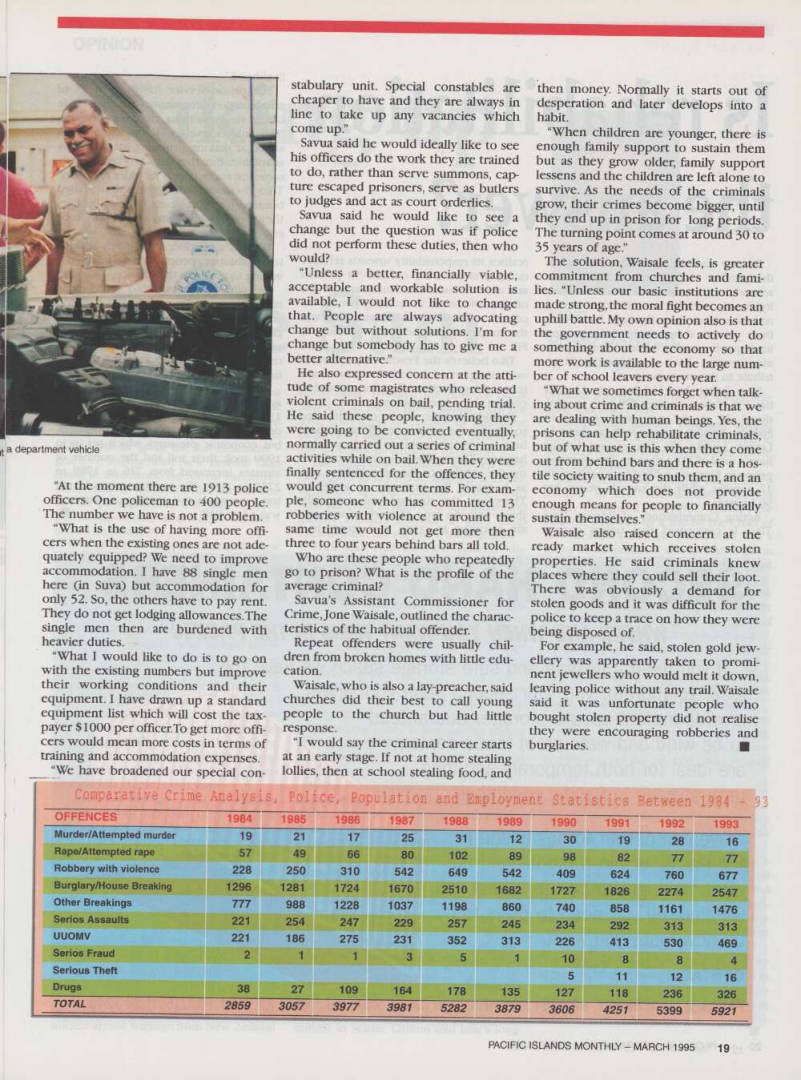
Comparative Crime Analysis, Police, Population and Employment Statistics Between 1984 - 93
Offences
1984 1985 1986 1987 1988 1989 1990 1991 1992 1993 Murder/Attempted murder 19 21 17 25 31 12 30 19 28 16 Rape/Attempted rape 57 49 66 80 102 89 98 82 77 77 Robbery with violence 228 250 310 542 649 542 409 624 760 677 Burglary/House Breaking 1296 1281 1724 1670 2510 1682 1727 1826 2274 2547 Other Breakings 777 988 1228 1037 1198 860 740 858 1161 1476 Serios Assaults 221 254 247 229 257 245 234 292 313 313
Uuomv
221 186 275 231 352 313 226 413 530 469 Serios Fraud 2 1 1 3 5 1 10 8 8 4 Serious Theft 5 11 12 16 Drugs 38 27 109 164 178 135 127 118 236 326
Total
2859 3057 3977 3981 5282 3879 3606 4251 5399 5921