Tragedy
pp. 12-13 · Read in the full issue
Violence
strikes home
Papua New Guinea has the world’s second highest incidence of violence against women , according to a UNICEF report. But a new trend shows men are just as likely to fall victim to abuse in the homes.
By Ruth Waram
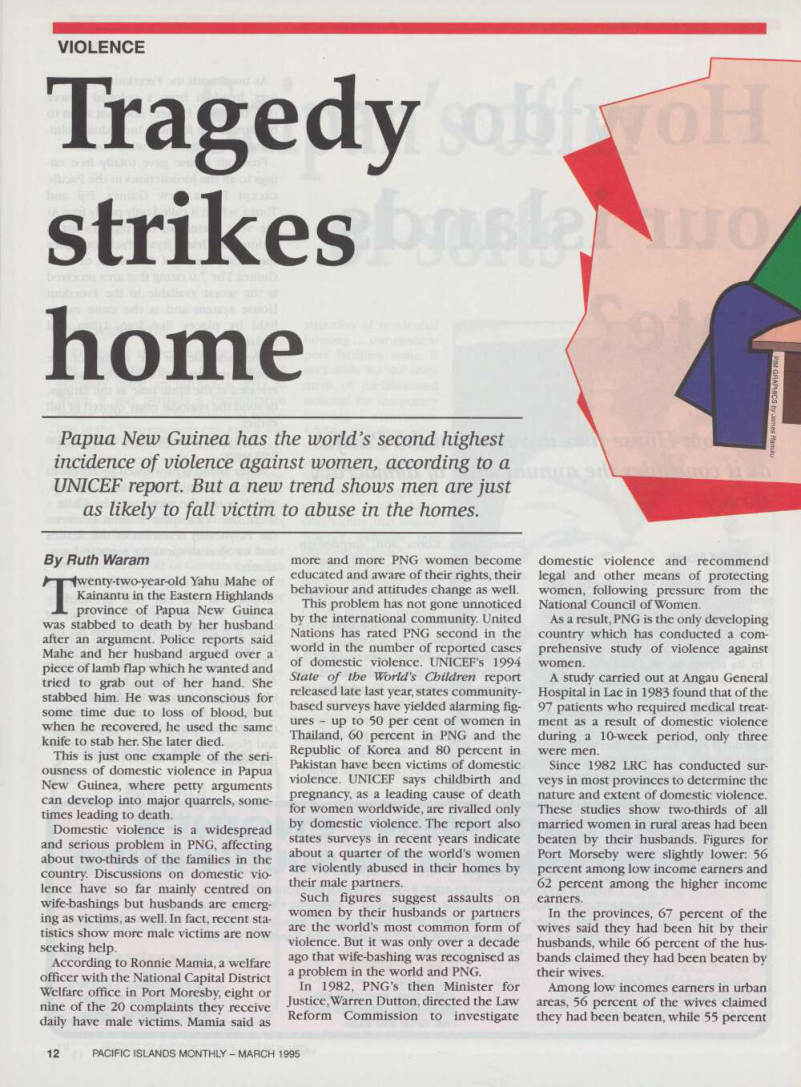
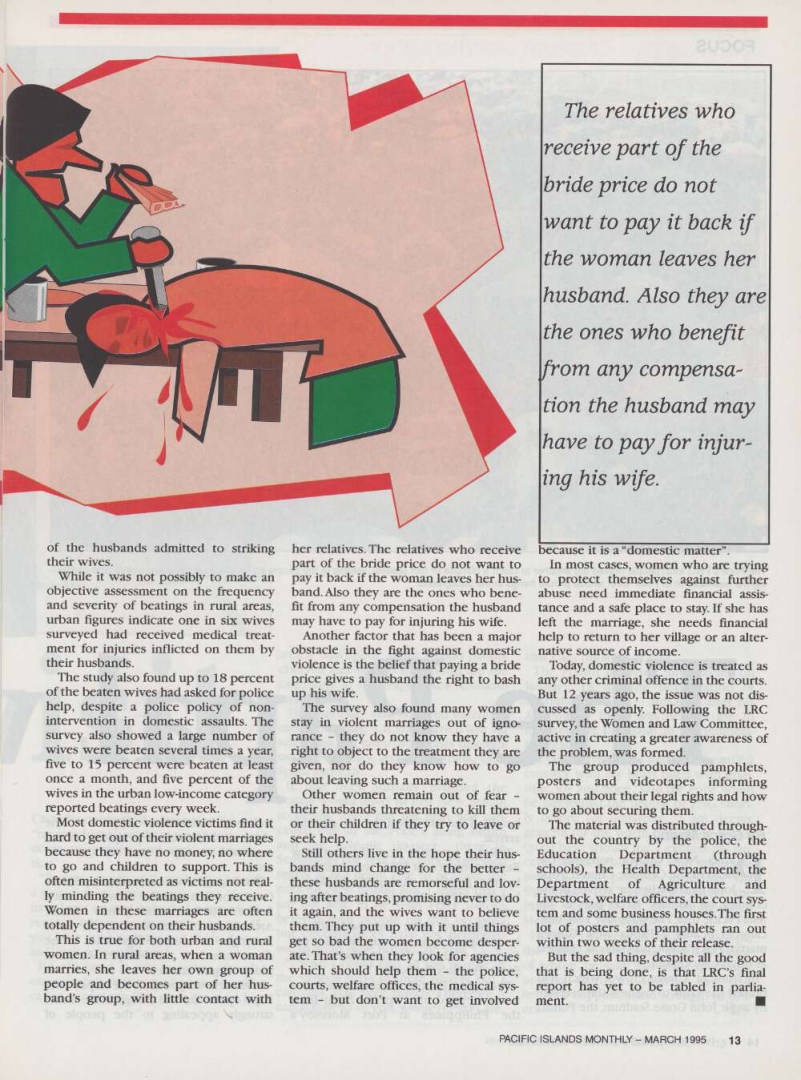
Twenty-two-year-old Yahu Mahe of Kainantu in the Eastern Highlands province of Papua New Guinea was stabbed to death by her husband after an argument. Police reports said Mahe and her husband argued over a piece of lamb flap which he wanted and tried to grab out of her hand. She stabbed him. He was unconscious for some time due to loss of blood, but when he recovered, he used the same knife to stab her. She later died.
This is just one example of the seri ousness of domestic violence in Papua New Guinea, where petty arguments can develop into major quarrels, some times leading to death.
Domestic violence is a widespread and serious problem in PNG, affecting about two-thirds of the families in the country. Discussions on domestic vio lence have so far mainly centred on wife-bashings but husbands are emerg ing as victims, as well. In fact, recent sta tistics show more male victims are now
seeking help.
According to Ronnie Mamia, a welfare officer with the National Capital District Welfare office in Port Moresby, eight or nine of the 20 complaints they receive daily have male victims. Mamia said as
more and more PNG women become educated and aware of their rights, their behaviour and attitudes change as well.
This problem has not gone unnoticed by the international community. United Nations has rated PNG second in the world in the number of reported cases of domestic violence. UNICEF’s 1994 State of the World’s Children report released late last year, states community based surveys have yielded alarming fig ures - up to 50 per cent of women in Thailand, 60 percent in PNG and the Republic of Korea and 80 percent in Pakistan have been victims of domestic violence. UNICEF says childbirth and pregnancy, as a leading cause of death for women worldwide, are rivalled only by domestic violence. The report also states surveys in recent years indicate about a quarter of the world’s women are violently abused in their homes by their male partners.
Such figures suggest assaults on women by their husbands or partners are the world’s most common form of violence. But it was only over a decade ago that wife-bashing was recognised as a problem in the world and PNG.
In 1982, PNG’s then Minister for Justice,Warren Dutton, directed the Law Reform Commission to investigate
domestic violence and recommend legal and other means of protecting women, following pressure from the National Council of Women.
As a result, PNG is the only developing country which has conducted a com prehensive study of violence against women.
A study carried out at Angau General Hospital in Lae in 1983 found that of the 97 patients who required medical treat ment as a result of domestic violence during a 10-week period, only three were men.
Since 1982 LRC has conducted sur veys in most provinces to determine the nature and extent of domestic violence.
These studies show two-thirds of all married women in rural areas had been beaten by their husbands. Figures for Port Morseby were slightly lower: 56 percent among low income earners and 62 percent among the higher income earners.
In the provinces, 67 percent of the wives said they had been hit by their husbands, while 66 percent of the hus bands claimed they had been beaten by their wives.
Among low incomes earners in urban areas, 56 percent of the wives claimed they had been beaten, while 55 percent
of the husbands admitted to striking their wives.
While it was not possibly to make an objective assessment on the frequency and severity of beatings in rural areas, urban figures indicate one in six wives surveyed had received medical treat ment for injuries inflicted on them by their husbands.
The study also found up to 18 percent of the beaten wives had asked for police help, despite a police policy of non intervention in domestic assaults. The survey also showed a large number of wives were beaten several times a year, five to 13 percent were beaten at least once a month, and five percent of the wives in the urban low-income category reported beatings every week.
Most domestic violence victims find it hard to get out of their violent marriages because they have no money, no where to go and children to support. This is often misinterpreted as victims not real ly minding the beatings they receive.
Women in these marriages are often totally dependent on their husbands.
This is true for both urban and rural women. In rural areas, when a woman marries, she leaves her own group of people and becomes part of her hus band’s group, with little contact with
her relatives. The relatives who receive part of the bride price do not want to pay it back if the woman leaves her hus band. Also they are the ones who bene fit from any compensation the husband may have to pay for injuring his wife.
Another factor that has been a major obstacle in the fight against domestic violence is the belief that paying a bride price gives a husband the right to bash up his wife.
The survey also found many women stay in violent marriages out of igno rance - they do not know they have a right to object to the treatment they are given, nor do they know how to go about leaving such a marriage.
Other women remain out of fear their husbands threatening to kill them or their children if they try to leave or
seek help.
Still others live in the hope their hus bands mind change for the better these husbands are remorseful and lov ing after beatings, promising never to do it again, and the wives want to believe them. They put up with it until things get so bad the women become desper ate. That’s when they look for agencies which should help them - the police, courts, welfare offices, the medical sys tem - but don’t want to get involved
because it is a “domestic matter”.
In most cases, women who are trying to protect themselves against further abuse need immediate financial assis tance and a safe place to stay. If she has left the marriage, she needs financial help to return to her village or an alter native source of income.
Today, domestic violence is treated as any other criminal offence in the courts.
But 12 years ago, the issue was not dis cussed as openly. Following the LRC survey, the Women and Law Committee, active in creating a greater awareness of the problem, was formed.
The group produced pamphlets, posters and videotapes informing women about their legal rights and how to go about securing them.
The material was distributed through out the country by the police, the Education Department (through schools), the Health Department, the Department of Agriculture and Livestock, welfare officers, the court sys tem and some business houses. The first lot of posters and pamphlets ran out within two weeks of their release.
But the sad thing, despite all the good that is being done, is that LRC’s final report has yet to be tabled in parlia ment. ■
The relatives who receive part of the bride price do not want to pay it back if the woman leaves her husband. Also they are the ones who benefit from any compensa tion the husband may have to pay for injur
ing his wife.