pursuit of
Law
In pursuit of justice
Last month PiM highlighted flaws in Fiji s magistra cy which were affecting the course of justice. While concern was raised in some quarters, not much seems to have changed in the courts since
By Yunus Rashid
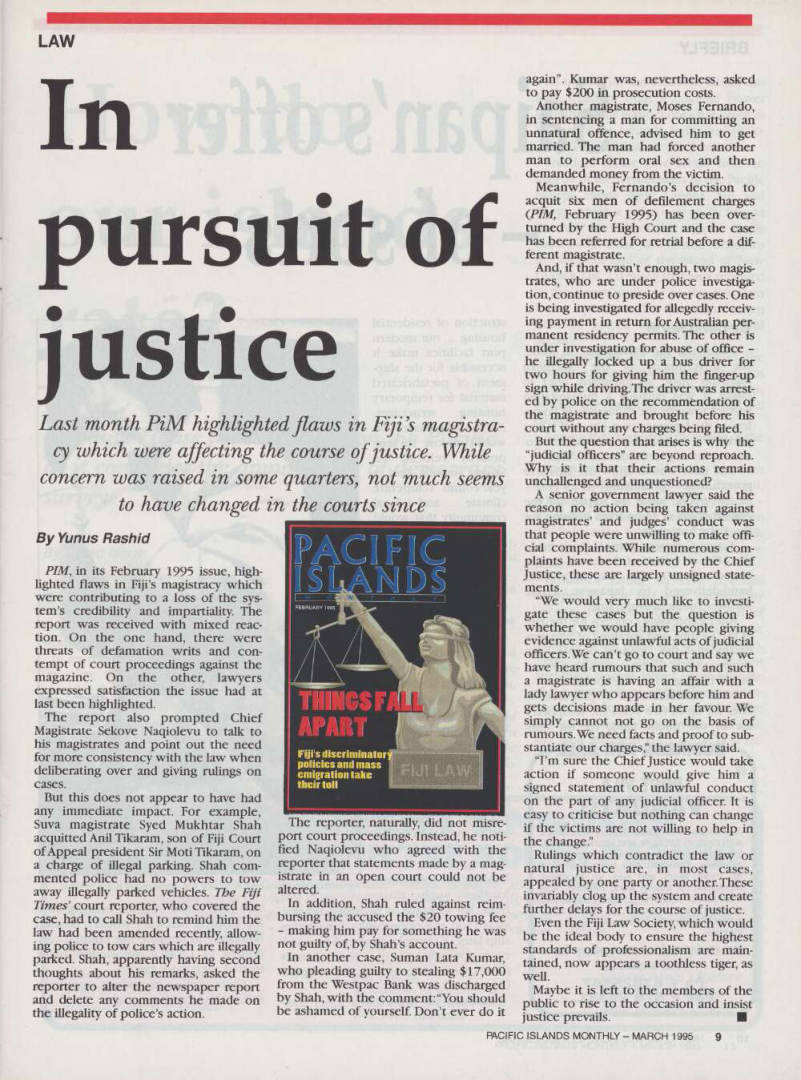
PIM , in its February 1995 issue, high lighted flaws in Fiji’s magistracy which were contributing to a loss of the sys tem’s credibility and impartiality. The report was received with mixed reac tion. On the one hand, there were threats of defamation writs and con tempt of court proceedings against the magazine. On the other, lawyers expressed satisfaction the issue had at last been highlighted.
The report also prompted Chief Magistrate Sekove Naqiolevu to talk to his magistrates and point out the need for more consistency with the law when deliberating over and giving rulings on cases.
But this does not appear to have had any immediate impact. For example, Suva magistrate Syed Mukhtar Shah acquitted Anil Tikaram, son of Fiji Court of Appeal president Sir Moti Tikaram, on a charge of illegal parking. Shah com mented police had no powers to tow away illegally parked vehicles. The Fiji Times’ court reporter, who covered the case, had to call Shah to remind him the law had been amended recently, allow ing police to tow cars which are illegally parked. Shah, apparently having second thoughts about his remarks, asked the reporter to alter the newspaper report and delete any comments he made on the illegality of police’s action.
The reporter, naturally, did not misre port court proceedings. Instead, he noti fied Naqiolevu who agreed with the reporter that statements made by a mag istrate in an open court could not be altered.
In addition, Shah ruled against reim bursing the accused the $2O towing fee - making him pay for something he was not guilty of, by Shah’s account.
In another case, Suman Lata Kumar, who pleading guilty to stealing $17,000 from the Westpac Bank was discharged by Shah, with the comment: “You should be ashamed of yourself. Don’t ever do it
again”. Kumar was, nevertheless, asked to pay $2OO in prosecution costs.
Another magistrate, Moses Fernando, in sentencing a man for committing an unnatural offence, advised him to get married. The man had forced another man to perform oral sex and then demanded money from the victim.
Meanwhile, Fernando’s decision to acquit six men of defilement charges (PIM, February 1995) has been over turned by the High Court and the case has been referred for retrial before a dif ferent magistrate.
And, if that wasn’t enough, two magis trates, who are under police investiga tion, continue to preside over cases. One is being investigated for allegedly receiv ing payment in return for Australian per manent residency permits. The other is under investigation for abuse of office he illegally locked up a bus driver for two hours for giving him the finger-up sign while driving. The driver was arrest ed by police on the recommendation of the magistrate and brought before his court without any charges being filed.
But the question that arises is why the “judicial officers” are beyond reproach.
Why is it that their actions remain unchallenged and unquestioned?
A senior government lawyer said the reason no action being taken against magistrates’ and judges’ conduct was that people were unwilling to make offi cial complaints. While numerous com plaints have been received by the Chief Justice, these are largely unsigned state ments.
“We would very much like to investi gate these cases but the question is whether we would have people giving evidence against unlawful acts of judicial officers. We can’t go to court and say we have heard rumours that such and such a magistrate is having an affair with a lady lawyer who appears before him and gets decisions made in her favour. We simply cannot not go on the basis of rumours. We need facts and proof to sub stantiate our charges,” the lawyer said.
“I’m sure the Chief Justice would take action if someone would give him a signed statement of unlawful conduct on the part of any judicial officer. It is easy to criticise but nothing can change if the victims are not willing to help in the change.”
Rulings which contradict the law or natural justice are, in most cases, appealed by one party or another. These invariably clog up the system and create further delays for the course of justice.
Even the Fiji Law Society, which would be the ideal body to ensure the highest standards of professionalism are main tained, now appears a toothless tiger, as well.
Maybe it is left to the members of the public to rise to the occasion and insist justice prevails. ■