Johnston Atoll
pp. 46-50 · Read in the full issue

Special Report
Johnston Atoll revisited
As the disposal of chemical weapons on Johnston continues amid a series of accidents, concern is being raised over the programme’s
safety
By Ed Rampell
On January 3, the US Army announced it was seeking an extension and an additional US$65O million to fulfill its mandate to burn up to 6.6 percent of the US chem ical weapons stockpile at the US$24O million at Johnston Atoll Chemical Agent Disposal System’s incinerator complex.
Why is the Army asking for a modifi cation to its August 30,1995 deadline to incinerate 400,000 weapons, including mustard gas and 400 tons of nerve gas shipped from Germany to Johnston?
And how safe is JACADS?
According to the Army, delays have been caused by “unexpected opera tional problems” which include: □ A fire in the explosive containment area of the experimental plant on March 14, 1994 of Johnston, where the US Army incinerates much of its chemical weapons arsenal. According to US Environmental Protection Agency spokesman Ray Fox, “Rockets are chopped, then dropped down chutes of deactivation furnaces. There was a mis fortune - a spark went up through the chute and ignited a rocket. Although there was some damage and shutdown for a few days, there was no nerve agent release or injury.”
□ An accidental release of live nerve agent GB from a JACADS smokestack on March 23,1994. This 25-minute exposure was at least 10 times greater than EPA’s allowable levels. There were no injuries, but JACADS was shut down until July 12.(EPA also reports there was another accidental release of nerve agent GB since JACADS burning began on June 30,1990.) □ Hurricane John forced the evacuation of 1105 civilian and military personnel from Johnston Atoll on August 25,1994. The JACADS plant ceased burning chemical agents for up to three months, according to various estimates, and the Army reported “infrastructure ... damage.” □ Another fire and an explosion in the explosive and agent containment room at JACADS on November 19, 1994, during the shearing of a rocket that had been drained of nerve agent GB M 55.
The shearing machine was damaged and chemical rocket processing was halted at Johnston until December 5. □ A fire at JACADS caused by “a coolant line that came apart, spraying coolant on the hot surface of the deactivation furnace (on December 24,1994).
The fire lasted until the coolant burned out. There was soot, but no damage to equipment. Operations resumed Dec. 26,” according at EPA’s Fox.
This is not the first major delay for the facility. Activist Craig Williams of the Chemical Weapons Working Group and the Kentucky Environmental Foundation alleges, “I don’t know how often JACADS has ceased operation because there have been so many shut downs. JACADS is down more than 30 percent of the time.” Indeed, the Army’s own public notice regarding its exten sion request states that from June 30, 1990 to August 31, 1994, there were no hazardous waste operations at JACADS for 660 days, or about two years! And the above incidents are not the only accidents at Johnston Atoll.
According to the US magazine The Progressive, JACADS’s “test period was supposed to last about 16 months, from the middle of 1990 through late 1991.
But work had to be halted on 65 of the first 85 days of scheduled operations in 1990 because gas-leak monitors sound ed false alarms, conveyor belts melted, the incinerator overheated, and mechan ical equipment failed. Major repairs and
modifications required a protracted
shutdown”.
But Johnston’s calamities started long before construction of JACADS began in 1985, located outside the area covered by the South Pacific Nuclear Free Zone Treaty and not subject to all US environ mental laws. According to New Zealand journalist David Robie in Blood On Their Banner , “At Johnston, US Air Force planes dropped two thermonu clear bombs in 1958, and then used mis siles to launch a further 10 bombs into space four years later,” before the US USSR 1963 Partial Test Ban Treaty went into effect.
New Zealander Owen Wilkes, a longtime disarmament advocate, writes in Tu Galala, “On Johnston Atoll in 1962 the US shot nuclear warheads out into space to study the effects of nuclear blasts on radio, radar and satellites. The first missile was partially successful. The next went off course and plunged into deep water, from which its nuclear warhead was never recovered. The third blew up immediately overhead and falling debris injured two workers on the atoll. The fourth ... exploded in space and caused a brilliant artificial aurora that was seen from Alaska to Antarctica. Many people thought it was the end of the world; it also put out streetlights and triggered burglar alarms in Honolulu ... it had generated the world’s first electromagnetic pulse ...
The fifth blew up on the launchpad ...”
During the 1962 atmospheric test at Johnston, plutonium - the deadliest element known to man - was released at Johnston, which is 0.8 kilometres wide and 3.2 km long. According to “Mr D”, a defence industry source knowledgeable about JACADS, who agreed to speak on condition of anonymity, a nuke “went off
the launch pad and cracked ... The missile did not go off, but it cracked the casing, releasing plutonium.” The radioactive area is “off-limits via a chain link fence”. The world’s first and largest plutonium mining plant is separating contaminated soil in a US$ 10-million cleanup programme at the atomic atoll. Mr D says the plutonium poisoned area will be decontaminated in 1993.
Plutonium is not the only lethal substance to leak at Johnston. In the 19705, the US shipped millions of gallons of dioxin-contaminated Agent Orange, the birth defect-causing defoliant used in Vietnam, to Johnston. According to Mr D, “The Agent Orange was stored in 55gallon drums, which rusted, and the Agent Orange leaked into the soil.” (This still contaminated area is also fenced off.) According to Wilkes, the herbicide was finally burned on Vulcanus 11, the incinerator ship, which Wilkes calls “notoriously inefficient”, offshore of Johnston in 1976. Diesel fuel has also leaked from storage tanks into Johnston, Wilkes goes on to say in Tu Galala, “Johnston Atoll is a microcosm of the
backside-of-the-Earth syndrome. Here, to an extreme degree, the US military does anything that is too unpopular, too dan gerous and too secret to do elsewhere in the Pacific.” Robie says, “Johnston is also probably the most bizarre US mili tary installation in the Pacific.”
Greenpeace Pacific coordinator Sebia Hawkins adds, “I have to believe there are inherent flaws with the JACADS design. There are problems with most incinerators - everything f... up all the time. Johnston is one of the most conta minated places on Earth.”
Is Johnston the same atoll described so glowingly by US and defence indus try spokespeople? Mr D declares: “JACADS proves beyond a doubt you
can safely, environmentally, destroy
chemical weapons. There’s never been any violation of safety procedures.” Pro- JACADS sources cite a noble cause - rid ding the world of terrible weapons of mass destruction.
John Fairbanks, a civilian who has been to Johnston 12 times, says JACADS “stoppages have not been due to mechanical failure,” and points to Hurricane John as an example of a shut-
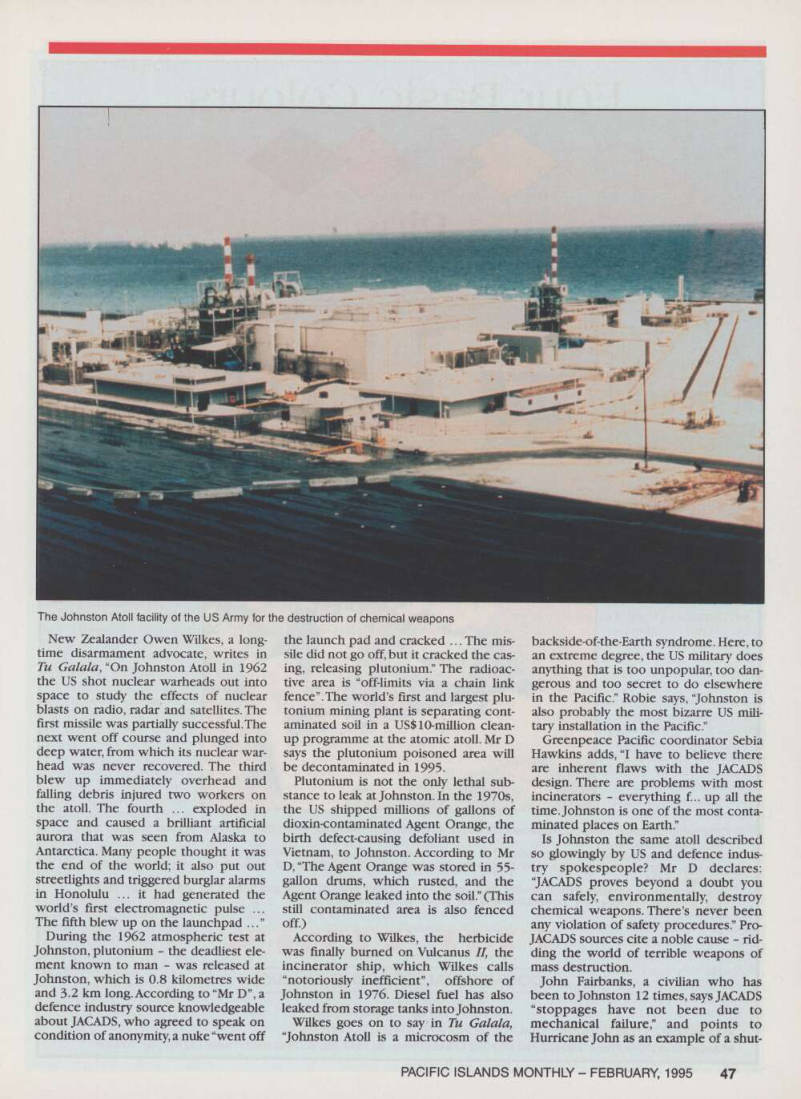
The Johnston Atoll facility of the US Army for the destruction of chemical weapons
down not owing to operational prob lems with the installation. Fairbanks adds, “There have been glitches all along. We learn from the problems.”
EPA’s Larry Bowerman states: “In gen eral, JACADS does a pretty good job. Trial burns are better than safety require ments. JACADs has a conservative atti tude regarding safety.”
Pro-JACADS forces assert the safety of the chemical incineration plant.
Following Hurricane John, a US Army Public Affairs Office press release announcing the end of the emergency said: “The dining facility was one of the most severely damaged buildings, and will require about a month to repair ...
The dining facility was damaged when the roof cover was stripped away and the interior ceiling collapsed into the dining area. The other critical casualty was the salt water pumping station which supplies water for fire fighting, flushing toilets and cooling of the Joint Operations Centre and the JACADS plant. A wall exposed to the lagoon was torn away and the electrical system was contaminated with salt water.”
The same Army press release makes a point of stating, “During the storm, the island infrastructure experienced dam age to buildings and facilities but the plant and the storage areas were undam aged. There was no leak of chemical agents.” According to the news releases, safety procedures were followed: “The JACADS plant was destroying chemical rockets containing nerve agent GB prior to the approach of Hurricane John. The
plant ceased operations, the agent in the plant was incinerated, lines and tanks were purged of agent residues and unprocessed rockets were returned to the igloo ammunition storage bunkers.”
Mr D contends JACADS is composed of “concrete reinforced with steel. There was no JACADS damage. Not a wind in the world could hurt the incineration plant.”
Safety again is stressed in a November 20,1994 press release on the explosion (which it describes as “a low order det onation”): “The detonation occurred within the explosive and agent contain ment room which is designed to sustain explosive pressures and to contain the agent within the facility. There was dam age to the shearing machine. The rocket had previously been drained of chemi cal agent. There were no injuries, nor escape of chemical agent from the plant. The plant is designed so that no workers are within the destruction area.
The process of rocket demilitarisation is mechanically controlled with video visual monitoring.”
The safety issue is bolstered in anoth er press release by Marilyn Tischbin, Public Affairs Chief of the US Army Chemical Stockpile Disposal Program at the Aberdeen Proving Ground, Maryland, which announced, “Chemical rocket processing resumed today at Johnston Island following a detonation that damaged equipment in one of the two Explosive Containment Rooms ...
Damage was limited to the immediate area and agent operations have contin
ued in the rest of the facility, including the liquid incinerator. The Dunnage Incinerator has also been operating ...
The Johnston Island facility was designed to handle explosive materials and contain chemical agents ...”
But separately interviewed, pro- JACADS sources don’t always see eye-to eye.As for release of a nerve agent from the smokestack, Mr D proclaims: “This is
technically impossible. Nerve agent
can’t be released from a smokestack. I’m positive.” On the other hand, army spokesman Fairbanks says: “There was a stack emission of a recordable amount.
The smokestack is scrubbed out, and goes through a liquid scrubber system ... It did register positive for 18 sec onds.” Fairbanks adds the episode did “not cause a shutdown, but (the system) was not operating at the time because it was switching from one munition to another and refiguring the system.” EPA confirms nerve agent release through a stack, adding it caused a shutdown for more than three months.
Mr D, Fairbanks, and EPA also disagree on fires at JACADS, (in particular after the November 19 explosion. Mr D insists, “I’m 100 percent sure there was not another fire.” But Fairbanks says there was, “minor dripping of hydraulic fluid on a hot incinerator. They let it burn off, then started up.” EPA confirms a fire took place December 24, 1994, shutting JACADS down for two days.
There is also disagreement on the ben efits of locating JACADS at Johnston. Mr D says, “Johnston is the ideal place to
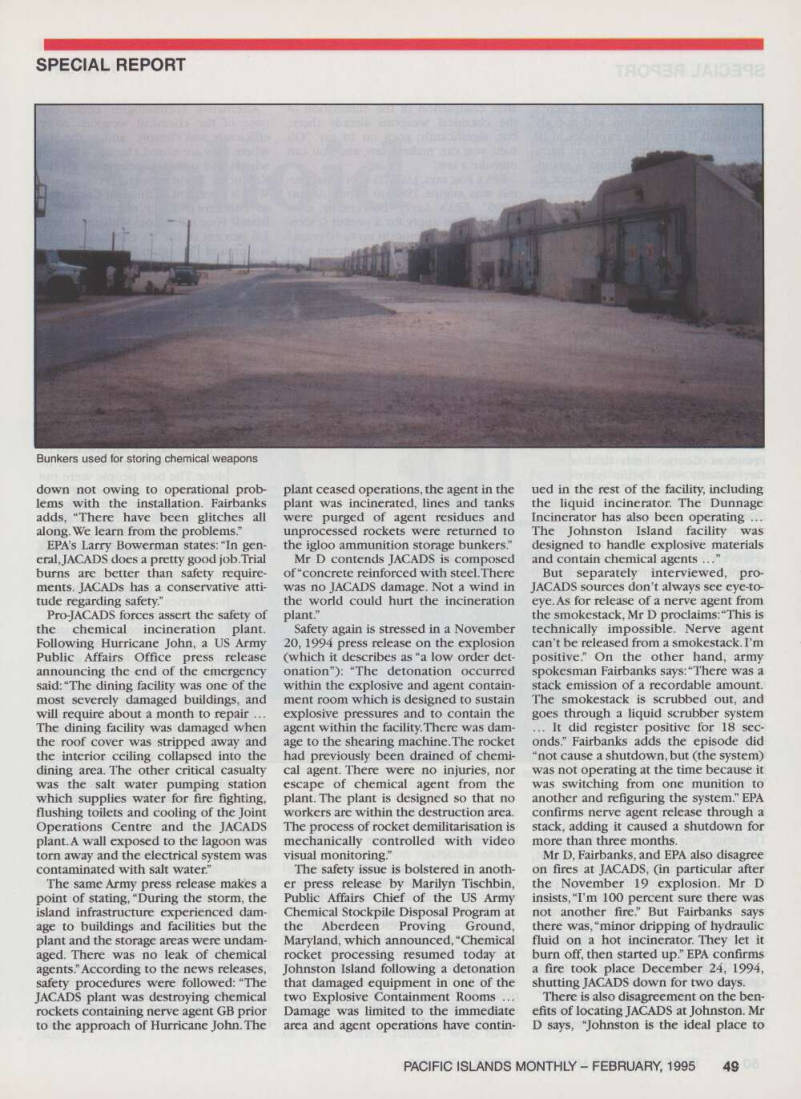
Bunkers used for storing chemical weapons
incinerate chemical weapons. There’s no indigenous population, and nobody downwind. If everything explodes, in 10 miles it will dissipate. There’s no harm to any personnel downrange - grand mothers, couples are safe, and not in risk.”
Fairbanks differs: “The location is far from ideal. JACADS is extremely costly.
It’s in a hostile, salt-laden atmosphere.
The plant will be ready to come down
due to corrosion ... You have to ship in fuel, pay excess money to workers (who are shipped in and, by the way, forbidden to unionise), pay for a desalinisation plant and power plant. It’s very expensive to operate.”
The defence industry, Army, and EPA spokesmen also disagree on when - and if - JACADS will shut down. JACADS is now mandated to cease operations once the munitions Already stored there are incinerated. When US President George Bush held a rare summit with Pacific repre sentatives on October 27,1990 in Honolulu, he “assured the leaders that we plan to dispose of only the chemical munitions ... found in the Pacific islands and those relatively small quantities shipped from Germany ...We have no plans to use Johnston Atoll for any other chemical munitions purposes.”
While Fairbanks raised the pos sibility that JACADS might contin ue operation as far into the future as 2010, he said, “but as stated now, (no additional chemical weapons) from the mainland” will be shipped and incinerated there. “The plant will be disas sembled and Johnston will revert to a bird sanctuary,” under the jurisdiction of the US Fish and Wildlife Service.
But Mr D is more bullish on
JACADS and its possible future. “The shutdown date was never reasonable.
The army was under pressure, due to the treaty that (ex-USSR President Mikhail) Gorbachev signed with President Bush”, banning further pro duction of chemical weapons and creat ing a timetable for eliminating most existing arsenals by the beginning of the 21st century. “JACADS won’t make the date. It’s too far behind.”
Mr D adds, “It’s ideal for all nerve agents to go to Johnston to be incinerat ed. It makes most sense to continue” operation of JACADS. Mr D confirms JACADS is mandated to be dismantled
after completion of the elimination of the chemical weapons already there, but, significantly, goes on to say: “Oh sure, you can make a law, and you can unmake a law.”
EPA’s Fox says, JACADS’s “original per mit was August 1985 to expire August 1995”. EPA’s Larry Bowerman says, JACADS “can apply for a permit (exten sion) from a few months up to 10 years.”
Bowerman adds JACADS’s concern with
safety is “why it has been slower than originally planned ... Various opera tional problems and time to fix them” add to the delay.
According to Craig Williams of the Chemical Weapons Working Group, which has members in the US, Russia and the Pacific, the big picture is about “money, vested interests, like Raytheon (the defence contractor at JACADS).
Defence contractors are gauging the taxpayers. With the end of the Cold War, suddenly they’re environmental dis posers. It’s the same people, with a con tinuing relationship with the military.
It’s a revolving door.”
Alternative technologies could dis pose of the chemical weapons more efficiently and cheaply and at the site where they are stored, charges Williams, who is also national spokesman for the Kentucky Environmental Foundation, Why is a resident of this East Coast state so concerned about distant Johnston Island? Four miles from Williams’ home, 1.6 percent of the US chemical arsenal is stored at Lexington in Kentucky, one
of eight states where chemical weapons are stockpiled and pro posed JACADS-like plants may be built in order to burn the weapons there.
Since these states have - unlike Johnston - resident populations, community protests in the 1980 s forced the US govern ment to postpone building untested plants in these states.
Instead, the incineration was relocated to Johnston, which, Williams says, is supposed to be a “showcase to prove it can be done. The best people were put on it. JACADS is supposed to be the crown jewel demonstrating the viability” of the incineration of chemical agents.
Williams points out that if JACADS proved to be successful, not only would eight other incineration plants then be built in America, but plants could also be built in Russia.
Thus defence contractors stand to make billions - if JACADS is a success - which may explain why so much is riding on the facility, information is so limited and the operation so secretive.
A second plant is being pre pared at Tooele, Utah, where 42.3 percent of US chemical weapons stock is stored.
Williams asserts Tooele is trou bled and has been the subject of many media exposes, adding “If
you think Tooele is bad, JACADS must be a nightmare. At least there’s some over sight at Tooele - at JACADS, only JACADS is doing it. God knows what’s happen ing.”
Williams and Mr D agree on one point: 100 workers are at Johnston for repair purposes.
Johnston Atoll Chemical Agent Disposal System opponents are, as of this writing, considering formally requesting major investigations of JACADS by independent sources, the Department of Defence’s Inspector General, and/or the Army’s Inspector General. ■
Chemical warheads at Johnston Atoll