peril
Headlines
Papua New Guinea
Pope
for
peace
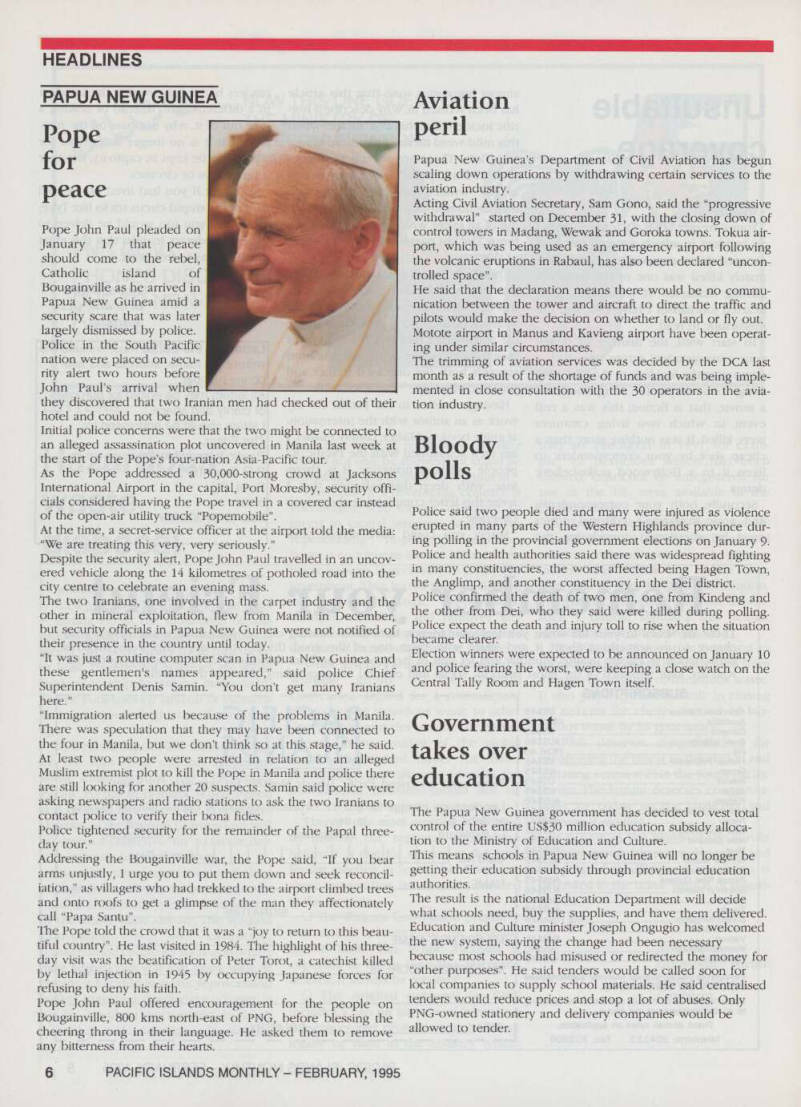
Pope John Paul pleaded on January 17 that peace should come to the rebel, Catholic island of Bougainville as he arrived in Papua New Guinea amid a security scare that was later
largely dismissed by police.
Police in the South Pacific nation were placed on secu rity alert two hours before John Paul’s arrival when
they discovered that two Iranian men had checked out of their hotel and could not be found.
Initial police concerns were that the two might be connected to an alleged assassination plot uncovered in Manila last week at the start of the Pope’s four-nation Asia-Pacific tour.
As the Pope addressed a 30,000-strong crowd at Jacksons International Airport in the capital, Port Moresby, security offi cials considered having the Pope travel in a covered car instead of the open-air utility truck “Popemobile”.
At the time, a secret-service officer at the airport told the media: “We are treating this very, very seriously.”
Despite the security alert, Pope John Paul travelled in an uncov ered vehicle along the 14 kilometres of potholed road into the city centre to celebrate an evening mass.
The two Iranians, one involved in the carpet industry and the other in mineral exploitation, flew from Manila in December, but security officials in Papua New Guinea were not notified of their presence in the country until today.
“It was just a routine computer scan in Papua New Guinea and these gentlemen's names appeared,” said police Chief Superintendent Denis Samin. “You don’t get many Iranians here.”
“Immigration alerted us because of the problems in Manila.
There was speculation that they may have been connected to the four in Manila, but we don’t think so at this stage,” he said.
At least two people were arrested in relation to an alleged Muslim extremist plot to kill the Pope in Manila and police there are still looking for another 20 suspects. Samin said police were asking newspapers and radio stations to ask the two Iranians to contact police to verify their bona fides.
Police tightened security for the remainder of the Papal three day tour.”
Addressing the Bougainville war, the Pope said, “If you bear arms unjustly, I urge you to put them down and seek reconcil iation,” as villagers who had trekked to the airport climbed trees and onto roofs to get a glimpse of the man they affectionately call “Papa Santu”.
The Pope told the crowd that it was a “joy to return to this beau tiful country”. He last visited in 1984. The highlight of his three day visit was the beatification of Peter Torot, a catechist killed by lethal injection in 1945 by occupying Japanese forces for refusing to deny his faith.
Pope John Paul offered encouragement for the people on Bougainville, 800 kms north-east of PNG, before blessing the cheering throng in their language. He asked them to remove any bitterness from their hearts.
Aviation
peril
Papua New Guinea’s Department of Civil Aviation has begun scaling down operations by withdrawing certain services to the
aviation industry.
Acting Civil Aviation Secretary, Sam Gono, said the “progressive withdrawal” started on December 31, with the closing down of control towers in Madang, Wewak and Goroka towns. Tokua air port, which was being used as an emergency airport following the volcanic eruptions in Rabaul, has also been declared “uncon trolled space”.
He said that the declaration means there would be no commu nication between the tower and aircraft to direct the traffic and pilots would make the decision on whether to land or fly out.
Motote airport in Manus and Kavieng airport have been operat ing under similar circumstances.
The trimming of aviation services was decided by the DCA last month as a result of the shortage of funds and was being imple mented in close consultation with the 30 operators in the avia
tion industry.
Bloody
polls
Police said two people died and many were injured as violence erupted in many parts of the Western Highlands province dur ing polling in the provincial government elections on January 9.
Police and health authorities said there was widespread fighting in many constituencies, the worst affected being Hagen Town, the Anglimp, and another constituency in the Dei district.
Police confirmed the death of two men, one from Kindeng and the other from Dei, who they said were killed during polling.
Police expect the death and injury toll to rise when the situation became clearer.
Election winners were expected to be announced on January 10 and police fearing the worst, were keeping a close watch on the Central Tally Room and Hagen Town itself.
Government
takes over
education
The Papua New Guinea government has decided to vest total control of the entire US$3O million education subsidy alloca tion to the Ministry of Education and Culture.
This means schools in Papua New Guinea will no longer be getting their education subsidy through provincial education authorities.
The result is the national Education Department will decide what schools need, buy the supplies, and have them delivered.
Education and Culture minister Joseph Ongugio has welcomed the new system, saying the change had been necessary because most schools had misused or redirected the money for “other purposes”. He said tenders would be called soon for local companies to supply school materials. He said centralised tenders would reduce prices and stop a lot of abuses. Only PNG-owned stationery and delivery companies would be allowed to tender.