New Year's Dreaming
pp. 56-57 · Read in the full issue
Yachting
By Sally Andrew
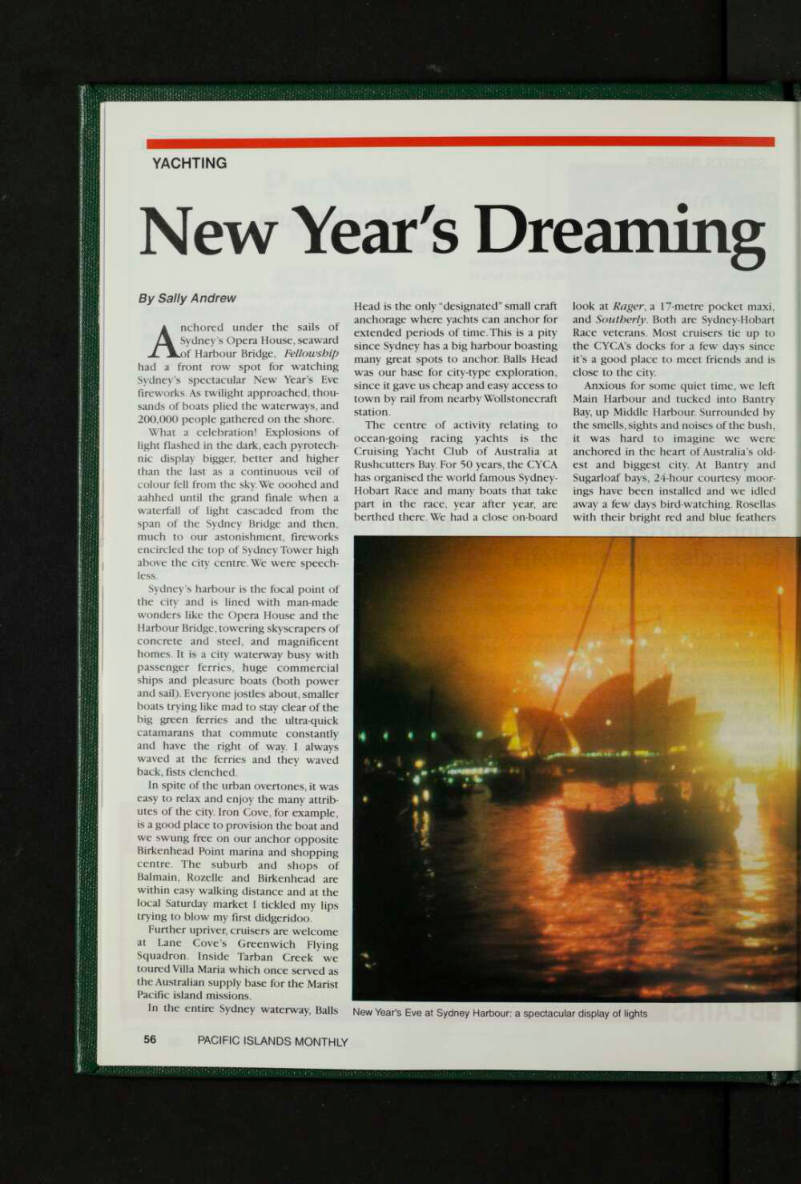
Anchored under the sails of Sydney’s Opera House, seaward of Harbour Bridge, Fellowship had a front row spot for watching Sydney’s spectacular New Year’s Eve fireworks. As twilight approached, thou sands of boats plied the waterways, and 200,000 people gathered on the shore.
What a celebration! Explosions of light flashed in the dark, each pyrotech nic display bigger, better and higher than the last as a continuous veil of colour fell from the sky. We ooohed and aahhed until the grand finale when a waterfall of light cascaded from the span of the Sydney Bridge and then, much to our astonishment, fireworks encircled the top of Sydney Tower high above the city centre. We were speech less.
Sydney’s harbour is the focal point of the city and is lined with man-made wonders like the Opera House and the Harbour Bridge, towering skyscrapers of concrete and steel, and magnificent homes. It is a city waterway busy with passenger ferries, huge commercial ships and pleasure boats (both power and sail). Everyone jostles about, smaller boats trying like mad to stay clear of the big green ferries and the ultra-quick catamarans that commute constantly and have the right of way. I always waved at the ferries and they waved back, fists clenched.
In spite of the urban overtones, it was easy to relax and enjoy the many attrib utes of the city. Iron Cove, for example, is a good place to provision the boat and we swung free on our anchor opposite Birkenhead Point marina and shopping centre. The suburb and shops of Balmain, Rozelle and Birkenhead are within easy walking distance and at the local Saturday market I tickled my lips trying to blow my first didgeridoo.
Further upriver, cruisers are welcome at Lane Cove’s Greenwich Flying Squadron. Inside Tarban Creek we toured Villa Maria which once served as the Australian supply base for the Marist Pacific island missions.
In the entire Sydney waterway, Balls
Head is the only “designated” small craft anchorage where yachts can anchor for extended periods of time. This is a pity since Sydney has a big harbour boasting many great spots to anchor. Balls Head was our base for city-type exploration, since it gave us cheap and easy access to town by rail from nearby Wollstonecraft station.
The centre of activity relating to ocean-going racing yachts is the Cruising Yacht Club of Australia at Rushcutters Bay. For 50 years, the CYCA has organised the world famous Sydney- Hobart Race and many boats that take part in the race, year after year, are berthed there. We had a close on-board
look at Rager, a 17-metre pocket maxi, and Southerly. Both are Sydney-Hobart Race veterans. Most cruisers tie up to the CYCA’s docks for a few days since it’s a good place to meet friends and is close to the city.
Anxious for some quiet time, we left Main Harbour and tucked into Bantry Bay, up Middle Harbour. Surrounded by the smells, sights and noises of the bush, it was hard to imagine we were anchored in the heart of Australia’s old est and biggest city. At Bantry and Sugarloaf bays, 24-hour courtesy moor ings have been installed and we idled away a few days bird-watching. Rosellas with their bright red and blue feathers
New Year’s Eve at Sydney Harbour: a spectacular display of lights
welcomed us with their “kweek-kweek” as they dashed amongst the branches of nearby eucalyptus.
The most hospitable marina in Sydney is Cammeray Marina, Middle Harbour, where overseas cruisers get heaps of attention and assistance from the owners and staff. Thousands of native birds make their home in the neighbouring bush and when the cock atoos hung upside-down in our neigh bour’s rigging, the kookaburras laughed like demented children.
When we left Sydney Harbour, we headed for the northern suburb of Manly where neon lights and a ferris wheel lend a carnival atmosphere to the waterfront. Manly is a peninsula with Sydney harbour on one side and the open ocean on the the other. Sixteen beaches, inlets and coves satisfy all swimming, surfing and sunning require ments. Store Beach, inaccessible by land, is a quiet little cove popular with Sydney boaters because of its sandy beach and expanse of parkland.
Forty Basket Beach and Sydney Harbour National Park are a stone’s throw from Manly. Several trails lead around Dobroyd Head and we walked from Forty Basket Beach to Sandy Bay via the lighthouse at Grotto Point. There are side trails and several scenic view points along the way, most of them peaceful. But at the Crater Cove over look, remote control model aircraft zoomed back and forth overhead while colourful kites drifted in the upper air space.
Here in North Harbour we met Australian adventurers Don and Margie Mclntyre. Don and Margie’s big dream for 1995 is to sail their 18-metre yacht Spirit of Sydney to Cape Denison, Antarctica, where they will erect a small prefabricated high-tech hut to live in over the long dark winter - raising money for charity and pursuing scientif
ic projects. Cape Denison is the coldest, windiest place on earth and the site of Australian explorer Sir Douglas Mawson’s historic hut, 2360 kilometres south of Hobart,Tasmania.
Via Inmarsat Satellite Communications, Don and Margie will be involved in a major educational pro gramme with 10,000 Australian schools.
The major theme presented to students will be “Caring for our Environment and Antarctica, the Last Great Wilderness, and Australia’s Historical and Current Involvement in it”. The school project will give kids an appreciation of facili ties normally take for granted - electric ity, transportation, fresh water, even toi lets - since “Expedition Ice Bound” must be entirely self-sufficient and has a nil environmental impact policy. For Don and Margie, living in Antarctica will be a dream come true. ■
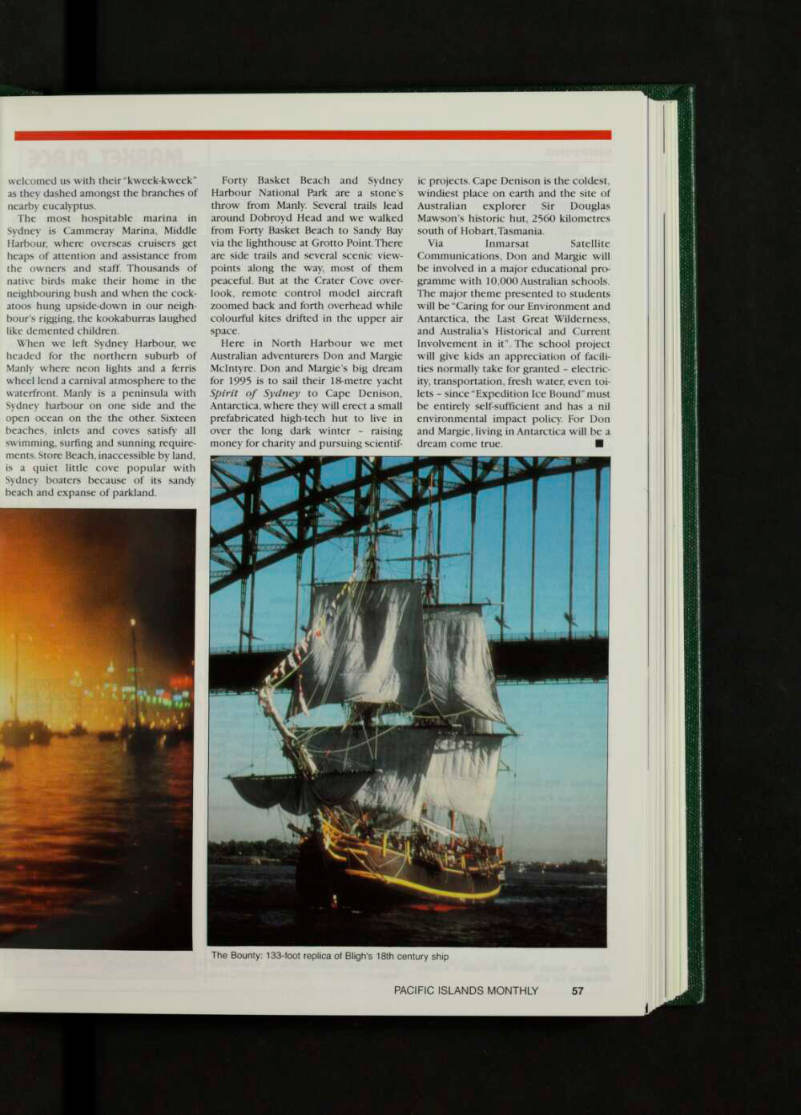
The Bounty: 133-foot replica of Bligh’s 18th century ship