provincial
pp. 26-27 · Read in the full issue
Vanuatu
Upset in provincial elections
November’s Provincial Elections have brought in a new balance of power in Vanuatu. The ruling Union of Moderate Parties, which had introduced a new vot ing system designed to give them a decisive edge, was
bitterly disappointed
By Patrick Decloitre
It was the first time Vanuatu had to choose the members of its six provin cial councils after the Decentralisation Act was passed in Parliament last May.
The act was designed to replace the former system of eleven local govern ment councils. In August, the new names of the six provinces were off.cially announced and one month later, , 7 the eleven existing councils were abol t & ished - paving the way for the six new y & 7 provinces.
Not only was the provincial system new, but the voting system was new too. It allowed candidates with the most votes to automatically obtain 30 , 7 percent of the seats in a provincial F council. The scheme was to have given ... s a decisive advantage to a majority a J 7 party, m much more radical ways than . . 7 any other voting system.
Obviously, this system could only , 7 7 benefit a party with a strong base. rru c & Therefore, People’s Democratic Party, .. „ • ... 7 the small junior coalition partner of rrwn UMP (four seats m parliament, three n „-.. x . . , government portfolios), led by deputy d • . . c . K 7 Prime Minister Sethy Regenvanu, even . , . tually gave up contesting the elections.
DnD * , PDP had first tried to contest the elec-
Tttkata . • , „
tions jointly with UMP, which, sure of 0 „ n - „ , getting more than enough votes, . , . . cr . tyrned down the offer. PDP then made
approaches to the Opposition, but no agreement was reached.
Qn tht other side the Opposition had formed a « Unity Front -, consisting of Donald Kalpokas . s yanuaaku Pali, Barak Sope , s Melanesian Progressive Party vincem Boulekone . s Xan Union and Hranky Stevens . Nagriamell (although Stevens is leader of govern . mem business Parliament) xhis e , grouping of opposition parties proved . . , , , . . u to be a workable response to the new .. . „ T<r , , . , voting system. If we had tried to con test individually, we would not have had a chancc of getting through . Barak s told a ess conference in October D T - • > XT . TT • ™ But Walter Lim s National Unity Party , was confident enough to contest the . . , , . provincial elections on its own. . XT , On election day, November 15, tropi , , v . .. f t cal cyclone Vania, the first of the season . ... m the region, disrupted voting, espe ... - u . , ’ c cially m the northern islands of w U T - , . , .
Vanuatu. In these parts of the island + ,,/ , . . r state, voting had to be extended for . . another day.
Tt I
Unity Front spokesman Peter , \ Taurakoto also complained of what he . saw as irregularities, like the allegation ~,. „ , ® of roadblocks on northern Santo . , . , island, during which a truck was
. . , , Itxm
stopped by local UMP supporters and . ~\, , ballot boxes opened,
Taurakoto also expressed concern at the fact that ni-Vanuatu residents in New Caledonia had the opportunity to vote at the Noumea polling station, the only one overseas. “If people can vote in Noumea, then our nationals should be able to vote in other countries where we have a significant communi ty, like Fiji or Australia,”Taurakoto said.
He also complained that some Opposition supporters living in Noumea went to the Vanuatu consulate to obtain information on voting dates, but were not given accurate answers.
Nine days after the vote (a delay owed, the Electoral Commission said, to the cyclone and some ballot boxes arriving late), official results confirmed what unofficial results had already clearly shown: not only did UMP not get the number of provinces it had
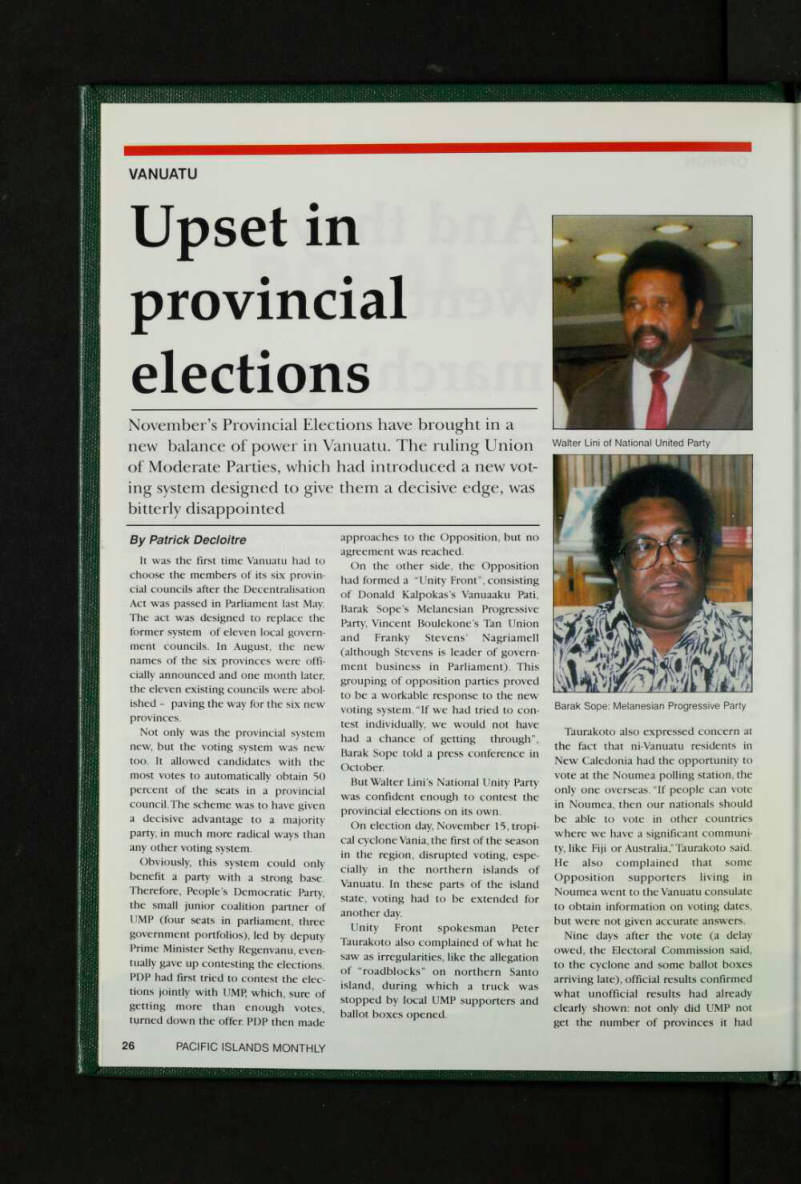
Walter Uni of National United Party
Barak Sope: Melanesian Progressive Party
expected (three - some leaders even said four out of six), but they were close to defeat. In southern Tafea, they had a tie with Unity Front with exactly the same number of votes (4139) each. They only got control of this province through an “age difference” clause in the voting system, which gives priority to the list of candidates with the larger age average. Even in Malampa, UMP’s advantage over Unity Front is only 76.
As for the other two lists (Unity Front National United Front party), they got two provinces each.
The Unity Front group had reason to be disappointed, as it just missed a clear victory. Lini’s NUP results lived up to its expectations and are considered good, since the party is just over three years old. The party owes much of its success to the personal charisma of the ex- Prime Minister.
The Decentralisation Act voting sys tem, which was originally designed to provide a solid majority in the provinces to ruling UMP, turned out to be double edged and casts a shadow over next year’s general elections results, as well. ■
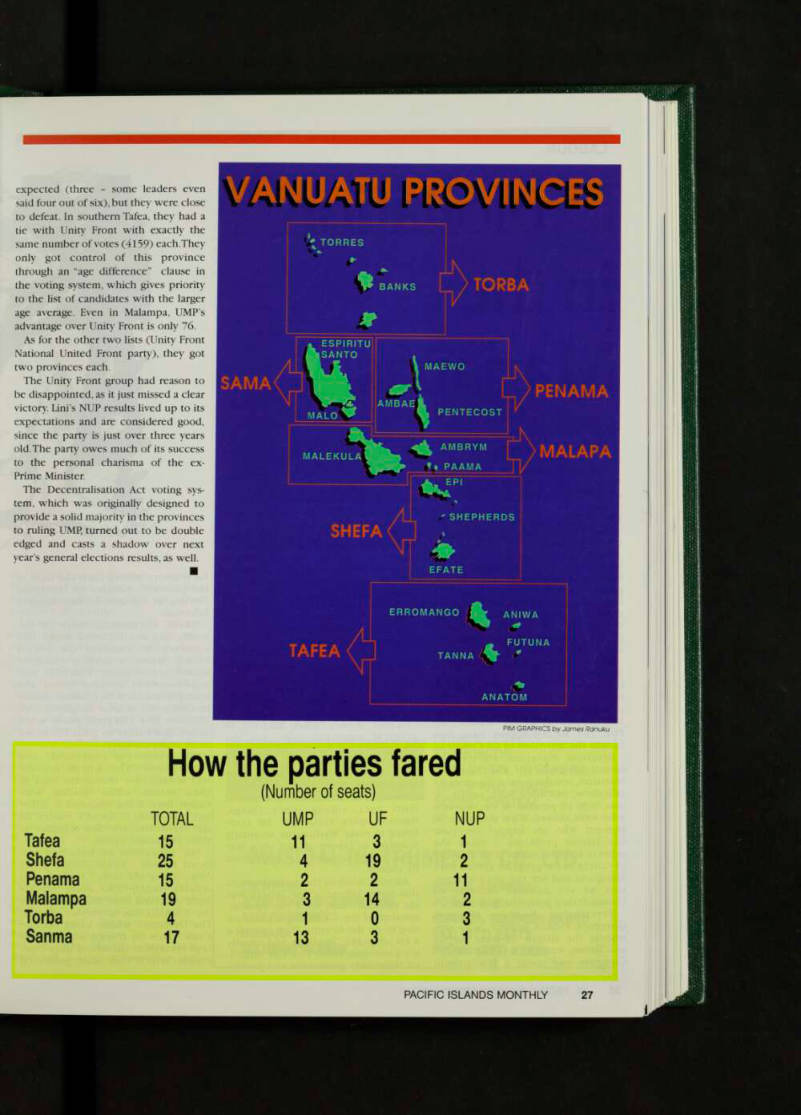
PIM GRAPHICS by James Ranuku
How the parties fared
(Number of seats)
Total
Ump
UF
Nup
Tafea 15 11 3 1 Shefa 25 4 19 2 Panama 15 2 2 11
Maiampa
19 3 14 2 Torba 4 1 0 3 Sanma 17 13 3 1