McKinnon's view of
pp. 22-23 · Read in the full issue
The Region
McKinnon's view of the Pacific
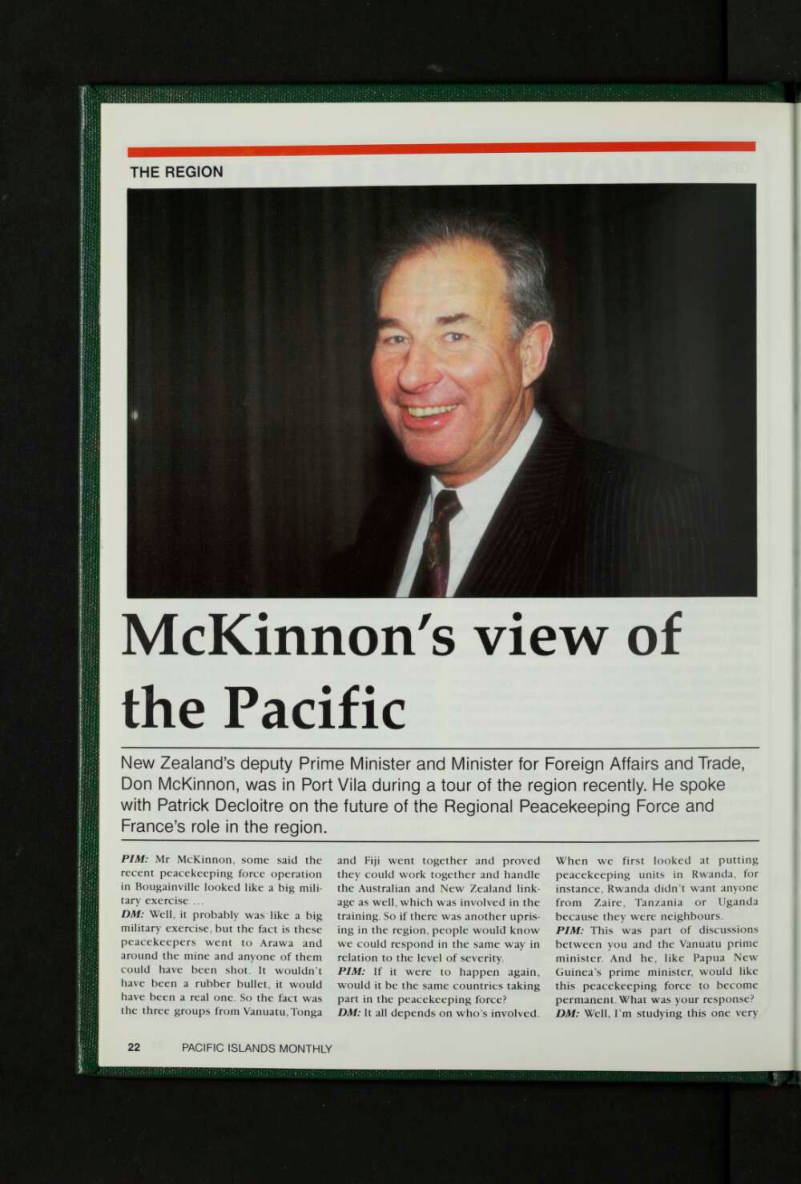
New Zealand’s deputy Prime Minister and Minister for Foreign Affairs and Trade, Don McKinnon, was in Port Vila during a tour of the region recently. He spoke with Patrick Decloitre on the future of the Regional Peacekeeping Force and France’s role in the region.
PIM: Mr McKinnon, some said the recent peacekeeping force operation in Bougainville looked like a big mili tary exercise ...
DM: Well, it probably was like a big military exercise, but the fact is these peacekeepers went to Arawa and around the mine and anyone of them could have been shot. It wouldn’t have been a rubber bullet, it would have been a real one. So the fact was the three groups from Vanuatu, Tonga
and Fiji went together and proved they could work together and handle the Australian and New Zealand link age as well, which was involved in the training. So if there was another upris ing in the region, people would know we could respond in the same way in relation to the level of severity.
PIM: If it were to happen again, would it be the same countries taking part in the peacekeeping force?
DM: It all depends on who’s involved.
When we first looked at putting peacekeeping units in Rwanda, for instance, Rwanda didn’t want anyone from Zaire, Tanzania or Uganda because they were neighbours.
PIM: This was part of discussions between you and the Vanuatu prime minister. And he, like Papua New Guinea’s prime minister, would like this peacekeeping force to become permanent. What was your response?
DM: Well, I’m studying this one very
carefully because I’m aware that Sir Julius (PNG prime minister) and Maxime Carlot have interest in this. I probably don’t see it with the same level of necessity. And I guess I’m probably saying that because I know that we can do it in an ad hoc way quite successfully. If anything hap pens, we know we can put this group together. All these forces are at the same time exercising among them selves from time to time, and with the Australians. So there’s a regular kind of involvement of forces. They don’t come together as aliens at all. As long as that can happen, I don’t see the need for a permanent force.
PIM: What about disaster relief oper ations, as they suggest?
DM: The second factor is the question of disaster relief; in many ways, it’s a similar response. Three years ago when I was in the region here, I was following a cyclone. And I was horri fied to find there was an Australian air craft travelling north to an island. Five minutes later, there was a New Zealand aircraft travelling in the same direction. And then I thought: can’t we do a little bit better than this?
Later there was better coordination between the three main players in the region - Australia, New Zealand and France.
My officials had told me France would not come into this. I told them to try.
You see, we must engage France in the region, France belongs in the Pacific.
We must continue to engage them because there has been a long period of people throwing rocks at each other over nuclear testing, the Rainbow Warrior ... And I sent this proposal to Mr LePensec (who was then minister for French overseas ter ritories). He replied it was a good idea. So we got together and now the idea when there is a natural disaster in the region is for all three countries’ military officials to meet and organise and coordinate relief operations. It’s just a logistical and administrative centre.
With this in place, you don’t need a permanent force, you know. What we could do in the future is call upon small sections of the Vanuatu,Tonga or Fiji forces for these sorts of things. We, on our part, have the aircraft to pick
‘France sees itself as a permanent
player here.
Why do we try and kid ourselves that France is a colonial power that is just
drawing back?’
- Don McKinnon
people up as we did with the Vanuatu forces recently to carry them to Bougainville.
PIM: Also a permanent force would be expensive.
DM: Yes, that’s a fact.
PIM: New Zealand is now a member of the United Nations Security Council. Do you see your country as a voice for the region?
DM: Very much so, and I made the point when campaigning for the posi tion, saying we wanted to be speaking for the region. I told the countries of the region that we wanted their sup port, but we would always come back to them if they wanted to raise an issue. For instance, global warming is going to affect us all.
PIM: What about France’s role in the Pacific? Things seem to have changed in the past few years in terms of its image.
DM: I must admit I got a bit of a shock about 10 years ago. I was in French Polynesia and I met the French gov ernment’s delegate then. I asked him what France’s role in the Pacific would be in 20 years. His response was “This is France.” Then I realised
that France sees itself as a permanent player here. So why do we try and kid ourselves that France is a colonial power that is just drawing back?
When I became minister I decided to start some positive dialogue with France. They’re a big player, they’re spread from New Caledonia, Wallis and Futuna, French Polynesia, right across the Pacific. Let’s be a little bit more welcoming and positive.
PIM: Why did that change all of a sud den?
DM: You see the government that pre ceded me had the battle over nuclear testing and the Rainbow Warrior.
Let’s get it behind us. Rocard came to New Zealand in 1991. It was excel lent. It was a turning point. We smoothed out a lot of things and then I was able to get my disaster relief thing off the ground. I had a special visit to New Caledonia and we got trade agreements going. With LePensec, and his successor Dominique Perben, we have good relationships. I had discussions with my French counterpart, Alain Juppe, in New York a month ago. We want them to be players in the region.
PIM: On the same level?
DM: It’s entirely up to them. We’re not going to say “you shouldn’t be here”, we re saying “you’re here. Right. There are things we can work together on”.
PIM: But the uncertainty over the resumption of French nuclear testing is still there.
DM: It’s there, but I’m not going to let that bother me at the present time.
We’ve got enough things to worry about with what’s happening today, without worrying too much about what may happen tomorrow. I’ve made very strong comments because France did have one or two tests after we were engaging with them in a pos itive way. I’m very pleased that Mitterrand has said “no more”, but what happens after the end of May (French presidential elections)? But it’s not a big deal. I’m not going to let that issue dominate other issues.
PIM: What if France began testing again?
DM: If France started testing again, it would have the capacity to destabilise the relationship with New Zealand. ■