The storm of 1994
pp. 56-57 · Read in the full issue
Yachting
By Sally Andrew
May mornings in New Zealand, crisp with the promise of win ter in the air, inspire dreams of the South Pacific. Nowhere is this more apparent than at Gulf Harbour, where activities reach a fevered pitch. The annu al Island Cruising Regatta to Tonga leaves at the end of May and crew are busy putting stores aboard, attending safety seminars and gearing up for offshore pas sages.
Not only regatta boats but “indepen dent” cruisers, migrating back to the South Pacific after a cyclone season south of the danger zone, are ready to leave. Strong westerlies produced a sloppy 12-foot beam sea but Saturday, when the wind finally shifted southwest, about 50 boats took off in what promised to be improv ing weather conditions.
Regatta Winner Heart of God (San Francisco), a very fast Schumacher 50, delighted in the windy conditions and cranked off the first 830 miles in four days.
As Jim and Sue Corenman observed, “It ultimately saved our butts”. Len and Merline aboard Gallant Cavalier were the only other regatta participants to cross the finish line of the meteorological “bomb”.
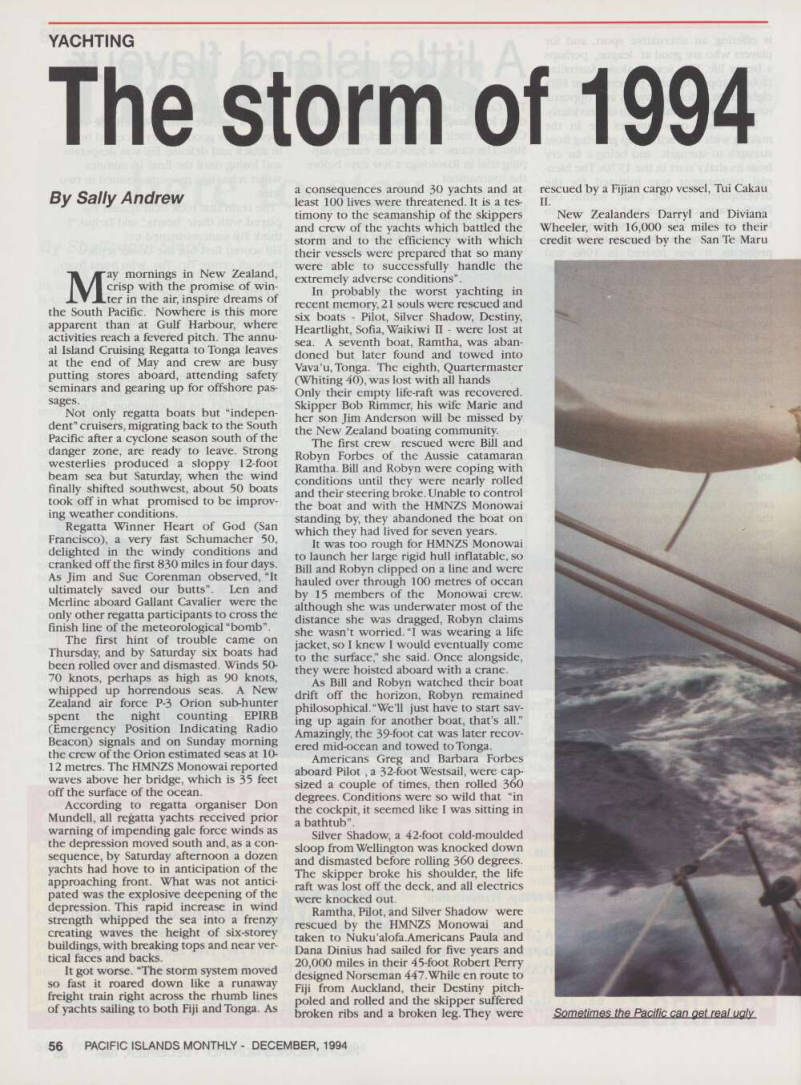
The first hint of trouble came on Thursday, and by Saturday six boats had been rolled over and dismasted. Winds 50- 70 knots, perhaps as high as 90 knots, whipped up horrendous seas. A New Zealand air force P-3 Orion sub-hunter spent the night counting EPIRB (Emergency Position Indicating Radio Beacon) signals and on Sunday morning the crew of the Orion estimated seas at 10- 12 metres. The HMNZS Monowai reported waves above her bridge, which is 35 feet off the surface of the ocean.
According to regatta organiser Don Mundell, all regatta yachts received prior warning of impending gale force winds as the depression moved south and, as a con sequence, by Saturday afternoon a dozen yachts had hove to in anticipation of the approaching front. What was not antici pated was the explosive deepening of the depression. This rapid increase in wind strength whipped the sea into a frenzy creating waves the height of six-storey buildings, with breaking tops and near ver tical faces and backs.
It got worse. “The storm system moved so fast it roared down like a runaway freight train right across the rhumb lines of yachts sailing to both Fiji and Tonga. As
a consequences around 30 yachts and at least 100 lives were threatened. It is a tes timony to the seamanship of the skippers and crew of the yachts which battled the storm and to the efficiency with which their vessels were prepared that so many were able to successfully handle the extremely adverse conditions”.
In probably the worst yachting in recent memory, 21 souls were rescued and six boats - Pilot, Silver Shadow, Destiny, Heartlight, Sofia, Waikiwi II - were lost at sea. A seventh boat, Ramtha, was aban doned but later found and towed into Vava’u, Tonga. The eighth, Quartermaster (Whiting 40), was lost with all hands Only their empty life-raft was recovered.
Skipper Bob Rimmer, his wife Marie and her son Jim Anderson will be missed by the New Zealand boating community.
The first crew rescued were Bill and Robyn Forbes of the Aussie catamaran Ramtha. Bill and Robyn were coping with conditions until they were nearly rolled and their steering broke. Unable to control the boat and with the HMNZS Monowai standing by, they abandoned the boat on which they had lived for seven years.
It was too rough for HMNZS Monowai to launch her large rigid hull inflatable, so Bill and Robyn clipped on a line and were hauled over through 100 metres of ocean by 15 members of the Monowai crew, although she was underwater most of the distance she was dragged, Robyn claims she wasn’t worried. “I was wearing a life jacket, so I knew I would eventually come to the surface,” she said. Once alongside, they were hoisted aboard with a crane.
As Bill and Robyn watched their boat drift off the horizon, Robyn remained philosophical.“ We’ll just have to start sav ing up again for another boat, that’s all.”
Amazingly, the 39-foot cat was later recov ered mid-ocean and towed to Tonga.
Americans Greg and Barbara Forbes aboard Pilot , a 32-foot Westsail, were cap sized a couple of times, then rolled 360 degrees. Conditions were so wild that “in the cockpit, it seemed like I was sitting in a bathtub”.
Silver Shadow, a 42-foot cold-moulded sloop from Wellington was knocked down and dismasted before rolling 360 degrees.
The skipper broke his shoulder, the life raft was lost off the deck, and all electrics were knocked out.
Ramtha, Pilot, and Silver Shadow were rescued by the HMNZS Monowai and taken to Nuku’alofa.Americans Paula and Dana Dinius had sailed for five years and 20,000 miles in their 45-foot Robert Perry designed Norseman 447. While en route to Fiji from Auckland, their Destiny pitch poled and rolled and the skipper suffered broken ribs and a broken leg. They were
rescued by a Fijian cargo vessel, Tui Cakau 11.
New Zealanders Darryl and Diviana Wheeler, with 16,000 sea miles to their credit were rescued by the San Te Maru
Sometimes the Pacific can get real ugly
18, a 390-ton New Zealand fishing vessel.
During the rescue, their catamaran Heartlight was smashed and sank. The San Te Maru 18 also recovered the ill-fated Quartermaster’s life raft which, according to Darryl, was “flying down the waves like a balloon”.
Sofia, a 32-foot William Atkin design, was another rollover victim that “came up with the mast gone, just about everything on deck but the life raft gone, the skylight hatch gone”. Aucklander Keith Levy had four years cruising experience and was accompanied by his Swiss girlfriend Ursula Schmidt. They were rescued by the
Jacques Cartier, a 260-foot French naval vessel based in New Caledonia.
Although the worst damage occurred between 28 and 29 degrees south,Waikiwi II (44-foot Les Rolfe design) from Lyttleton, New Zealand, was rolled and dismasted while hove to at 33 degrees south.
Uninjured, the crew were picked up by a
Panama-bound Norwegian cargo ship, Nomadic Duchess. An attempt to tow the vessel failed. Skipper John Hilhorst and his wife Catherine Gilmour were on the first stage of a five-year trip around the world.
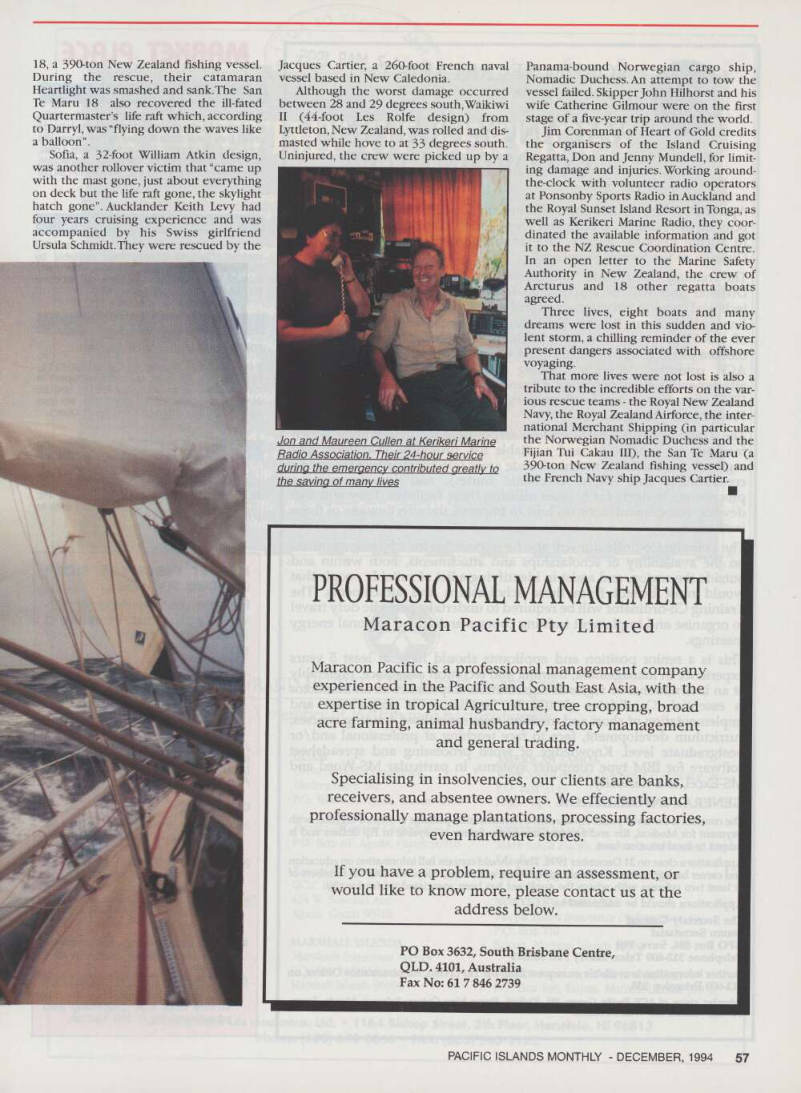
Jim Corenman of Heart of Gold credits the organisers of the Island Cruising Regatta, Don and Jenny Mundell, for limit ing damage and injuries. Working around the-clock with volunteer radio operators at Ponsonby Sports Radio in Auckland and the Royal Sunset Island Resort in Tonga, as well as Kerikeri Marine Radio, they coor dinated the available information and got it to the NZ Rescue Coordination Centre.
In an open letter to the Marine Safety Authority in New Zealand, the crew of Arcturus and 18 other regatta boats agreed.
Three lives, eight boats and many dreams were lost in this sudden and vio lent storm, a chilling reminder of the ever present dangers associated with offshore voyaging.
That more lives were not lost is also a tribute to the incredible efforts on the var ious rescue teams - the Royal New Zealand Navy, the Royal Zealand Airforce, the inter national Merchant Shipping (in particular the Norwegian Nomadic Duchess and the Fijian Tui Cakau III), the San Te Maru (a 390-ton New Zealand fishing vessel) and the French Navy ship Jacques Cartier. ■
Jon and Maureen Cullen at Kerikeri Marine Radio Association. Their 24-hour service during the emergency contributed greatly to the saving of many lives