Justice delayed
p. 29 · Read in the full issue
Opinion
Moari unquestionably lost assets worth hundreds of millions of dollars at the hands of New Zealand's European colonisers.
How are they to be compensated and why?
IF THERE is one problem above all others that has dogged successive New Zealand governments over the years, it is how to settle Maori grievances over loss of their lands to European colonial settlers.
Most New Zealanders recognise that Maori were simply ripped off over a long period of time despite the 1840 Treaty of Waitangi which guaranteed them “full exclusive and undisputed possession of their lands and estates, forests, fisheries and other properties”.
Excessive claims and provocative statements by militants in what has been described as the Maori “grievance” have cost them some sympathy, but majority of pakeha probably still agree that Maori deserve some compensation.
The big questions are: How much?
And how is that compensation to be shared to ensure that all Maori, and their future generations, benefit from it?
Twenty years ago, the then Labour government set up the Waitangi Tribunal to deal with the claims. It did not achieve a great deal, until 10 years later its membership was expanded and its jurisdiction extended to hear claims dat ing back to 1840.
This sparked a rush of claims, swamping the body, which currently has about 400 cases all alleging the Crown has breached its Waitangi treaty obligations to Maori on its books.
Many are huge and complex and it has been clear for some time that if the tri bunal sat 24 hours a day it would take years to get through its work.
It is also clear that many of the claimants are bound to be disappointed not just by the fact that return of, or
compensation for, privately-owned land
is specifically excluded from any deal.
Although Maori unquestionably lost assets worth hundreds of millions of dol lars at the hands of New Zealand’s
European newcomers, public opinion
would not support an overly-extravagant pay-out at a time of increasing demand
for more government funds to be spent on health and education.
Full recompense for all Treaty of
Waitangi claimants is “utterly beyond the
ability of the Crown”, Justice Minister Doug Graham said frankly early this year.
And the longer the process drags on, the bigger the claims will inevitably get, increasing the potential for both Maori dissatisfaction and pakeha resentment.
A resolution has to be found, for as Graham has said: “The grievances are not likely to fade away... they have to be addressed if New Zealand is to enjoy harmonious race relations.
“Ignoring the problem exists creates a time bomb for the next generation.”
Defusing that time bomb is the gov ernment’s challenge and it is clearly not going to be an easy one.
Graham, who has confessed that he personally feels guilty, not so much for the wrongs done to Maori in the past, but for the decades their cries for redress have gone unheeded, has been working on a plan for the past year.
He scheme essentially calls for the government to set aside a so-called “fis cal envelope” containing the total sum of money it is prepared to pay in settlement of all Maori claims. It would also proba bly include a yearly budget, allowing the payouts to be made progressively over about 10 years.
Graham has also been keen to devise a system to put an end to the historical claims. If this is not done, new ones would keep cropping up and the time would tick on for future Maori and pake ha generations.
He initially suggested a cut-off date of June 1996, but later appeared to back off this in the face of objections that it would pressure tribes and also stir up even more pakeha resentment if Maori
began lodging large numbers of claims
(with or without justification) in order to meet the deadline.
It was the same principle the govern ment used in 1992 when it provided $l5O million for Maori to buy 50% of Sealord Products Ltd, the country’s biggest fishing company. It had earlier given Maori quota totaling 10% of the total allowable commercial catch, in all a $239 million payout giving them 37% of the country’s $1.2 billion fishing industry.
Under the deal, Maori renounced all further commercial fisheries claims under the Treaty of Waitangi.
The only problem was it sparked a series of challenges by various tribes and groups who claimed the negotia tors, supposedly representing all Maori, did not, in fact, represent their interests.
The row continued as the Treaty of Waitangi Fisheries Commission set about sharing the assets and quotas among tribes increasingly at each other’s throats.
The government naturally wants to avoid a recurrence of this in its final set tlement of land claims which is why Graham has rejected calls for a pan- Maori solution in favour of his fiscal envelope and individual settlements.
That way, he says, Maori groups will know how much is in the pot and whether the sum they get is fair relative to other claimants. Many Maori oppose the envelope and any suggestion of a cut-off date, and Graham has been bit terly attacked for not consulting them in drafting his proposals.
He says realistically that he does not expect them to agree to whatever the government decides it still has a responsibility to settle the question in the interests of all New Zealanders. Future generations will owe him a debt of grati tude if he can pull it off. ■
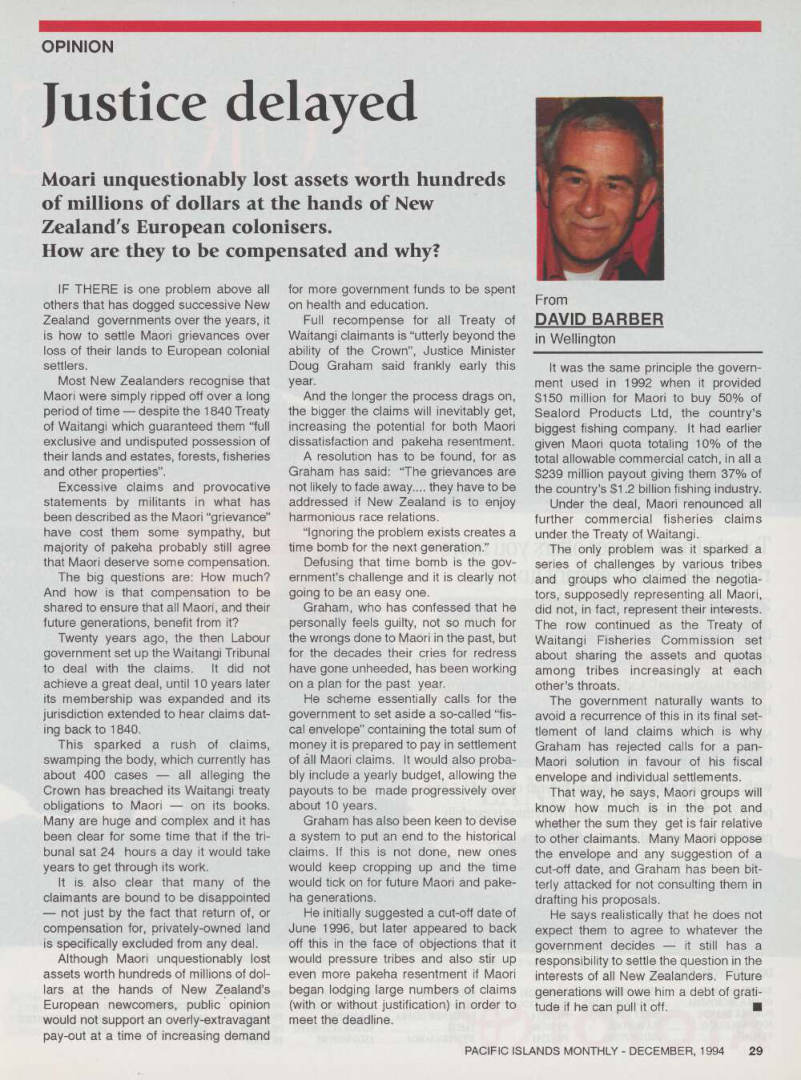
From
David Barber
in Wellington