Mamaloni
pp. 27-28 · Read in the full issue
Solomon Islands
Mamaloni back at the helm
by Patrick Decloitre
Solomon Islands’ constitutional crisis in October ended with the resignation of Francis Billy Hilly and the return of Solomon Mamaloni, after serving just 16 months as Opposition leader.
It began at the end of September, when two ministers from Hilly’s gov ernment resigned. They were Youth and Sports minister Alfred Maetia and Agriculture minister Edmund Andresen.
The following week, on October 4, Provincial Government minister Oliver Zapo and Education minister John Musuota made the same move.
Five ministers had left the Hilly Cabinet in less than two weeks, placing his government, which came into power in June, 1993, in a minority posi tion with only 17 of the 47-seat parlia ment on his side.
At the same time, the Opposition had regrouped its forces into a so-called National Unity and Reconciliation Progressive Party (NURPP), claiming the support of 25 members of parliament (including the five ministers who had crossed the floor) . The NURPP then announced it was in a position to form a government and informed the Governor General of its intentions.
On October 13, Governor General Moses Pitakako, in a surprise move, announced Hilly was no longer prime minister because he no longer com manded the support of the majority in parliament.
Hilly, refusing to accept the decision took the matter to High Court two days later, seeking a ruling on whether the Governor General had the powers to sack a prime minister.
Before a ruling was handed down, Pitakako announced he would install a caretaker prime minister until parlia ment convened on October 31. On October 24, Mamaloni was installed caretaker prime minister as the nation awaited a High Court ruling, effectively
Another Pacific island government falls before the end of its term, as Francis Billy Hilly loses the ultimate numbers game
giving the country to prime ministers: Mamaloni and Hilly.
On October 26 the High Court ruled in favour of Hilly, affirming the Governor General could not dismiss a prime minister, but that a vote of no confidence in parliament could.
Pitakako appealed against the deci sion which led to Justice minister [ackson Paisai proposing a national opinion poll calling on the Governor General to resign. Piasi said the “very crude role” played by the Governor General “could not have been in good faith” and Solomon Islands needed a Governor General who was “neutral, fair and upholds the constitution”. The poll did not, however, take place.
By then all eyes were on the sched uled parliament sitting of October 31 when anything could happen - even a vote of no confidence and the election of a new prime minister.
But what did happen was in many ways an anti-climax - Hilly, accepting his lack of support, resigned, saying, “I am leaving with peace of mind and no regrets.”
It was now left to the Governor General to announce a date for the elec tion of a new prime minister, which was set for November 7.
As was to be expected Mamaloni was the favourite - with his group totaling 25 of the 47 MPs. Hilly was not nominated by his group of seven which had frag mented anyway. The last minute surprise other candidate was former Governor General Sir Badley Devesi who, in an attempt to secure more support, promised his Cabinet would include members from both camps.
The tactic did not make much of a dif ference to the vote count: Mamaloni won with 27 to Devesi’s 18, making this his third term as prime minister.
Three days after coming into power he announced an 18-member cabinet which included the five who had resigned from Hilly’s cabinet. ■
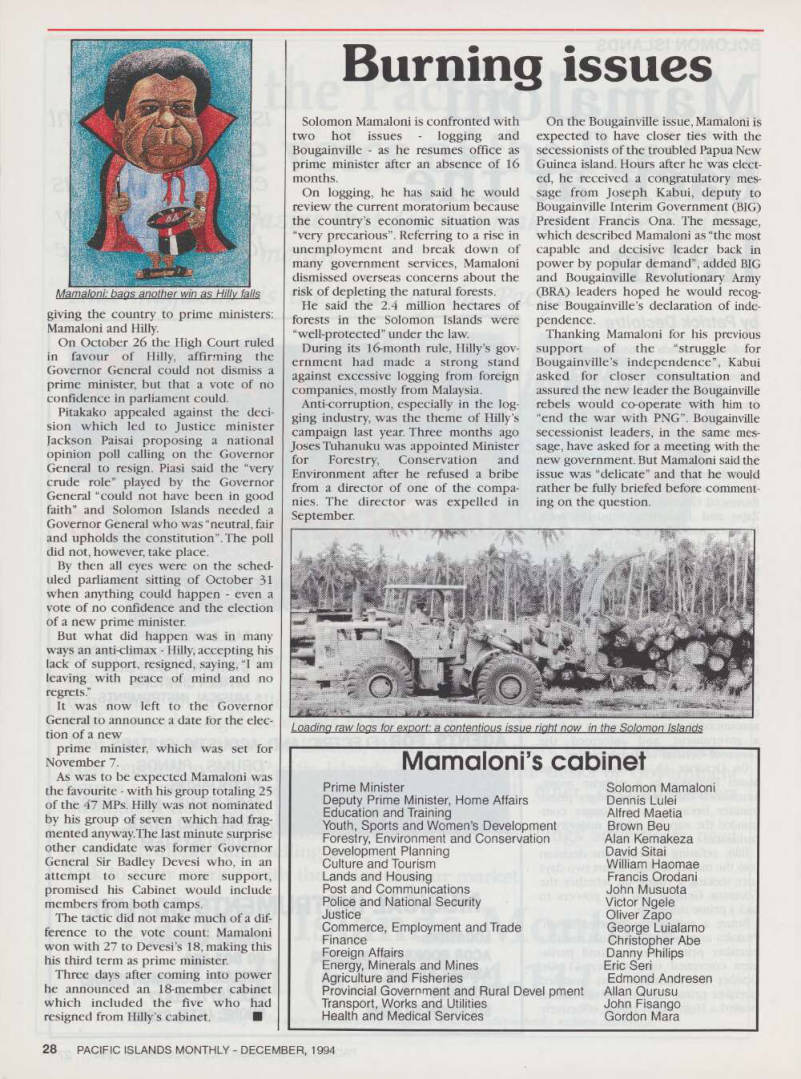
Mamaloni: bags another win as Hilly falls