price soars
pp. 23-25 · Read in the full issue
Business
Coconut oil price soars
By David North
The most pervasive form of economic activity in the islands is the harvest, shipment and processing of the omnipresent coconut, so it is good news for the entire region when the value of coconuts increases.
In recent months the price of coconut oil, the biggest money earner from the coconut tree, has increased by 50 per cent going from about US2O cents a pound to more than 30 cents. (As with most widely traded commodities, the price is quoted at a particular place in the world - in this case dockside in New Orleans, the American port.) To the extent that the commodity price increase reaches back to the islands, this is good news all around, for producers, for shippers, and particularly for governments.
Why for government? Because many of them prop up the price of coconuts or copra, the dried form, to encourage people to stay in the outer islands, where coconut is the primary and sometimes only cash crop.
The Marshall Islands, for example, has long used some of its Compact of Free Association money from the US govern ment to subsidise both the growing of coconuts in the outer islands, and the conversion of them into coconut oil for export.
Along with the usual economic moti vations there is a demographic one, too.
Majuro is splitting at the seams as a result of migration to the capital island, and subsidisation of outer island coconut production is one of the tools the government is using to keep Majuro’s population growth down to
manageable proportions. (So is a family planning program; see “Investing in the future” PIM Oct. 1994).
My impression is that the French have followed the same coconut-production subsidy policy for similar reasons in French Polynesia, to ease the popula tion pressures on Tahiti.
While coconut oil prices are up, at the moment, this has not had - may not have - a significant impact on the slow ly declining production in coconuts, a trend that has been in play for decades.
Growing, harvesting and particularly processing coconuts, is a labour-inten sive process; it is hard work, and usually not well-paid work, and how much of it is done on a specific island often relates to decisions made in distant capitals.
If, for example, a metropolitan power (e.g. Germany before World War I, or Japan between the two wars) decides it wants to grow coconuts for export to the homeland, it organises the local economy so that this occurs; if it does not care about such exports, and is interested in pursuing other values, coconut production and processing may suffer.
Palau is a good example of these swings in imperial moods; the Germans (in power in Palau for only 15 years)
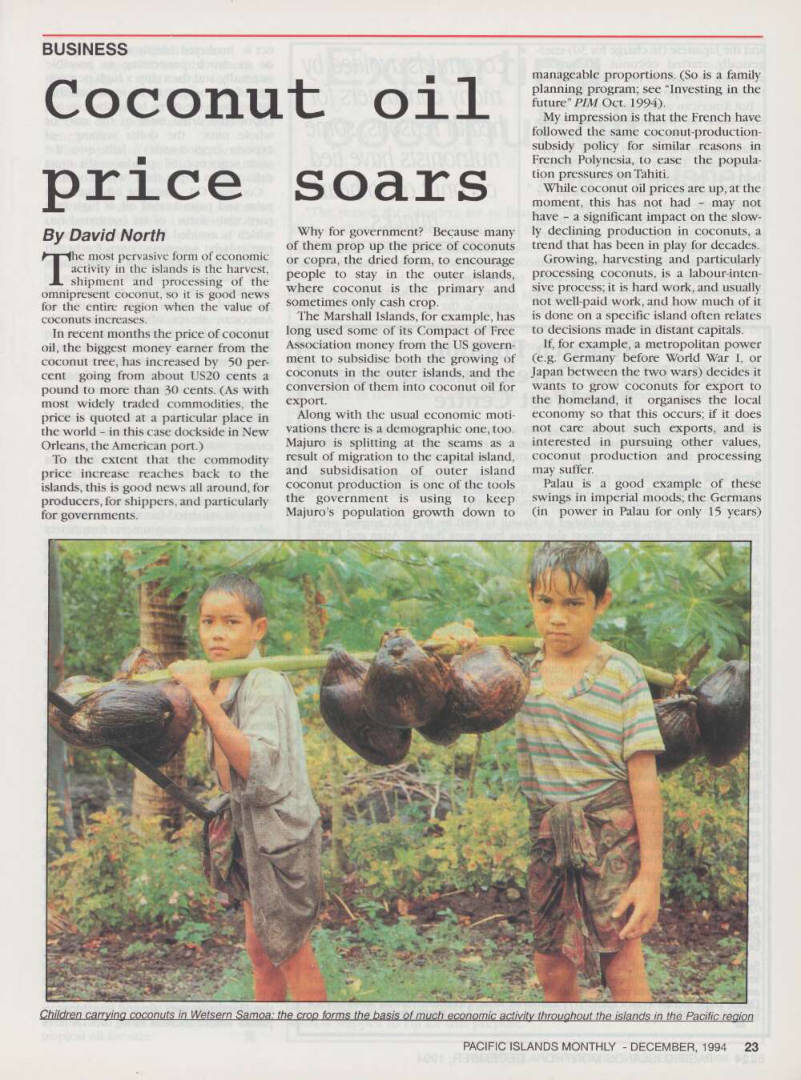
Children carrying coconuts in Wetsern Samoa: the crop forms the basis of much economic activity throughout the islands in the Pacific region
and the Japanese (in charge for 30) ener getically started coconut plantations and then brought in the needed labour to harvest and process the product.
But American administrators on Palau, and back in Washington, had other ideas. They brought a welfare state to Palau and did not import labour for the plantations. To oversimplify, Palauns then had the choice of working for the US - subsidised local government, or working the coconuts - and few took the latter choice. Palau’s coconut oil pressing facility was closed down years ago as a result.
But there are other island nations that have to operate without the generosity of Washington ((or Paris), and that, plus adequate land masses, is why PNG, Fiji,
Coconut is avoided by many consumers for health reasons; some nutrionists have tied coconut oil to heart attacks
the Solomons and Western Samoa con tinue to pay attention to the economics of the coconut.
One basic consideration for these nations is the form in which the prod
uct is marketed. Ideally a nation would do as much processing as possible internally, and then ship a high percent age of the output in its most valuable form. There are three basic choices: oil, copra (the dried meat of the nut) or whole nuts; the dollar volume of exports (region-wide) falls into the same sequence, oil produces the most dollars, then copra, then whole nuts.
Coconut Oil Coconut oil, like both palm and palm kernel oil, is high in a particular form of fat (saturated fat) which is avoided by many consumers, particularly American ones, for health reasons; some outspoken nutritionists have tied it to heart attacks.
A few years ago we reported that packaged cookies and biscuits in American stores often carried little brightly coloured labels “Contains No Tropical Oils”. While these labels have disappeared, many manufactured foods still brag about their low fat, and partic ularly their low saturated fat, content.
Turning from packaged foods made with vegetable oils to the sale of bottled vegetable oils in the supermarkets, one cannot, without going to a specialty store, buy coconut oil for cooking, but one buys oil from corn, canola (rape seed), soybean, sunflowers, safflower and peanuts (ground nuts), all much lower in saturated fats than the tropical oils. Qapanese consumers, fortunately for the islands, do not worry about such things.) Most of the coconut oil shipped to the US is used for non-food items, likes soaps, shampoos and can dles.
The price of coconut oil is volatile on the world market; sometimes reflecting fashions in eating habits, but more often the classic fluctuations of supply and demand. The average price in 1991 was 19.7 cents, in 1992 the average was 26.1 cents, in October, 1993 it had fallen to 20.5 cents, and in November 1994 had bounced back to 33 cents.
The substantial increase in the value of exports between 1991 and 1992 - it was about 60 percent - reflected both a better harvest in the islands (about 30 percent more oil) and a better price (another 30 percent.) If production in 1994 holds up to the 1992 levels, and a 30-cent per pound price turns out to be the year’s average, the region’s exports of coconut oil will reach nearly $40,000,000 - up a bit from 1992, and almost double the 1991 total of $21,500,000.
Copra To produce copra one opens the nut and dries it until the moisture level is reduced to about 14 percent; then it can be shipped either for press ing into oil, or for other uses. The drying process in many of the islands, such as the Marshalls, uses air and sunshine; in places where there is more fuel there is
the option of kiln-dried copra.
Copra exports from the islands in 1992 had a total value of about $25,000,000 according to the FAO, about two-thirds of the value of the coconut oil exported that year from the
same places.
The principal island exporters of copra that year were PNG ($9,000,000), Vanuatu ($7,300,000), and the
Solomons ($6,500,000).
Whole Nuts Most large American supermarkets have a dozen or two coconuts for sale, at prices of about US$ 1.00 each. The worker back in the islands who harvested the coconut and brought it to a local middleman may have received all of one American cent for it.
Other nations produce other coconut products. Thailand, for example, exports canned coconut milk, often used in cur ries, and the Philippines (the world leader in coconut production) produces a moist coconut meat which is used in candy bars.
Palm Oil and Palm Kernel Oil The two commodities have quite different qualities, and are produced and priced separately. PNG is the principal suppli er of these oils in the islands; production of both kinds of oils has just about tripled in PNG between 1982 and 1993- Palm oil is relatively high in saturated fat (51 percent compared to 92 percent in coconut oil, and only 18 percent in peanut oil) but it is grouped with, and often priced with, other vegetable oils.
Since this is the case, events half way around the world can raise and lower palm oil prices, which went from about 16 cents a pound when it hit its lowest in June, 1993, up to the level at this writ ing, of 27 cents a pound.
According to a tropical oil specialist in the US Department of Agriculture, Malaysia increased its production of palm oil sharply in 1993, driving down the world price, and making it, for a while, the least expensive of the veg etable oils.
Then two other distant events occurred; the great flood of the Mississippi River later in 1993 ruined the soybean crop (from which soy oil is extracted) and to ease inflationary pres sures in hundreds of millions of kitchens the government of China start ed importing a large volume of various kinds of vegetable oils for subsidised resale. So with a smaller supply, and heightened demand, palm oil prices surged.
Unlike cartels that seek to regulate prices in other commodities, as in cof fee, tin and diamonds, there appears to be no such operation in tropical oils. So, if the future is like the past, prices will surge up and done.At the moment, how ever, it is a good time to have some tropical oil for sale. ■