Uvea?... Where's that?
p. 56 · Read in the full issue
Yachting
By Sally Andrew
“Uvea? Wallis? I’ve heard of it.” Great.
That’s exactly why we’re going there.
Well off the beaten track, Wallis seduces very few tourists. Most of those that do arrive are French overseas workers pass ing through on their way to or from Noumea or Papeete and Paris. Hes Wallis, part of France’s smallest South Pacific ter ritory of Wallis and Futuna, lies midway between Fiji and Samoa.
The main island of Uvea is a high vol canic isle with a number of crater lakes, archaeological ruins and imposing church es. Uvea is ringed by reefs and outer isles which can only be explored by yacht,
dinghy or kayak.
The largest of the outer islets is Faioa.
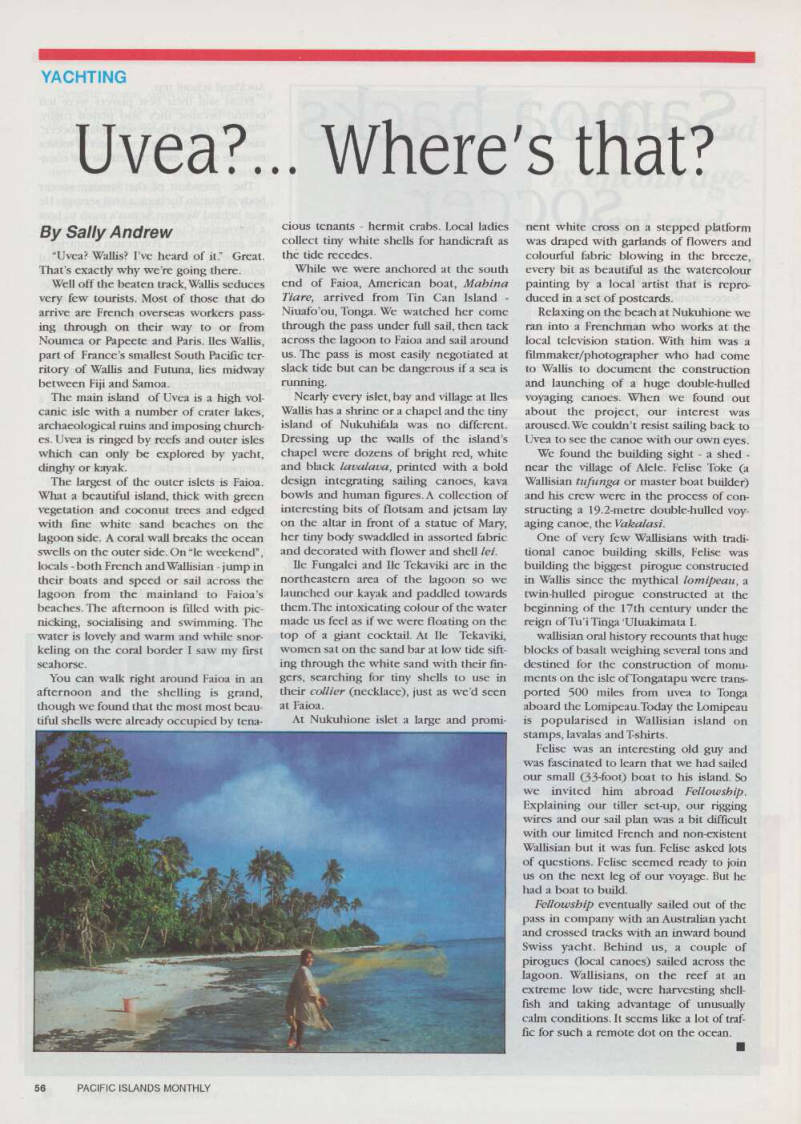
What a beautiful island, thick with green vegetation and coconut trees and edged with fine white sand beaches on the lagoon side. A coral wall breaks the ocean swells on the outer side. On “le weekend”, locals - both French and Wallisian - jump in their boats and speed or sail across the lagoon from the mainland to Faioa s beaches. The afternoon is filled with pic nicking, socialising and swimming. The water is lovely and warm and while snor keling on the coral border I saw my first seahorse.
You can walk right around Faioa in an afternoon and the shelling is grand, though we found that the most most beau tiful shells were already occupied by tena
cious tenants - hermit crabs. Local ladies collect tiny white shells for handicraft as the tide recedes.
While we were anchored at the south end of Faioa, American boat, Mahina Tiare, arrived from Tin Can Island - Niuafo’ou, Tonga. We watched her come through the pass under full sail, then tack across the lagoon to Faioa and sail around us. The pass is most easily negotiated at slack tide but can be dangerous if a sea is running.
Nearly every islet, bay and village at lies Wallis has a shrine or a chapel and the tiny island of Nukuhifala was no different.
Dressing up the walls of the island’s chapel were dozens of bright red, white and black lavalava, printed with a bold
design integrating sailing canoes, kava
bowls and human figures. A collection of interesting bits of flotsam and jetsam lay on the altar in front of a statue of Mary, her tiny body swaddled in assorted fabric and decorated with flower and shell lei. lie Fungalei and He Tekaviki are in the northeastern area of the lagoon so we launched our kayak and paddled towards them. The intoxicating colour of the water made us feel as if we were floating on the top of a giant cocktail. At lie Tekaviki, women sat on the sand bar at low tide sift ing through the white sand with their fin gers, searching for tiny shells to use in their collier (necklace), just as we’d seen at Faioa.
At Nukuhione islet a large and promi-
nent white cross on a stepped platform was draped with garlands of flowers and colourful fabric blowing in the breeze, every bit as beautiful as the watercolour painting by a local artist that is repro duced in a set of postcards.
Relaxing on the beach at Nukuhionc we ran into a Frenchman who works at the local television station. With him was a filmmaker/photographer who had come to Wallis to document the construction and launching of a huge double-hulled voyaging canoes. When we found out about the project, our interest was aroused. We couldn’t resist sailing back to Uvea to see the canoe with our own eyes.
We found the building sight - a shed near the village of Alele. Felise Toke (a Wallisian tufunga or master boat builder) and his crew were in the process of con structing a 19-2-metre double-hulled voy aging canoe, the Vakalasi.
One of very few Wallisians with tradi tional canoe building skills, Felise was
building the biggest pirogue constructed
in Wallis since the mythical lomipean, a twin-hulled pirogue constructed at the beginning of the 17th century under the reign of Tu’iTinga ‘Uluakimata I. wallisian oral history recounts that huge blocks of basalt weighing several tons and destined for the construction of monu ments on the isle ofTongatapu were trans ported 500 miles from uvea to Tonga aboard the Lomipeau.Today the Lomipeau is popularised in Wallisian island on stamps, lavalas and T-shirts.
Felise was an interesting old guy and was fascinated to learn that we had sailed our small (33-foot) boat to his island. So we invited him abroad Fellowship.
Explaining our tiller set-up, our rigging wires and our sail plan was a bit difficult with our limited French and non-existent Wallisian but it was fun. Felise asked lots of questions. Felise seemed ready to join us on the next leg of our voyage. But he had a boat to build.
Fellowship eventually sailed out of the pass in company with an Australian yacht and crossed tracks with an inward bound Swiss yacht. Behind us, a couple of pirogues (local canoes) sailed across the lagoon. Wallisians, on the reef at an extreme low tide, were harvesting shell
fish and taking advantage of unusually
calm conditions. It seems like a lot of traf fic for such a remote dot on the ocean.