Oceania strikes back
pp. 52-54 · Read in the full issue
Sports
By Shailendra Singh
FIFA, the world soccer governing body, is continuing its drive to develop the sport in the Oceania region. The assurance was given by Oceania Football
Confederation (OFC) president,
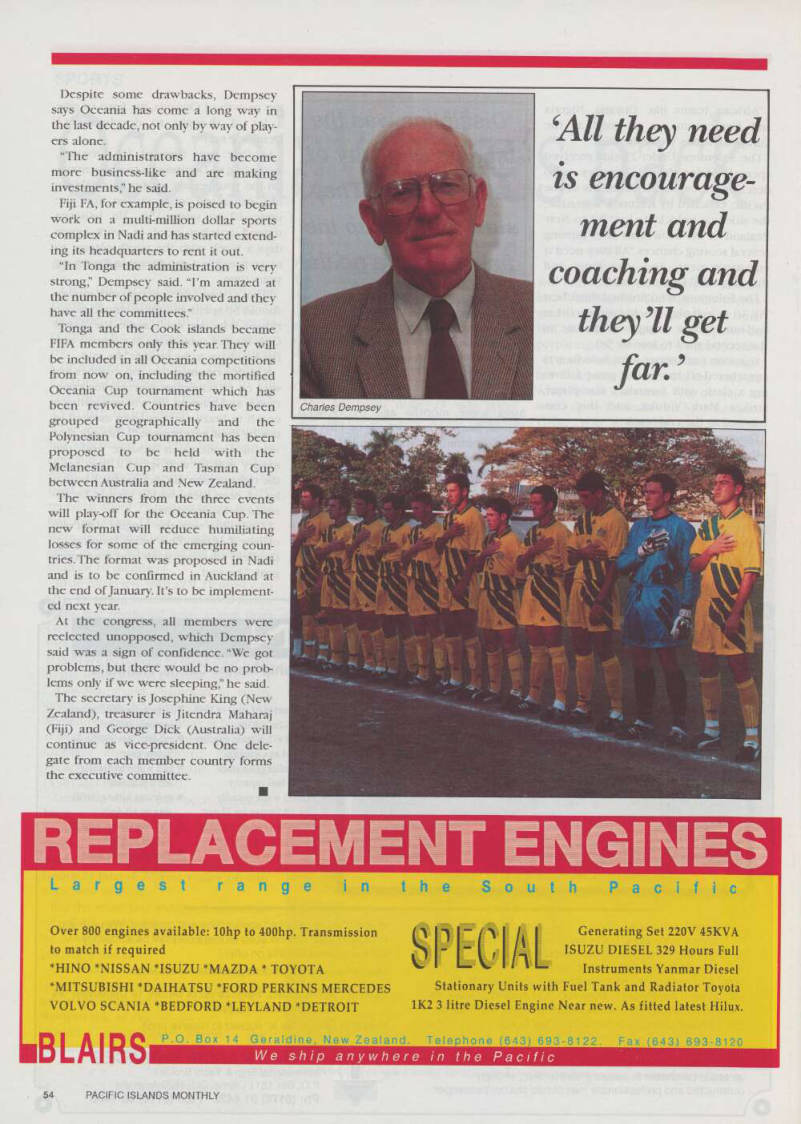
Charles Dempsey, who was in Fiji last month for the Oceania Under
-23 youth tournament.
The former New Zealand FA president has speculated that FIFA will pump in one million Swiss francs for its develop ment programmes in Oceania to be used over the next four years. The OFC received about 73 million francs for the last four years. These and other issues were discussed at last month’s OFC con gress in Nadi, which had full attendance from its 10 members.
In an interview with PIM, Dempsey, an OFC founding member, out-lined future plans and predicted more teams from Oceania will be in the World Cup by the turn of the century. Teams from the region are struggling to make their mark in the world’s most popular sport.
Australia, world champion in rugby union, managed 52nd position in FIFA’s September rankings - the best from the region. New Zealand ranked 93- Other Oceania countries were: Fiji(108), French Polynesia (143), the Solomons (158) and Vanuatu (169).
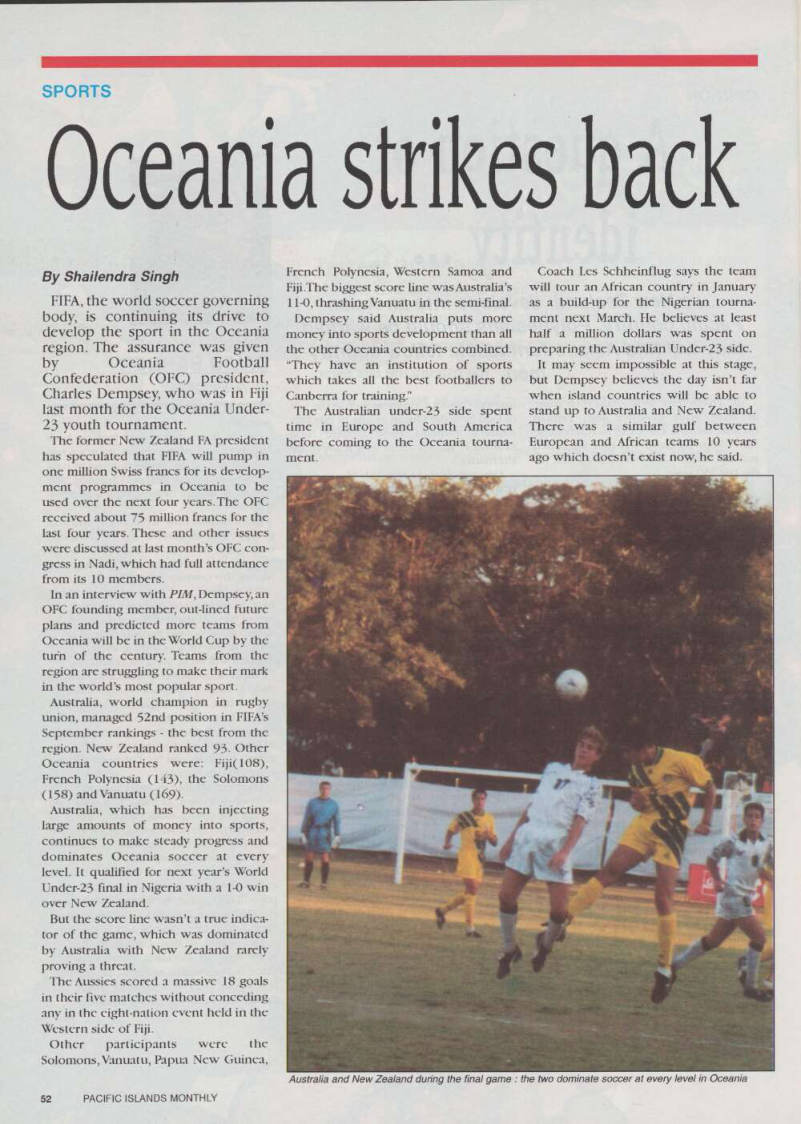
Australia, which has been injecting large amounts of money into sports, continues to make steady progress and dominates Oceania soccer at every level. It qualified for next year’s World Under-23 final in Nigeria with a 1-0 win over New Zealand.
But the score line wasn’t a true indica tor of the game, which was dominated by Australia with New Zealand rarely proving a threat.
TheAussics scored a massive 18 goals in their five matches without conceding any in the eight-nation event held in the Western side of Fiji.
Other participants were the Solomons, Vanuatu, Papua New Guinea,
French Polynesia, Western Samoa and Fiji. The biggest score line was Australia’s 11-0, thrashing Vanuatu in the semi-final.
Dempsey said Australia puts more money into sports development than all the other Oceania countries combined.
“They have an institution of sports which takes all the best footballers to Canberra for training.”
The Australian under-23 side spent time in Europe and South America before coming to the Oceania tourna ment.
Coach Les Schheinflug says the team will tour an African country in January as a build-up for the Nigerian tourna ment next March. He believes at least half a million dollars was spent on preparing the Australian Under-23 side.
It may seem impossible at this stage, but Dempsey believes the day isn’t far when island countries will be able to stand up to Australia and New Zealand.
There was a similar gulf between European and African teams 10 years ago which doesn’t exist now, he said.
Australia and New Zealand during the final game: the two dominate soccer at every level in Oceania
“African teams like Guyana, Nigeria and Cameroom are as good as the European teams today,” he said.
The Solomons Under-23 side received
special praise from Dempsey who
described them as the Brazilians of the Pacific. Coached by Kazunofi Watanabe, the side was unlucky to lose 0-1 to New Zealand in the semi-finals after missing several scoring chances.“ All they need is encouragement and coaching and they’ll get far,” Dempsey said.
The Solomons,who finished third, beat Fiji 3-1 in poll play. It held Australia 0-1 at half-time before being overrun late in the second spell to lose by 5-0.
Solomon goalkeeper, John Solodia was stretchered-off late in this game follow ing a clash with Australia’s star player, striker Mark Viduka, and this con tributed to the end result.
Dempsey believes the Solomons, like other island teams do not lack talent, he blames a lack of money as the major drawback. No other country in Oceania, except perhaps New Zealand, could afford a build-up tour like the Australians.
Dempsey says FIFA does not give countries cash, but provides technical assistance and expertise. Coaching
‘Discipline was the biggest difficulty of island teams. They start running up the field to score goals and lose more goals.’
workshops are held in all the islands and FIFA plans to continue with courses for referees. The most recent was held in Suva some months ago by General Farouk Buzo of Syria, who is on FIFA ref erees’ committee, and attended by all Oceania members. There will be anoth er course in New Zealand when the Under-17 youth tournament is staged there in January.
FIFA has employed former New Zealand national coach, Kevin Fallon, as its full time technical director. Fallon travels to all Oceania countries holding clinics for coaches and players. “With
the growth of Oceania, we have to give a lot of thought to development,”
Dempsey said.
Another way forward for Oceania, according to Dempsey, is to concentrate on the younger age group by establish ing organised competition for the under-10 to under-15’s. He believes trained coaches need to work seven days a week with the youth players to make possible a good team in five to six years time.
“That’s were the energy and money should be spent and there should be no reason why we can’t make the World Cup. It’s not something like instant cof fee. You have to be patient,” he said.
It is also essential that top coaches are sent on attachments overseas for expe rience and training. Fiji will be sending a coach to Brazil and has been assisted in this by their government.“l thought that was a tremendous gesture and the money will be well spent if they send the right person. He’ll come back with a lot of new ideas which should be lis tened to by everyone.
“Discipline was the biggest difficulty of island teams. They start running up the field to score goals and lose more goals,” he said.
Despite some drawbacks, Dempsey says Oceania has come a long way in the last decade, not only by way of play ers alone.
“The administrators have become more business-like and are making investments,” he said.
Fiji FA, for example, is poised to begin work on a multi-million dollar sports complex in Nadi and has started extend ing its headquarters to rent it out.
“In Tonga the administration is very strong,” Dempsey said. “I’m amazed at the number of people involved and they have all the committees.”
Tonga and the Cook islands became FIFA members only this year. They will be included in all Oceania competitions from now on, including the mortified Oceania Cup tournament which has been revived. Countries have been grouped geographically and the Polynesian Cup tournament has been proposed to be held with the Melanesian Cup and Tasman Cup between Australia and New Zealand.
The winners from the three events will play-off for the Oceania Cup. The new format will reduce humiliating losses for some of the emerging coun tries. The format was proposed in Nadi and is to be confirmed in Auckland at the end of January. It’s to be implement ed next year.
At the congress, all members were reelected unopposed, which Dempsey said was a sign of confidence. “We got problems, but there would be no prob lems only if we were sleeping,” he said.
The secretary is Josephine King (New Zealand), treasurer is Jitendra Maharaj (Fiji) and George Dick (Australia) will continue as vice-president. One dele gate from each member country forms the executive committee.
6 All they need is encourage ment and coaching and they 7/ get far.’
Charles Dempsey