Construction
pp. 35-36 · Read in the full issue
Advertising Feature
Construction in the Pacific A look at one of the fastest growing ind sutries in the region.
One hundred years ago, South Pacific island nations were barren of what is today known as the urban jun gle. Indigenous peoples mainly lived in grass homes while the European settlers opted for wooden ones. The construction industry while in exis tence kept a low profile. But all this has changed in the last 20 to 30 years, depending on the economy of the countries.
Today the urban jungles are a reali ty. Grass homes have been bull-dozed and replaced with concrete infra structure. Wooden bridges have been replaced with mega-steel structures, stone jetties have been converted to luxury berthing spaces, and homes have been built incorporating west ern designs with traditional architec ture.
All in all, the construction industry has dome wondrously well.
In Fiji, the industry saw a stagnant period after the military coups but this may have been a blessing in dis guise because three years after coup, the industry saw a boom which it had never seen before.
Hardware stores like Fiji’s Vinod Patel and Suncourt became chain operations, more roads took shape during a short period of three years, bigger and better homes reaching the heights of luxury emerged from vacant lots and office blocks contin ued to reach for the sky.
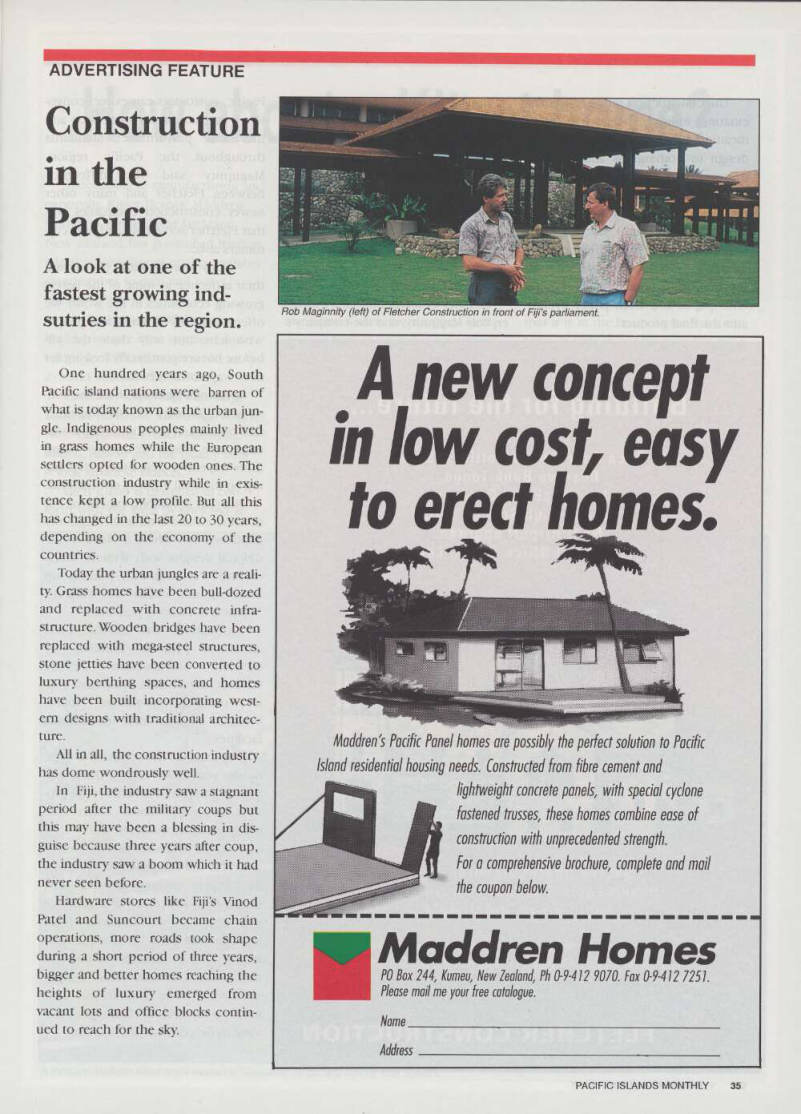
Rob Maginnity (left) of Fletcher Construction in front of Fiji’s parliament.
The construction industry is a fas cinating industry because it gives meaning to abstract ideas. It gives design to nothingness and converts dreams into reality - albeit at a cost, of course. The fascination is in the fact that any person could mentally visu alise a structure and say; "I want that”. Provided the dreamer has money, the vision gets converted from the mind into words, the words get onto paper and from paper eventu ates the final product.
In the Pacific, when one talks about construction, some names immediately come to mind. One such name is Fletcher Construction.
Fletcher Construction serves nine island nations, having started from Western Samoa in 1946 and spreading to Fiji and Papua New Guinea in 1969 and then to Solomon Islands,Vanuatu, Tonga, Cooks Islands, American Samoa, and Kiribati.
Fletcher Construction’s Fiji manag er, Rob Maginnity, said the company’s
Pacific . customers can expect consis tency and continuity of service and the same performance standards throughout the Pacific region.
Maginnity said the difference between Fletcher and many other newer construction companies was that Fletcher served old and new cus tomers alike.
"Many are looking to expand their influence in some of the fastest growing economies in the world. We offer a diversity of skills, and people who have not only done the job before but are continually looking for new ways to do it better.”
Speaking in general about the con struction industry in Fiji, Maginnity said building in the South Pacific was expensive, some countries being more expensive than others, depend ing on the local input of raw material.
Not only is building expensive, but in some instances difficult. Maginnity explained that where a blend of tra ditional designs with Western archi tecture was required, putting up infrastructure could be difficult.
"This is not always possible”.
Throughout the Pacific, civic amenities projects handled by Fletcher Construction include schools, universities, hospitals, clin ics, utilities reticulation, roads, bridges, marinas and recreational facilities.
The motto of the company is to be by the year 2000, one of those suc cessful companies which would pro cure business solutions rather than solely construct projects.
Fletcher Construction plans to assemble and integrate project teams and supply chains, pioneer new information processes, and generate and deliver new solutions. “Our strategic goal must be to create per sistent value in facilities for our cus tomers and their customers,” manag ing director David Chandler said. This in fact is the test and challenge of sur vival in the construction industry.