Enchanting Asanvare
p. 58 · Read in the full issue
Yachting
By Sally Andrew
IN mid-sentence, I stopped. Foster and I were below decks, sharing a cup of tea with the owners and crew of Manaroa 111 , when a blue calico sail passed by their port hole. I leapt up on deck to investigate and, just for fun, I put out my thumb to hitch a ride. Much to my delight, the four young men tacked back and sailed towards Manaroa 111. I jumped into our dinghy which was trailing astern and when the wooden sailing canoe came alongside, I transferred myself carefully into its narrow hull.
Off we went, sailing around the bay in a small outrigger canoe, with me grin ning from ear to ear. There wasn’t much wind enough to keep us moving, but not enough to make the boat scream along. My ni-Vanuatu crew sang a medley of songs, singing and harmonis ing as we cruised around the bay looking for wind, sometimes using the paddles to bring the boat around. Beautiful four part harmonies echoed around Asanvare’s quiet harbour.
Later, back aboard Manaroa 111 , we storied on with with fellow cruisers, Gwenda and David.
Asanvare is located at the southern tip of a long skinny island called Maewo in northern Vanuatu. Maewo was created 18 million years ago by volcanic erup tions and is the wettest island in Vanuatu. Asanvare has become a popu lar spot with yachties because of its beautiful waterfall and because of the warm welcome they receive from the
people of the village.
During our first trip to the waterfall, seven young kids stopped to say hello and joined us. Merilyn, Naomi, Watson, Linda, Daton, Dinneth and Dagles had been walking home to their village in the hills after a day at school. We played catch with a small plastic shampoo bottle, diving and splashing one another trying to grab it. After a while, one of them looked at me with wide eyes and sofly asked, “Could we come back to your ship and sing some songs?”
It was getting late in the afternoon and the air was cool. Even the kids’ teeth were chattering behind their smiles. So we said. “Let’s go!”
On board our 33-foot Fellowship , I made hot chocolate to warm us up. Then the children started to sing. The songs were beautiful, their harmonies loud and resonant in our small cabin. After each song, big bowls of sweet, salty, and spicy popcorn were passed back and forth
between them while they thought of an other song to sing.
The kids returned to shore before dark. It had been a great afternoon.
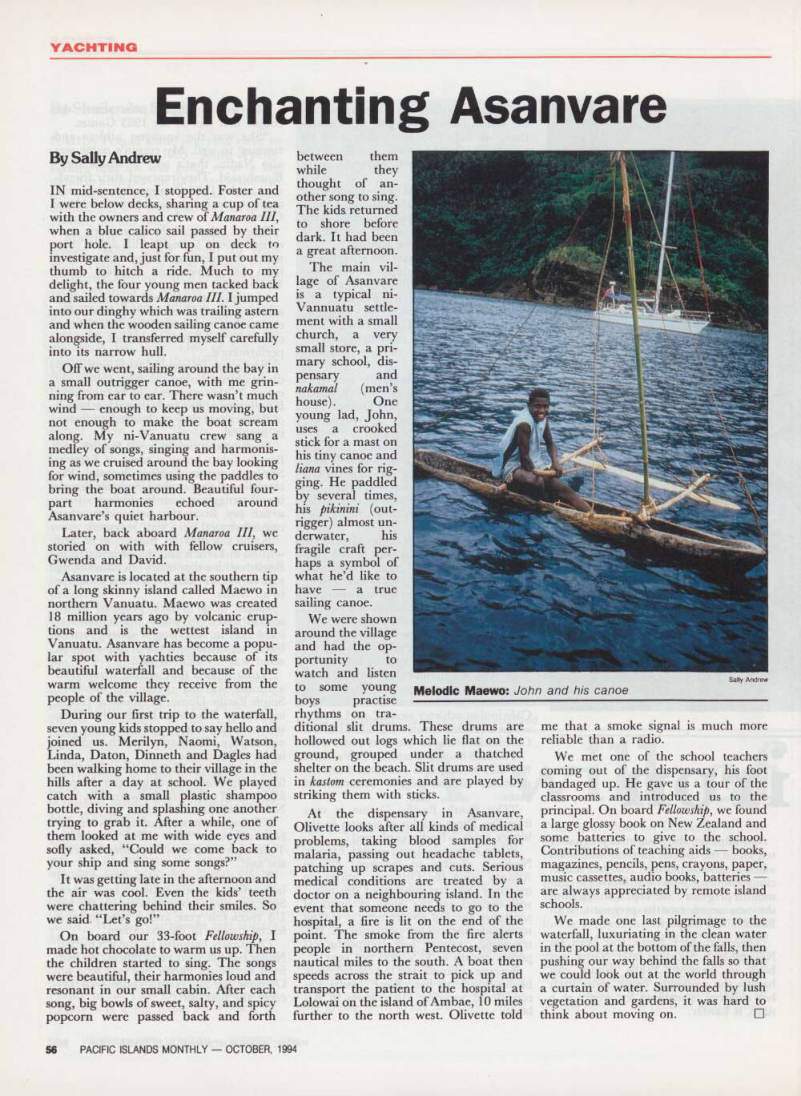
The main vil lage of Asanvare is a typical ni- Vannuatu settle ment with a small church, a very small store, a pri mary school, dis pensary and nakamal (men’s house). One young lad, John, uses a crooked stick for a mast on his tiny canoe and liana vines for rig ging. He paddled by several times, his pikinini (out rigger) almost un derwater, his fragile craft per haps a symbol of what he’d like to have a true sailing canoe.
We were shown around the village and had the op
portunity to
watch and listen to some young
boys practise
rhythms on tra
ditional slit drums. These drums are hollowed out logs which lie flat on the ground, grouped under a thatched shelter on the beach. Slit drums are used in kastom ceremonies and are played by striking them with sticks.
At the dispensary in Asanvare, Olivette looks after all kinds of medical problems, taking blood samples for malaria, passing out headache tablets, patching up scrapes and cuts. Serious medical conditions are treated by a doctor on a neighbouring island. In the event that someone needs to go to the hospital, a fire is lit on the end of the point. The smoke from the fire alerts people in northern Pentecost, seven nautical miles to the south. A boat then speeds across the strait to pick up and transport the patient to the hospital at Lolowai on the island of Ambae, 10 miles further to the north west. Olivette told
me that a smoke signal is much more reliable than a radio.
We met one of the school teachers coming out of the dispensary, his foot bandaged up. He gave us a tour of the classrooms and introduced us to the principal. On board Fellowship , we found a large glossy book on New Zealand and some batteries to give to the school.
Contributions of teaching aids books, magazines, pencils, pens, crayons, paper, music cassettes, audio books, batteries
are always appreciated by remote island
schools.
We made one last pilgrimage to the waterfall, luxuriating in the clean water in the pool at the bottom of the falls, then pushing our way behind the falls so that we could look out at the world through a curtain of water. Surrounded by lush vegetation and gardens, it was hard to think about moving on. □
Sally Andrew Melodic Maewo: John and his canoe