Welcome to Fiji
p. 35 · Read in the full issue
Visit South Pacific Year '95
Fiji
By Yunus Rashid
SCATTERED across 1,290,000 square kilometres of some of the most beautiful ocean in the world, and conveniently located at 4450 kilometres southwest of Hawaii and 2730 kilometres of Sydney, Fiji has made the most of its hub-of-the- Pacific location to become a fore-runner in the region.
Nowhere has its ideal location been felt more than in the dramatic growth its tourism industry has experienced in the last two decades.
From being a mere port-of-call for cruise liners in the seventies (drawn here by the attractive duty-free prices of electronic goods), Fiji has managed to harness and package its charm into a lucrative and growing industry. So much so that today tourism contributes 17 per cent towards Fiji’s GDP and represents 25 per cent percent of total export earnings.
But, as an income earner, tourism is an
extremely volatile industry. Dependent
to a large extent on forces outside its control, such as the economies of its main markets, fluctuating dollar values and changing demands of travellers, the industry has nevertheless managed to overcome its initial growing pains and carved out a niche for itself in the highly competitive market-place.
Today, Fiji has a well-targeted mar keting strategy reaching as far as Europe and North America, and with a constant eye kept on its traditional source of visitors, Australia and New Zealand, as well.
Fiji can be found participating at international tourism conventions, expo sitions and seminars, alongside its main competitors, Indonesia, Malaysia, Ha waii and the Caribbean. Fiji is a member of the Tourism Council of the South Pacific which, with the financial backing of the European Community, promotes the South Pacific as a tourist destination
internationally.
The thrust of the campaign has shifted its focus from merely increasing the number of tourists to attracting a particular type of tourist.
“ We do not want high volumes and low yields. We want low volumes and high yields,” says TCSP director Levani Tuinabua. The rationale behind this concept is partly to protect the environ ment from excessive development and exploitation and also to minimise the effects of westernisation brought in by an
influx of tourists and to safeguard local culture.
Fiji has been able to successfully meet tourists’ demand for greater value for their money because of its unique characteristics. Tuinabua pointed out that the Pacific does not have compe tition in so far as its peoples and resources are concerned. Hence, Fiji, a melting pot, rich in its diversity, with an unspoilt natural beauty, has been able to encap sulate these into the ultimate experience.
A multi-cultural heritage based on years of inter-island migrations and the more recent arrival of Indians and
Chinese, has created a special identity for the country which was once dubbed, “Fiji the way the world should be”.
The cultural milieu is not the only unique hallmark of Fiji. The diversity of landforms and seascapes, from the gently rolling hillsides clothed in green forests to the incredibly colourful reefs inhabited by hundreds of species of marine life, reflecting a myriad of colours, have added to its attraction.
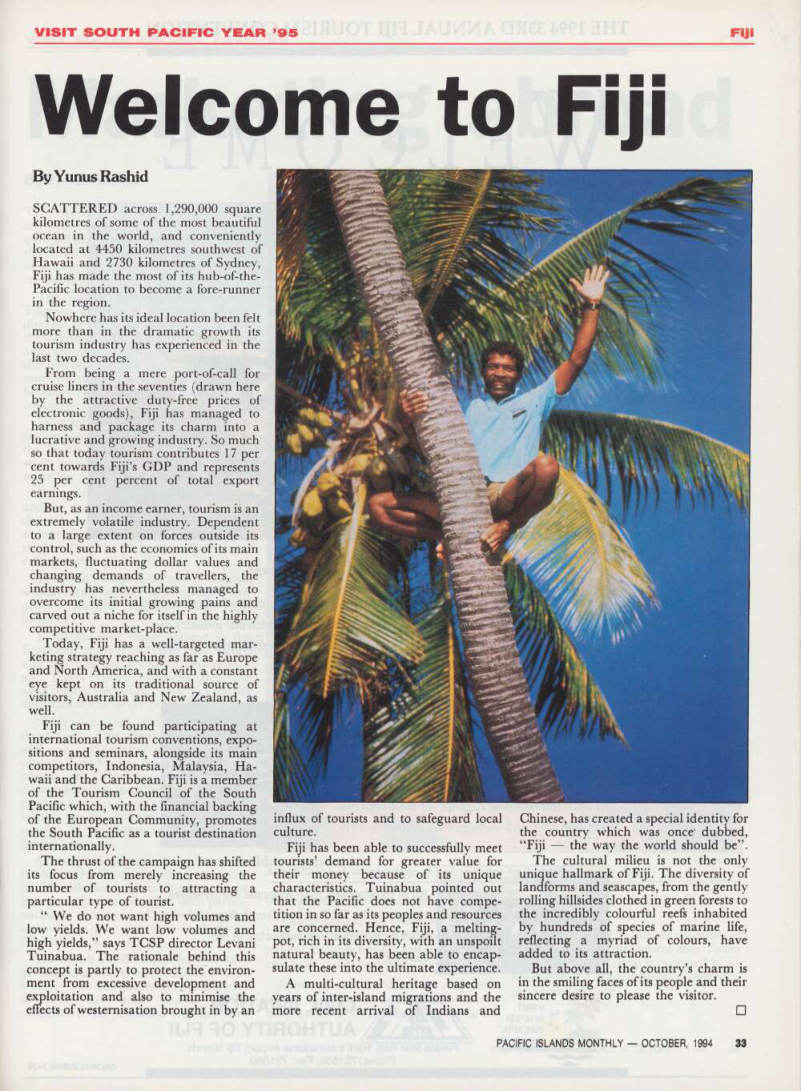
But above all, the country’s charm is in the smiling faces of its people and their sincere desire to please the visitor, □