Essence of a dying age
pp. 28-29 · Read in the full issue
Books
By Ian Williams
‘I wanted to record these rapidly disap pearing cultures
before they
were forgotten.
And Pd hope to see more social justice in the region Michael Krieger
IN 1984, American writer Michael Krieger was in Vanuatu working on a book when he discovered that there were still villages on Espiritu Santo that were completely inaccessible by road. “Their only contact with the outside world was the occasional copra trader. It showed me that there were still people living in a way that was vanishing quickly.”
He decided to try to catch some of that way of life before it finally disappeared, and the results appear in his just published book Conversations with Canni bals; The End of The Old South Pacific, recording his travels in Vanuatu, Tu valu, the Cook Islands, and the Sol omons.
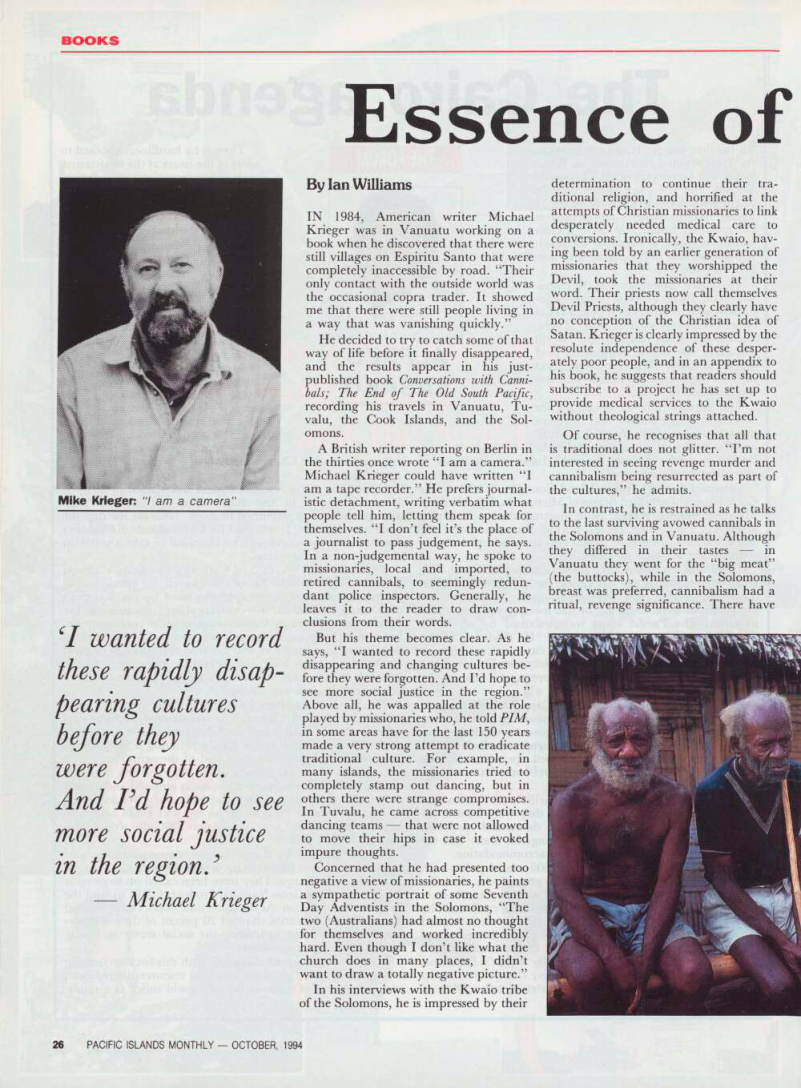
A British writer reporting on Berlin in the thirties once wrote “I am a camera.”
Michael Krieger could have written “I am a tape recorder.” He prefers journal istic detachment, writing verbatim what people tell him, letting them speak for themselves. “I don’t feel it’s the place of a journalist to pass judgement, he says.
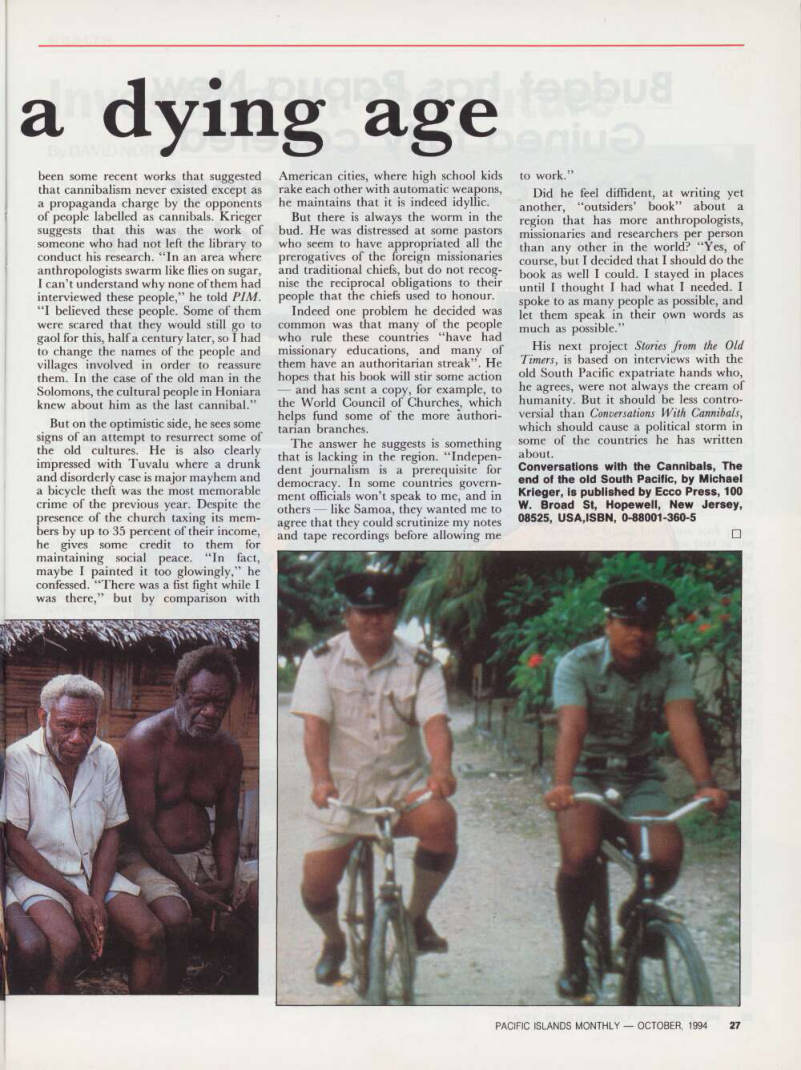
In a non-judgemental way, he spoke to missionaries, local and imported, to retired cannibals, to seemingly redun
dant police inspectors. Generally, he
leaves it to the reader to draw con clusions from their words.
But his theme becomes clear. As he says, “I wanted to record these rapidly disappearing and changing cultures be fore they were forgotten. And I’d hope to see more social justice in the region.”
Above all, he was appalled at the role played by missionaries who, he told PIM, in some areas have for the last 150 years made a very strong attempt to eradicate traditional culture. For example, in many islands, the missionaries tried to completely stamp out dancing, but in others there were strange compromises.
In Tuvalu, he came across competitive dancing teams that were not allowed to move their hips in case it evoked
impure thoughts.
Concerned that he had presented too negative a view of missionaries, he paints a sympathetic portrait of some Seventh Day Adventists in the Solomons, “The two (Australians) had almost no thought for themselves and worked incredibly hard. Even though I don’t like what the church does in many places, I didn’t want to draw a totally negative picture.”
In his interviews with the Kwaio tribe of the Solomons, he is impressed by their
determination to continue their tra ditional religion, and horrified at the attempts of Christian missionaries to link desperately needed medical care to conversions. Ironically, the Kwaio, hav ing been told by an earlier generation of missionaries that they worshipped the Devil, took the missionaries at their word. Their priests now call themselves
Devil Priests, although they clearly have
no conception of the Christian idea of Satan. Krieger is clearly impressed by the resolute independence of these desper ately poor people, and in an appendix to his book, he suggests that readers should subscribe to a project he has set up to provide medical services to the Kwaio
without theological strings attached.
Of course, he recognises that all that is traditional does not glitter. “I’m not interested in seeing revenge murder and cannibalism being resurrected as part of the cultures,” he admits.
In contrast, he is restrained as he talks to the last surviving avowed cannibals in the Solomons and in Vanuatu. Although they differed in their tastes in Vanuatu they went for the “big meat” (the buttocks), while in the Solomons, breast was preferred, cannibalism had a ritual, revenge significance. There have
Mike Krieger: "I am a camera”
been some recent works that suggested that cannibalism never existed except as
a propaganda charge by the opponents
of people labelled as cannibals. Krieger suggests that this was the work of someone who had not left the library to conduct his research. “In an area where anthropologists swarm like flies on sugar, I can’t understand why none of them had interviewed these people,” he told PIM.
“I believed these people. Some of them were scared that they would still go to gaol for this, half a century later, so I had to change the names of the people and villages involved in order to reassure them. In the case of the old man in the Solomons, the cultural people in Honiara knew about him as the last cannibal.”
But on the optimistic side, he sees some signs of an attempt to resurrect some of the old cultures. He is also clearly impressed with Tuvalu where a drunk and disorderly case is major mayhem and a bicycle theft was the most memorable crime of the previous year. Despite the presence of the church taxing its mem bers by up to 35 percent of their income, he gives some credit to them for maintaining social peace. “In fact, maybe I painted it too glowingly,” he confessed. “There was a fist fight while I
was there,” but by comparison with
American cities, where high school kids rake each other with automatic weapons, he maintains that it is indeed idyllic.
But there is always the worm in the bud. He was distressed at some pastors who seem to have appropriated all the prerogatives of the foreign missionaries and traditional chiefs, but do not recognise the reciprocal obligations to their people that the chiefs used to honour.
Indeed one problem he decided was common was that many of the people who rule these countries “have had missionary educations, and many of them have an authoritarian streak”. He hopes that his book will stir some action and has sent a copy, for example, to the World Council of Churches, which helps fund some of the more authoritarian branches.
The answer he suggests is something that is lacking in the region. “Independent journalism is a prerequisite for democracy. In some countries government officials won’t speak to me, and in others like Samoa, they wanted me to agree that they could scrutinize my notes and tape recordings before allowing me
to work.”
Did he feel diffident, at writing yet another, “outsiders’ book” about a region that has more anthropologists, missionaries and researchers per person than any other in the world? “Yes, of course, but I decided that I should do the book as well I could. I stayed in places until I thought I had what I needed. I spoke to as many people as possible, and let them speak in their <pwn words as much as possible.”
His next project Stories from the Old Timers, is based on interviews with the old South Pacific expatriate hands who, he agrees, were not always the cream of humanity. But it should be less contro versial than Conversations With Cannibals , which should cause a political storm in some of the countries he has written about.
Conversations with the Cannibals, The end of the old South Pacific, by Michael Krieger, is published by Ecco Press, 100 W. Broad St, Hopewell, New Jersey,