Freedom of
pp. 16-17 · Read in the full issue
Media
By David North
MEDIA freedom varies in the South Pacific with Fiji, Vanuatu and
Tonga having the least
of it. These were the conclusions of what cer tainly will be a contro
versial study released by
Freedom House, a New
York research organis
ation. Using a compli
cated formula, based on
several measures of press
and broadcast freedom,
the New York-based
study evaluated the
level of freedom in 186
countries.
Most of the studied nations, particu larly those in Africa and Asia, secured much less attractive ratings than even the worst in the Pacific. For example, 54 nations were rated as having “not free” media; Fiji, Vanuatu, and Tonga were the only nations in the Pacific with “partly free” ratings; the other seven rated in the region were all said to have “free” media. Looking elsewhere around the Pacific, New Zealand and Australia were rated as having the second and third most free media in the world, with Belgium winning first place.
The Freedom House annual survey measures the freedom of broadcast (radio and television) media, and the press, separately, giving the lowest marks to those with the most free expression.
Four different kinds of pressures against the media are measured, and points are distributed on the extent of the pressure. A maximum of ten points can be allocated in each of the following three categories: • Official pressure, laws and regulation; • Political pressure, through less formal intervention. • Economic pressure, from governmen tal and non-governmental forces. (This can include, in some countries, govern mental or private forces denying a newspaper paper it needs to print, as well as direct financial threats and reprisals).
The fourth category (D) called op pression, can bring as many as 20 points.
This includes actions ranging from cen sorship to the killing of journalists and the destruction of radio and television facilities.
Fiji’s marks for print media were A= 5, B= 8, C= 7, and D= 8; for broadcasting they were about the same
A= 4, B=7, C=7 and D= 9. This produced a raw score of 55. Nearby Indonesia, known for its harsh treatment of Timor, and to a lesser extent, of Irian Jaya, topped that with 58.
Vanuatu’s record suffered primarily from its treatment of the print media, with scores of 10 each for A, B, and C.
Freedom House gave zero (very good) scores on the D variable, and found the broadcast media much freer than print.
Tonga, with 35 total points against it,
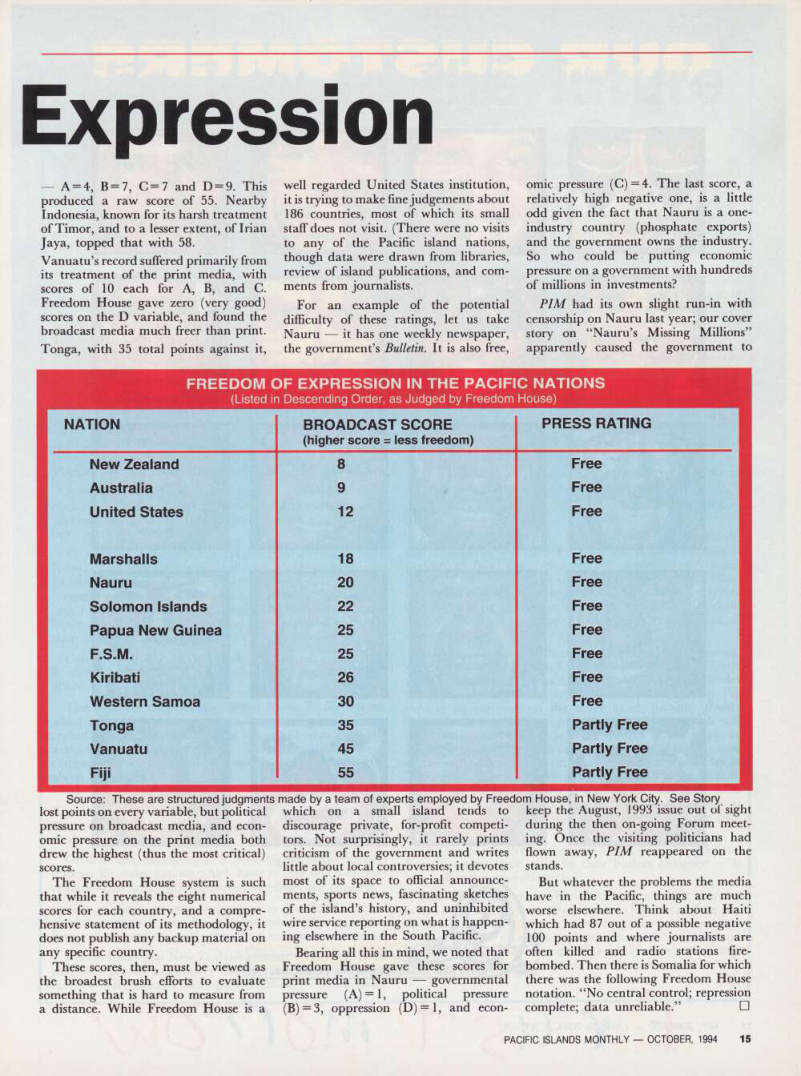
FREEDOM OF EXPRESSION IN THE PACIFIC NATIONS (Listed in Descending Order, as Judged by Freedom House)
Source: These are structured judgments made by a team of experts employed by Freedom House, in New York City. See Story
lost points on every variable, but political pressure on broadcast media, and econ omic pressure on the print media both drew the highest (thus the most critical) scores.
The Freedom House system is such that while it reveals the eight numerical scores for each country, and a compre hensive statement of its methodology, it does not publish any backup material on any specific country.
These scores, then, must be viewed as the broadest brush efforts to evaluate something that is hard to measure from a distance. While Freedom House is a
well regarded United States institution, it is trying to make fine judgements about 186 countries, most of which its small staff does not visit. (There were no visits to any of the Pacific island nations, though data were drawn from libraries, review of island publications, and com ments from journalists.
For an example of the potential difficulty of these ratings, let us take Nauru it has one weekly newspaper, the government’s Bulletin. It is also free,
which on a small island tends to
discourage private, for-profit competi
tors. Not surprisingly, it rarely prints criticism of the government and writes little about local controversies; it devotes most of its space to official announce ments, sports news, fascinating sketches of the island’s history, and uninhibited wire service reporting on what is happen ing elsewhere in the South Pacific.
Bearing all this in mind, we noted that Freedom House gave these scores for print media in Nauru governmental pressure (A) = l, political pressure (B) = 3, oppression (D) = l, and econ
omic pressure (C) =4. The last score, a relatively high negative one, is a little odd given the fact that Nauru is a one industry country (phosphate exports) and the government owns the industry.
So who could be putting economic pressure on a government with hundreds of millions in investments?
PIM had its own slight run-in with censorship on Nauru last year; our cover story on “Nauru’s Missing Millions” apparently caused the government to
keep the August, 1993 issue out of sight during the then on-going Forum meet ing. Once the visiting politicians had flown away, PIM reappeared on the stands.
But whatever the problems the media have in the Pacific, things are much worse elsewhere. Think about Haiti which had 87 out of a possible negative 100 points and where journalists are often killed and radio stations fire bombed. Then there is Somalia for which there was the following Freedom House notation. “No central control; repression complete; data unreliable.” □
Nation
Broadcast Score
(higher score = less freedom)
Press Rating
New Zealand 8 Free Australia 9 Free United States 12 Free Marshalls 18 Free Nauru 20 Free Solomon Islands 22 Free Papua New Guinea 25 Free
F.S.M.
25 Free Kiribati 26 Free Western Samoa 30 Free
Tonga
35 Partly Free Vanuatu 45 Partly Free Fiji 55
Partly Free