The man who is PM
p. 13 · Read in the full issue
WHEN parliament elected Sir Julius Chan the seventh prime minister of PNG for the second time, few in the know were surprised. For months, events leading to the change of government when Chan
replaced his former prime minister, Paias
Wingti, the writing was on the wall. ... , A disenchanted Chan held secret court •i... , . , r with the Opposition as he waited tor the ■ \ r ■ r™ . . . . right opportunity. 1 he Opposition m the meantime did all it could within its meagre resources to seek a court in-
terpretation of
Wingti’s surprise res
ignation and re election, and at
tacked Wingti’s style
of leadership and management of the economy.
On many oc casions, including his resignation and re
election, Wingti
acted without con sultation with his coaltion partners and during Chan’s absence from the country.
Chan’s letter of
resignation to Wingti
said, “Over the past 12 months, courses of national action were chosen with little, if any, consultation with either myself or
my party. The government has become a one-man show, with suspect advisers being vocal and aggressive in their actions.
“Your sudden and secret resignation last year was not in the best interests of PNG. These actions were dictated more by the desire to hold on to power for power’s sake alone, rather than for the good administration of our nation.”
On election day, the new prime minister declared that the outcome was inevitable. “The new coaltion govern ment of Papua New Guinea had to happen. It was quite obvious that there was really no other choice, ” he said in his victory speech, “the long train of mismanagement and scandal has led us to the event of today.
“I do not and will deny Paias Wingti a place in our history, but it would be a sin of gross omission to ignore the fact that by his own actions he has caused his downfall.”
The Supreme Court on August 25 ruled that while Wingti’s resignation was proper, his re-election was null and void.
Under the constitution the re-election of a new prime minister should take place at the next sitting of parliament after it has been informed. Wingti wrote to the governor-general on September 23, the announcement was made on September 24. He was re-elected the same day.
Paias Wingti had thought he had cleverly executed a ‘coup’ in PNG
politics when he resigned on September
23 last year and got re-elected the same day to secure power until the 1997 elections. As events culminated towards the change of government in August, that coup of Wingti’s caused his own downfall and the rise of Chan to prime ministership which he is guaranteed until the 1997 elections.
Then Chan scored his second victory when, for the first time in six years of the Bougainville crisis, a prime minister met the rebel high command and negotiated a ceasefire, signalling hope for peace.
“The guns of war are slowly being silenced,” announced Chan, after the signing of the ceasefire agreement be tween the PNG government and the
Bougainville Revolutionary Army in the
Solomons capital, Honiara, on Septem ber 8. The ceasefire, agreed to in talks between Chan and BRA commander Sam Kauona, came into effect the next
day.
This month another chapter will be written when a South Pacific peacekeep ing force an idea promoted by Chan since his prime-ministerial days in 1980 comprising troops from Tonga, Fiji and Vanuatu will be deployed to Bou gainville, the blockade will be lifted and a peace conference held in the troubled island’s badly ravaged headquarters, Arawa.
That he rallied and managed to organise a regional peacekeeping force
was Chan’s
third victory.
He had seen a dream become reality ... a force which can be used to attend to man-made and natural disasters in the future.
He was also
quick in visiting
Australia to, among other
things, organise
a logistic back up for the
peacekeeping
operation.
Chan is confi dent that the peace momen tum has picked up and will roll on to a happy ending, not in a
hurried way, but in a manner acceptable to all parties.
“At this stage, the process is fragile.
One wrong step will bring us right back to hell,” he cautioned. “I have no hang ups with questions of anyone’s status, whether a bad precedent would be set if a head of government lent legitimacy to a rebel group by meeting with its leader.
I have no worries on that score.
“The Bougainville Revolutionary
Army is a fact of fife, not a shadowy player in a theatrical game. I’m giving this everything I’ve got all my energy, every piece of experience and common sense I may possess.”
He further acknowledged there was blame on both sides and that there had “never been a matter of simple right and wrong”. “We all realise that firstly we must admit the mistakes of the past if we are going to solve them. We recognise and admit that there have been mistakes made on Bougainville.” □
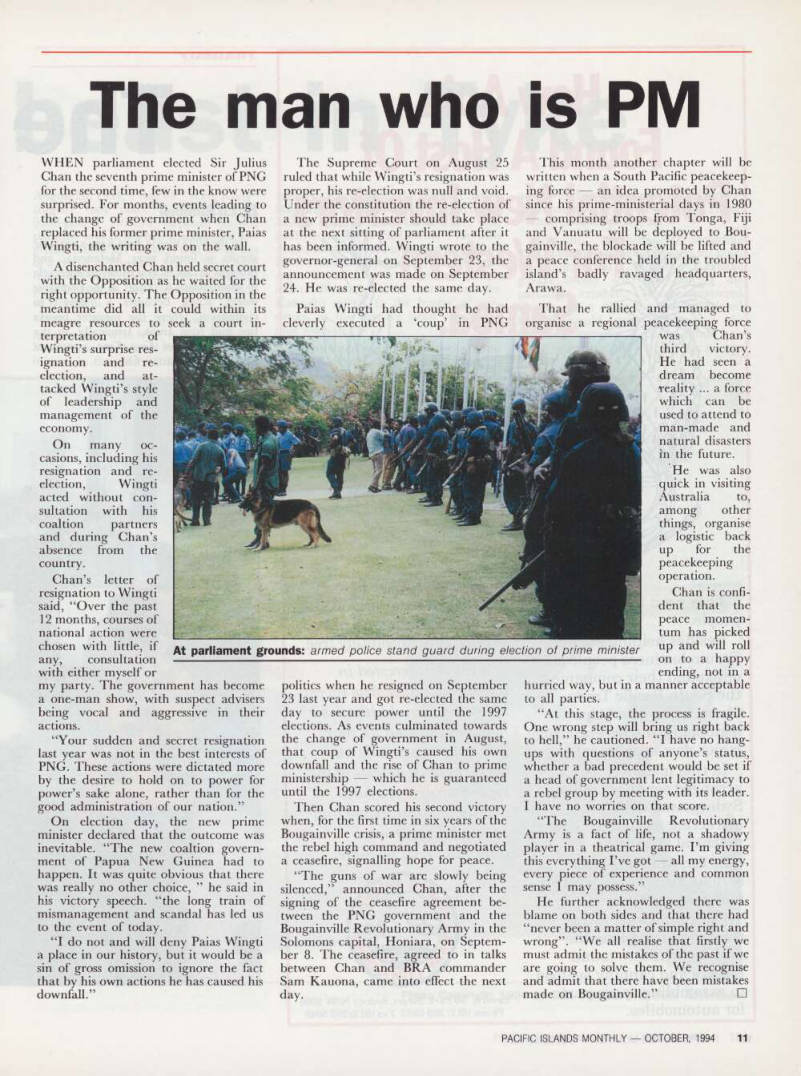
At parliament grounds: armed police stand guard during election of prime minister