In the Red
pp. 9-11 · Read in the full issue
LOTTERY and its jingle “Go Lotto” have been the buzzwords around Papua New Guinea this year. In August the jackpot was K 730,000 the biggest ever in the country. In February the prize was K 444,469. With promises of instant wealth, the game has taken the country
by storm, as people form ever-growing
queques at lottery sales outlets.
Maybe the government of Papua New Guinea should have been in the queque.
While it may seem wrong to gamble with public funds, the state of its pocket was such that any means of getting money was an option.
The state coffers were dry and in a financial mess which left it indebted to many, including its own workforce.
It was little wonder then that public servants were playing lotto and punting on horse races during work hours. For these officers it was no less a gamble than spending fortnights in an office, uncertain of what the return would be.
The crisis had grown to a stage where public servants were going without their pay, vital government services were on the verge of grinding to a halt, the national budget deficit was running at an all time high, and international reserves
were at their lowest levels.
PNG Defence Force soldiers, fighting a war on Bougainville and which was costing both lives and millions of kina, were on numerous occasions not paid or short of supplies and rations. The naval element at one stage withdrew ships from Bougainville, returned to Port Moresby and sat it out for a week until the government assured them that their allowances would be paid and that proper logistical support would be pro vided.
Public Employees Association president Napoleon Liosi complained, “Non payment of wages of public servants is totally unacceptable because numerous families’ survival and comfort depend on what the worker earns. It is morally and legally wrong for the government, as an employer to, to with-hold wages properly earned by workers.”
Leith Anderson, chief of disaster and emergency services said, “Where can I get the money from? I don’t know, it’s pretty bad,” while going through an other year of natural disasters hitting the country.
The government was caught in a stranglehold, and the public was running
worried. It asked how a country reaping benefits from the rich mines and oil fields now in their peak performance period could be short of money. Whatever had happened to the Papua New Guinea dubbed the “mountain of gold floating in a sea of oil”, many were to ask.
The Bougainville war, creation of vice
ministries, expensive government perks
and privileges, overseas trips by govern ment ministers and politicians, hiring of expensive consultants, high government legal fees, fulfillment of expensive elec
tion promises, unbudgeted expenditures,
general financial management... were explanations offered by many. Most, if not all, of these explanations were to prove valid.
The Wingti government responded to the crisis by first conceding that there were financial problems, but denied the country was bankrupt. Wingti’s finance minister, Masket langalio, urged public servants to be patient, saying the prob lems would continue for another four months.
The signs of economic crisis were obvi ous, and langalio made no bones of it when he warned in early August that the nation was facing bankruptcy if no
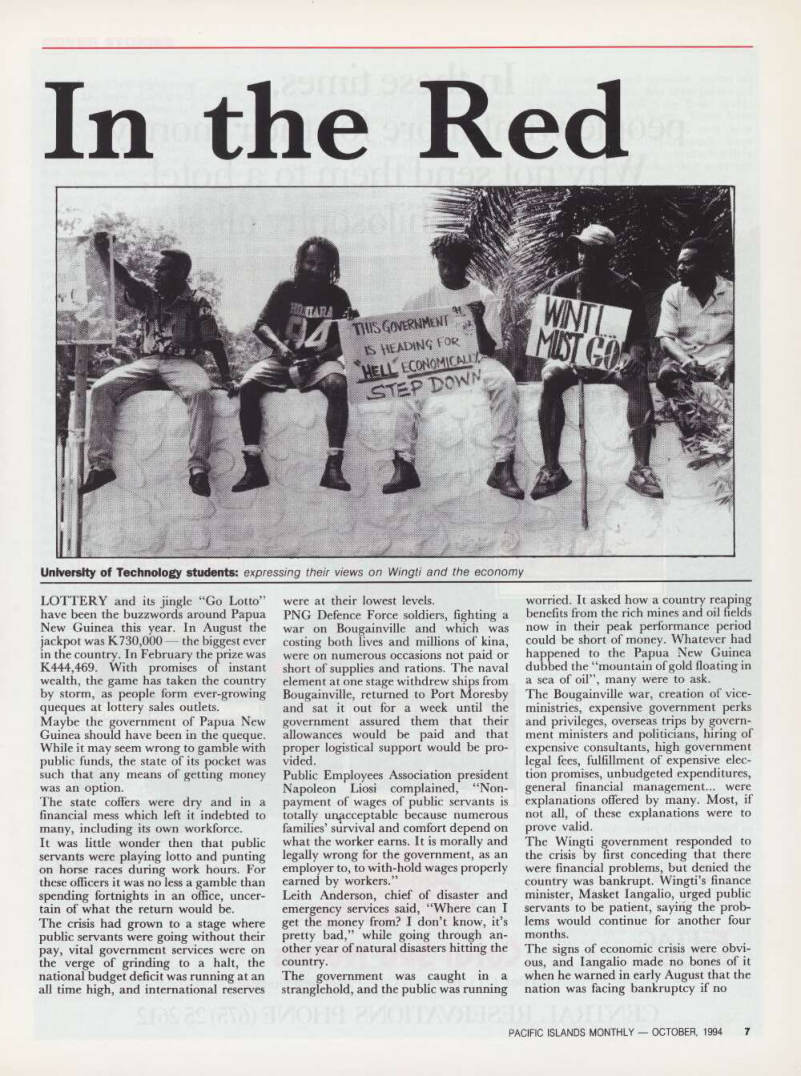
University of Technology students: expressing their views on Wingti and the economy
immediate “belt-tightening” action was taken. He even threatened to prosecute
government departmental heads they
overspent their budgets.
In a forceful address to them langalio said, “Papua New Guinea is now at a watershed. The current fiscal situation has become extremely serious. Most of the budget deficits have exceeded budgeted levels and at the end of 1993, the total accumulated budget stood at KB3l (5.5 per cent of GDP).”
An example of how serious the situ ation had become, the state-owned Post and Telecommunications Corporation, started cutting off telephone and other telecommunications services to cus tomers with accounts in arrears in order to meet its revenue target. A lot of these defaulters turned out to be government departments who found themselves in a communications black-out.
Private companies could not pay their taxes on time because they were owed money by the State. The government had landed itself in a catch-20 situation.
In March, langalio brought down a surprise mini-budget, in which he an
nounced cost-saving and revenue-raising
measures primarily aimed at making up for the estimated K2OO-million shortfall in revenue, which according to him, was a direct result of a sudden drastic drop in world oil prices.
In a more startling move, the govern ment handed over first rights to govern ment revenue from oil and mining projects to an international bank syndi cate led by Union Bank of Switzerland to pay off BUS9O million it secured to fund budget deficits. This government revenue, derived from taxes and profits usually paid to the Mineral Resources Stabilisation Fund, were to be paid to a nominee company, Raggiana Ltd, in the tax haven of Cayman Islands for three years.
Economist John Millet said the deal signalled the “inevitable result of break down in fiscal discipline”, while another economist described the deal as “the first sign that PNG is on the road to serious financial trouble, even bankruptcy”.
Opposition finance spokesman Rabbie
Namaliu, a former prime minister, said the arrangement was “ridiculous and unprecedented” and was “yet another nail in the coffin of PNG’s international credibility”. Namaliu further defended
public servants against langalio’s
“blatant buck-passing”, saying it was the politicians who had the final say on expenditure. He accused the Wingti government of destroying a healthy economy after the 1992 election.
“No amount of political bluster and mud-slinging can conceal the fact that Paias Wingti inherited a healthy econ omy from my government which he succeeded in destroying in a little more than two years,” Namaliu said.
The mini-budget measures to rein in government spending had “barely any
effect”, langalio later conceded. “The level of government deficit is completely unsustainable and if continued will bankrupt the country. We urgently need to address this, and our room for manoeuvre on this is months, not years.”
In June the Governor of the Bank of PNG, Sir Mekere Morauta, issued a warning that government spending had increased by 30 per cent since the beginning of the year, despite appeals for restraint.
Soon after the change of government in August, the new Chan regime said excessive government spending would be
controlled in weeks and the use of costly and largely expatriate consultants would be scrapped. The new finance minister Chris Haiveta said, “Belts that have been tightened will have to be tightened more to help the government in the whole exercise.”
In his acceptance speech Chan, the author of the 1993 and 1994 budgets under then-prime minister Paias Wingti, said his coalition was resuming power when the economy was on the rise. The economic bulletin for the March quarter of this year confirmed that this was true gross domestic product was expected to exceed the planned 14.4 per cent, and there was a stronger than anticipated growth in the private sector. The econ omy was not the problem, it was the government which was overspending, the report said.
Two days earlier, as he was preparing to leave the government of Wingti, Chan said, “The economy is thriving, it’s going strong and there is no reason why we should talk down the economy.” He urged that in order for the budget to work, the government should draw down loans provided by the World Bank, the Asian Development Bank and donor countries.
He later said as prime minister, “The
only cyclone on our horizon centres on the way expenditure has been permitted to storm ahead with very little visible sign of where it has gone. There have been no significant controls over how some government departments have been allowed to not only spend what they were given, but also what they were not given.
“The system has let us down, but the process was accelerated by the way in which spending outside the budget’s limits was allowed to proceed without restraint. I admit that some of our current economic statistics do not paint
a pretty picture.
“Primarily, it is the management of our cash flow which has been allowed to go haywire. The knives are out from today onwards. Expenditures will be trimmed and departments made ac countable for their sins. Heads will roll from sinful shoulders. Discipline and control will be introduced. They’ve been strangers to us for too long.”
His deputy Haiveta gave a “firm assurance” that public servants, the business sector and any others owed money to would be paid.
“I am determined to turn around the financial management of the govern ment’s resources without further delay,” he said.
The new government also promised to deal with and get the much-delayed multi-million kina Lihir gold project, in Chan’s own electorate, off the ground. It was revealed that the delay was caused by a dispute between Wingti and his Mining and Petroleum minister, Sir John
Kaputm.
“Projects which were supposed to have been started a year ago are still in the pipeline. The prime minister has made it Suite clear that Lihir gets first call after ougainville,” Haiveta said.
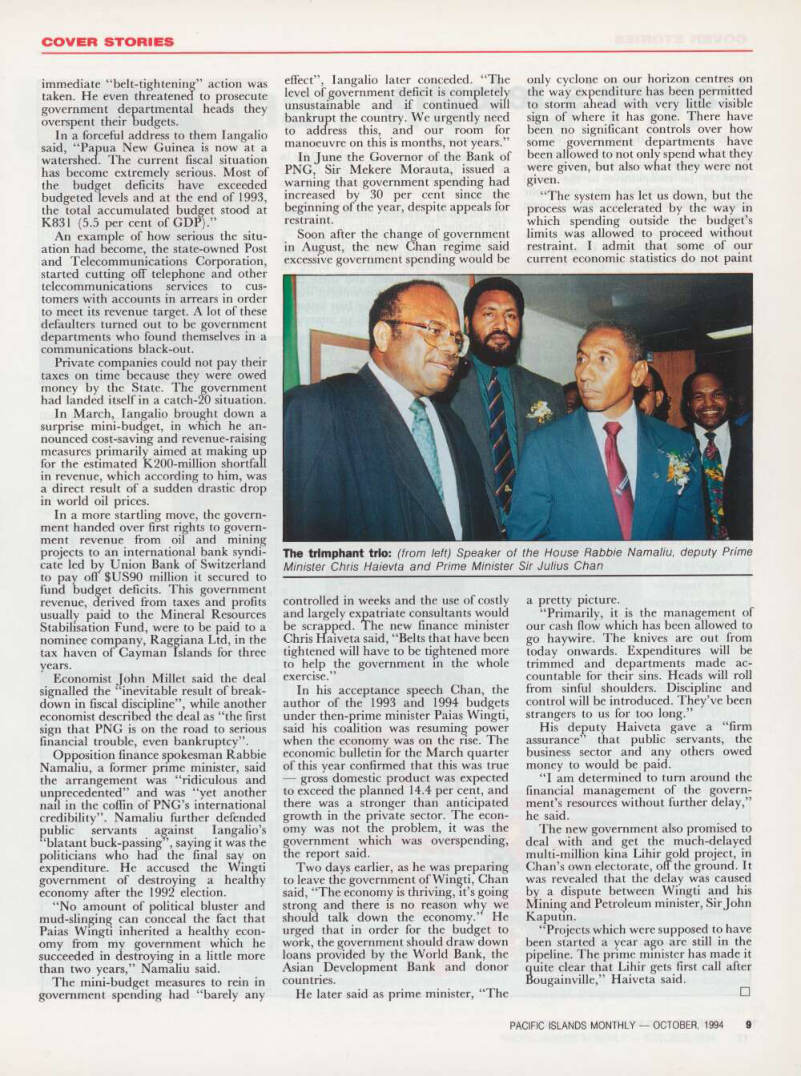
The trimphant trio: (from left) Speaker of the House Rabble Namaliu, deputy Prime Minister Chris Haievta and Prime Minister Sir Julius Chan