purse-strings
pp. 6-7 · Read in the full issue
Business
Managing the purse-strings
Fiji’s new Finance Minister, Berenado Vunibobo, discusses his views on the country’s economy and future with Yunus Rashid.
By Yunus Rashid
PIM: What do you see as your main role and mission in this portfolio and how do you plan to achieve it?
Vunibobo: My main role, apart from the statutory ones, is really to work closely with the other economic ministers in formulating and overseeing govern ment’s policies in the broad areas of the economy. This involves the closest co operation and consultation with the private sector. The other part of “my mission”, as you put it, is to work toward improving the management of govern ment finances. Put another way, I hope to contribute to the protection of the integrity of government finance and its management.
PIM: How do you view Fiji’s currentfinancial and economic position?
Vunibobo: The financial position of the government can be better. There is a need for a concerted effort to focus more clearly on the objectives of government expenditure. This will lay the basis for a squeeze on the current high level of the budget deficit. In addition, expenditure over and above the budgeted amount needs to be controlled very tightly.
The main threat to government finances at present is the possibility of large increases in the public service pay bill.
There is a so-called COLA (Cost of
Living Adjustment) payment in dispute.
This is with the Arbitration Tribunal.
There is also the Job Evaluation reports recommendations to deal with. These could raise government expenditure to highly unsustainable levels.
Fiji’s current economic position is good.
Contrary to the rather gloomy state ments on the economy from the oppo sition and other groups, economic growth will be strong this year. Our major industries, sugar and tourism, are heading for record years. Inflation is very low at present. This is a good sign and
will help our producers remain competi tive, both in export markets and in our domestic market.
PIM: What are Fiji’s strengths and weak nesses?
Vunibobo: Fiji’s main strength is its people. Our mainstay industries are also a source of strength. Tourism is a strength because it is internationally competitive and shows great potential for future development. The sugar industry is a source of both strength and weak nesses. It provides a livelihood to many of our people and is an important source of foreign exchange. However, there is also uncertainty about the future of sugar prices. This will necessitate changes in the industry.
Weaknesses a belief that government has all the answers and can wave a magic wand to eliminate problems; a lack of confidence that Fiji will be able to compete in the world. The Fiji economy
can become internationally competitive.
PIM: Are there plans to improve Fiji’s sugar and tourism industries?
Vunibobo: The major objective in the sugar industry must be to improve efficiency. This is essential in the face of sugar price cuts which are likely as a result of changes to the EU agricultural policy. The industry is currently looking at the possibility of introducing a quality payments system. At present, cane pay ments are based on weight. The new system would pay farmers on the basis of sugar content. This will provide the incentive to improve yields and to choose cane varieties which have high sugar content.
Our tourism industry is doing well this year. Visitor arrivals are at record levels and hotel occupancy rates are high. The challenge facing the industry is to sustain this growth over the long haul. New flights will help. There will be an additional flight to Japan (Osaka) start ing in October (this month). The new
Air Pacific flight to the West Coast of the US which started in July will tap both the USA and European markets. The Fiji Visitors Bureau, the hotels and airlines must continue to focus sharply on source markets with the greatest poten tial.
PIM: Are there any plans which you hope to implement to improve Fiji’s exports?
Vunibobo: Our government’s economic policies centre around economic growth achieved through the promotion of exports within a competitive market
economy. Successful exporting requires
that we are competitive at an interna tional level. This means bringing our domestic prices more in line with inter national prices. This is the rationale behind the trade deregulation pro gramme.
Government commissioned a study to develop an Export Development Strat egy last year. An Export Strategy Committee of government officials has been established to oversee the im plementation of the study’s recommen dations. We are looking at ways of channelling more aid funds direct to industry with the aim of improving firms’ ability to export. The TFF and TFZ
(Tax Free Factory/Zone) schemes,
together with company tax concessions for exporters, will remain as important incentives for exporters.
PIM : Do investors local and overseas have enough incentives to invest in Fiji?
Vunibobo: Yes, I believe that the incentive package we offer through the TFF/TFZ schemes and the company tax concessions for exporting are very gen erous by international standards. There is evidence, from international studies of incentives for investment, that factors other than tax holidays play a more significant role in attracting investment.
These are such things as government attitude to business, the availability of infrastructure, the availability of skilled labour at a reasonable price, a stable macro-economic framework.
PIM : How can Fiji compete with cheap goods imported from Asian sources?
Vunibobo: The deregulation of trade has considerably reduced Fiji cost structure.
This, coupled with very low inflation rates of late, will make Fiji producers better able to compete. Many of the cheap alternative products imported from some Asian countries, were initially very popular. However, many consumers have realised that they are of very low quality and are switching back to buy Fiji-made products. Better enforcement of quality and standards legislation is needed to ensure that there is fair competition between local producers and
imports.
PIM : How can local production costs be reduced to allow our manufacturers to compete with their overseas counterparts?
Vunibobo: The import substitution and self-sufficiency policies of the 1980 s led to high-cost economy. The process of trade deregulation is part of the solution for reducing costs. A major cost of pro duction, however, is the cost of labour.
The labour reforms of 1991 and 1992 were aimed at making changes in wages more closely aligned with the commer cial realities facing companies. It is important that, if we are to compete successfully, employers do not concede wage increases that are not paid for
through higher output.
PIM : Do you have plans which will help offset the negative effects of deregulation?
Vunibobo: The deregulation programme has brought many benefits. Consumers now face lower prices for many staple products. There is much more variety in the shops. Exporters find they are able to import raw materials at much lower cost and without time-consuming customs clearance.
However, the policy of deregulation has not been without its costs. The lowering of import tariffs has meant that many producers have had to make adjustments, sometimes painful adjust ments, to new economic conditions.
Government has monitored the im pact of deregulation on industries pro ducing for the local market. The moni toring exercise has been encouraging in that it has revealed measures have been taken to adjust to the competition.
Production has had to become more efficient in the face of greater competition from imports. Some producers have diversified into other products, some have increased export sales. These ad justments mean our economy is becom ing more efficient and better able to compete in the international market place.
As a result of these monitoring exer cises, the deregulation timetable was slowed down with the last cut in the general maximum import tariff limited to only five per cent instead of 10 per cent.
I am very concerned about the impact of deregulation. A study, which is currently underway, is taking a much wider view* of the whole deregulation process and is assessing the overall impact of deregulation. The results of this study will be used to devise ad ditional ways in which we, the govern ment, can assist in the process of adjustment. I should add that I think it essential that the deregulation pro gramme continues.
PIM : Do you think Fiji politics and issues
like the Sunday ban are a hindrance to economic growth?
Vunibobo: They are only a hindrance because of the way we have handled the issue. It is not an easy one to deal with because the issue has become emotionally charged. I myself believe that there are issues of public interest that are best addressed away from the public arena.
Grand-standing in order to highlight what is perceived as a weakness often ends up being counter-productive. If it has become a hindrance it is because we ourselves on both sides of the divide have made it a hindrance.
PIM : Will you revive the Economic Summit?
Vunibobo: This is something I have yet to give serious consideration to.
PIM : Do you have statistics on recent investments?
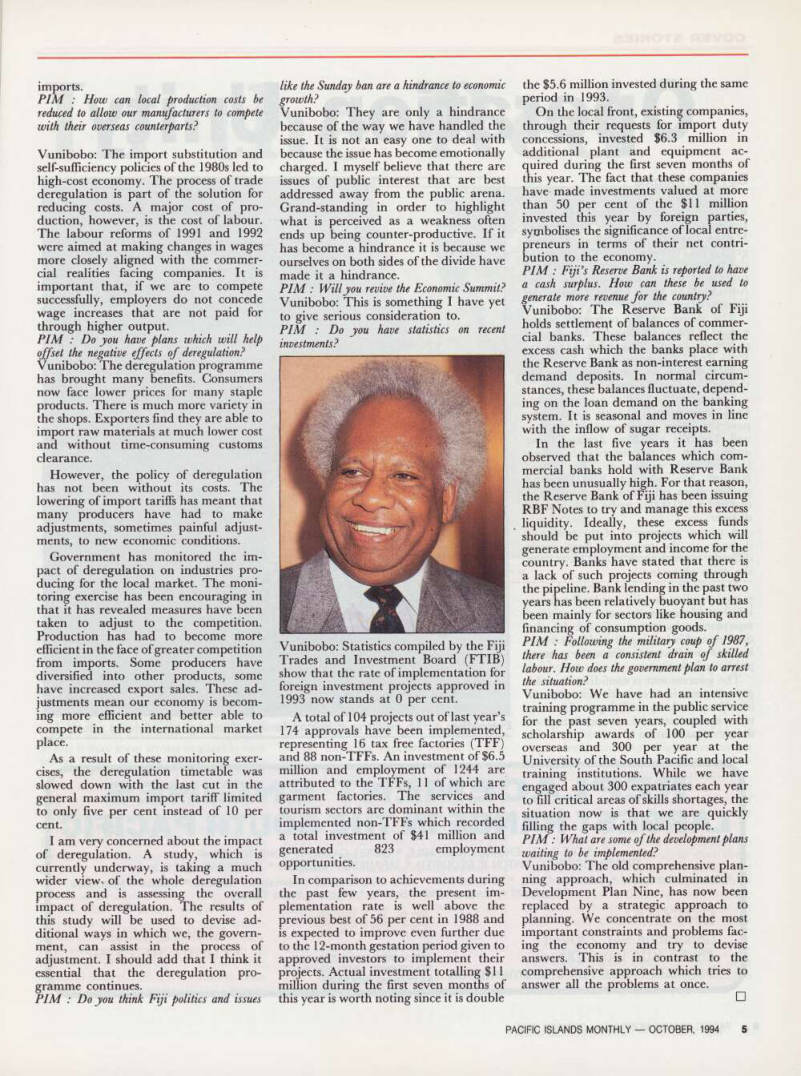
Vunibobo: Statistics compiled by the Fiji Trades and Investment Board (FTIB) show that the rate of implementation for foreign investment projects approved in 1993 now stands at 0 per cent.
A total of 104 projects out of last year’s 174 approvals have been implemented, representing 16 tax free factories (TFF) and 88 non-TFFs. An investment of $6.5 million and employment of 1244 are attributed to the TFFs, 11 of which are garment factories. The services and tourism sectors are dominant within the implemented non-TFFs which recorded a total investment of s4l million and
generated 823 employment
opportunities.
In comparison to achievements during the past few years, the present im plementation rate is well above the previous best of 56 per cent in 1988 and is expected to improve even further due to the 12-month gestation period given to approved investors to implement their projects. Actual investment totalling $ 11 million during the first seven months of this year is worth noting since it is double
the $5.6 million invested during the same period in 1993.
On the local front, existing companies, through their requests for import duty concessions, invested $6.3 million in additional plant and equipment ac quired during the first seven months of this year. The fact that these companies have made investments valued at more than 50 per cent of the $ 11 million invested this year by foreign parties, symbolises the significance of local entre preneurs in terms of their net contri bution to the economy.
PIM : Fiji’s Reserve Bank is reported to have a cash surplus. How can these be used to generate more revenue for the country?
Vunibobo: The Reserve Bank of Fiji holds settlement of balances of commer cial banks. These balances reflect the excess cash which the banks place with the Reserve Bank as non-interest earning demand deposits. In normal circum stances, these balances fluctuate, depend ing on the loan demand on the banking system. It is seasonal and moves in line with the inflow of sugar receipts.
In the last five years it has been observed that the balances which com mercial banks hold with Reserve Bank has been unusually high. For that reason, the Reserve Bank of Fiji has been issuing RBF Notes to try and manage this excess liquidity. Ideally, these excess funds should be put into projects which will generate employment and income for the country. Banks have stated that there is a lack of such projects coming through the pipeline. Bank lending in the past two years has been relatively buoyant but has been mainly for sectors like housing and financing of consumption goods.
PIM : Following the military coup of 1987, there has been a consistent drain of skilled labour. How does the government plan to arrest the situation?
Vunibobo: We have had an intensive training programme in the public service for the past seven years, coupled with scholarship awards of 100 per year overseas and 300 per year at the University of the South Pacific and local training institutions. While we have engaged about 300 expatriates each year to fill critical areas of skills shortages, the situation now is that we are quickly filling the gaps with local people.
PIM : What are some of the development plans waiting to be implemented?
Vunibobo: The old comprehensive plan ning approach, which culminated in Development Plan Nine, has now been
replaced by a strategic approach to
planning. We concentrate on the most important constraints and problems fac ing the economy and try to devise answers. This is in contrast to the comprehensive approach which tries to answer all the problems at once. □