Tua takes it easy
pp. 66-67 · Read in the full issue
By Atama Raganivatu
THE Pacific islands have a meritorious boxing tradition. The region can claim Commonwealth Games gold medalists, Commonwealth professional champions, Olympic Games medalists, world title
contenders and even a former holder of one of the sport’s less plausible versions of a world title.
However, a significant pro fessional world championship has proved elusive and, for many, it still seems too good to be true that a 21 year old Samoan is being acclaimed as a likely future contender for the sporting world’s greatest prize the World Heavy
weight Championship.
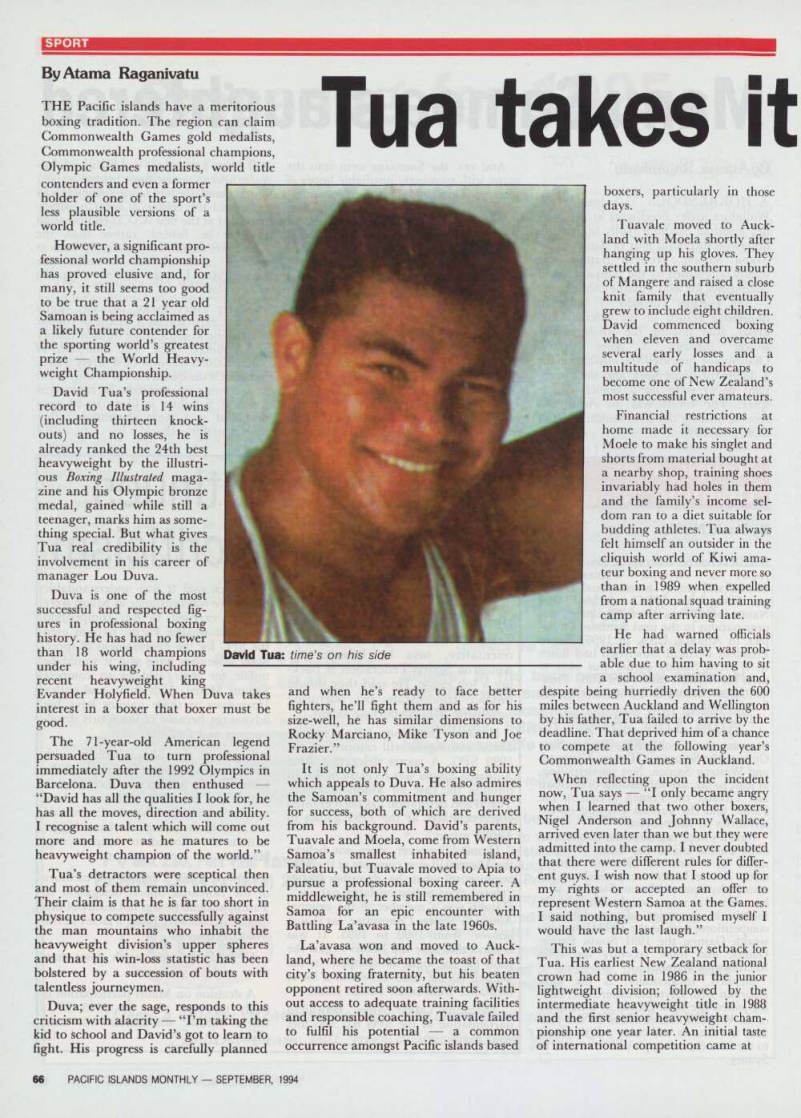
David Tua’s professional record to date is 14 wins (including thirteen knock outs) and no losses, he is already ranked the 24th best heavyweight by the illustri ous Boxing Illustrated maga zine and his Olympic bronze medal, gained while still a teenager, marks him as some thing special. But what gives Tua real credibility is the involvement in his career of manager Lou Duva.
Duva is one of the most successful and respected fig ures in professional boxing history. He has had no fewer than 18 world champions under his wing, including recent heavyweight king
Evander Holyfield. When Duva takes interest in a boxer that boxer must be good. rp, * . , , The 71-year-old American legend persuaded Tua to turn professional immediately after the 1992 Olympics in Barcelona. Duva then enthused “David has all the qualities I look for, he has all the moves, direction and ability.
I recognise a talent which will come out more and more as he matures to be , -i.i • c , , heavyweight champion of the world. 7 & r Tua’s detractors were sceptical then and most of them remain unconvinced.
Their claim is that he is far too short in
physique to compete successfully against
the man mountains who inhabit the heavyweight division’s upper spheres and that his win-loss statistic has been bolstered by a succession of bouts with
talentless journeymen.
Duva; ever the sage, responds to this criticism with alacrity “I’m taking the kid to school and David’s got to learn to fight. His progress is carefully planned
a nd when he’s ready to face better fighters, he’ll fight them and as for his size-well, he has similar dimensions to Rocky Marciano, Mike Tyson and Toe Frazi ' r » J .
It is not only Tuas boxing ability which appeals to Duva. He also admires the Samoan’s commitment and hunger for success, both of which are derived from his background. David's parents, Tuavale and Moela, come from Western c , 11 , 7 • i i*, i *i j Samoa s smallest inhabited island, f-s i . , m , , * . aea 1U ’ u uava move o pia o
a boxing careei j
middleweight, he is still remembered m Samoa or , an e .P lc Battling La avasa m the late 19605.
La’avasa won and moved to Auck land, where he became the toast of that
city’s boxing fraternity, but his beaten
opponent retired soon afterwards. With out access to adequate training facilities and responsible coaching, Tuavale failed to fulfil his potential a common occurrence amongst Pacific islands based
boxers, particularly in those
days.
Tuavale moved to Auck land with Moela shortly after
hanging up his gloves. They
settled in the southern suburb of Mangere and raised a close
knit family that eventually
grew to include eight children.
David commenced boxing when eleven and overcame several early losses and a multitude of handicaps to become one of New Zealand’s most successful ever amateurs.
Financial restrictions at home made it necessary for Mode to make his singlet and shorts from material bought at
a nearby shop, training shoes
invariably had holes in them and the family’s income sel dom ran to a diet suitable for
budding athletes. Tua always
felt himself an outsider in the cliquish world of Kiwi ama teur boxing and never more so than in 1989 when expelled from a national squad training camp after arriving late.
He had warned officials earlier that a delay was prob able due to him having to sit a school examination and,
despite being hurriedly driven the 600
miles between Auckland and Wellington by his father, Tua failed to arrive by the deadline. That deprived him of a chance to compete at the following year’s Commonwealth Games in Auckland, . .
When reflecting upon the incident n ° w > Tua says I only became angry
er \ learnecl other boxers,
Nl « el Anderson and Johnny Wallace, a t nv s vela a [ er lan ! u ! ' T"' I *.' admitted into the camp. 1 never doubted . r . , f that there were ditierent rules lor diller ent g U ys. I wish now that I stood up for m y r ig Fts or accepted an offer to represent Western Samoa at the Games.
I said nothing, but promised myself I would have the last laugh.” was but a temporary setback for Tua His earliest New Zealand national crown had come in 1986 in the junior lightweight division; followed by the intermediate heavyweight title in 1988 and the first senior heavyweight cham pionship one year later. An initial taste of international competition came at
David Tua: time's on his side
the 1991 World Junior Championships in Peru. He suffered a controversial loss to a Cuban there but soon afterwards beat the gold medal winner, Russia’s Angor Undrew, in a challenge match at Palmerston North.
Olympic champion Felix Savon of Cuba knocked him out during the first round of their World Championships semi final clash in Australia, just before the Barcelona Games. Still, Tua was gaining knowledge with every fight and he went to Spain confident of bringing home a gold medal. After conclusive wins over Spanish and Czech opponents, only Nigeria’s David Oizonritei stood be tween him and a rematch with Savon in the final. Unfortunately, the tall, willy Oizonritei outpointed a strangely listless Tua despite having his nose broken.
Tua had done sufficient in the two earlier bouts to impress Duva as an uncut diamond with immense promise. The teenager needed little persuasion to turn professional. Compatriot Jimmy Peau (now better known as Jimmy Thunder) stagnated far too long in the backwater of New Zealand amateur boxing and allowed his career to lose all momentum before, belatedly, joining the paid ranks.
Two or three more year as a carefully groomed amateur would probably have benefitted Tua but New Zealand was unlikely to provide this and, moreover, he was eager to secure the financial future of his family. “We are poor,” he said at the time. “I admit it and I’m not ashamed of it. But, hopefully, I can
change that.”
One of Duva’s priorities was to change Tua’s eating habits. His penchant for fresh bread and hamburgers (even when offered a variety of healthy food in Barcelona, he preferred to frequent the local McDonalds) may have been per missible in New Zealand’s haphazard amateur boxing circles but Duva insists his food intake now befits a top athlete.
Billed in the United States as “The Terminator”, Tua’sphysique, as well as ringcraft, have developed to an incred ible degree under the elderly guru.
In New Zealand and Western Samoa for a holiday during May and June, Tua also impressed interviews with his level headedness. “People have their own expectations of me. They want me to be the world heavyweight champion,” he contemplated. “I think I will be, but right now I just have be patient. My time will come and I will be ready. I am always learning. I know where I’m going and how I’m going to get there. No one will stop me, because I believe in myself.
That’s the key.” □