Living off the fertile resource of land
p. 61 · Read in the full issue
THE Vanuatu Archipelago consists of very fertile land. The population lives in small villages and meets most of its own needs as regards food and domestic necessities.
Traditional family “agriculture” is
based on root crops, planted in small, carefully-tended gardens. The crops con sist mainly of yams, taros, cassava and sweet potatoes but there are also ba nanas, sugar canes and kavas.
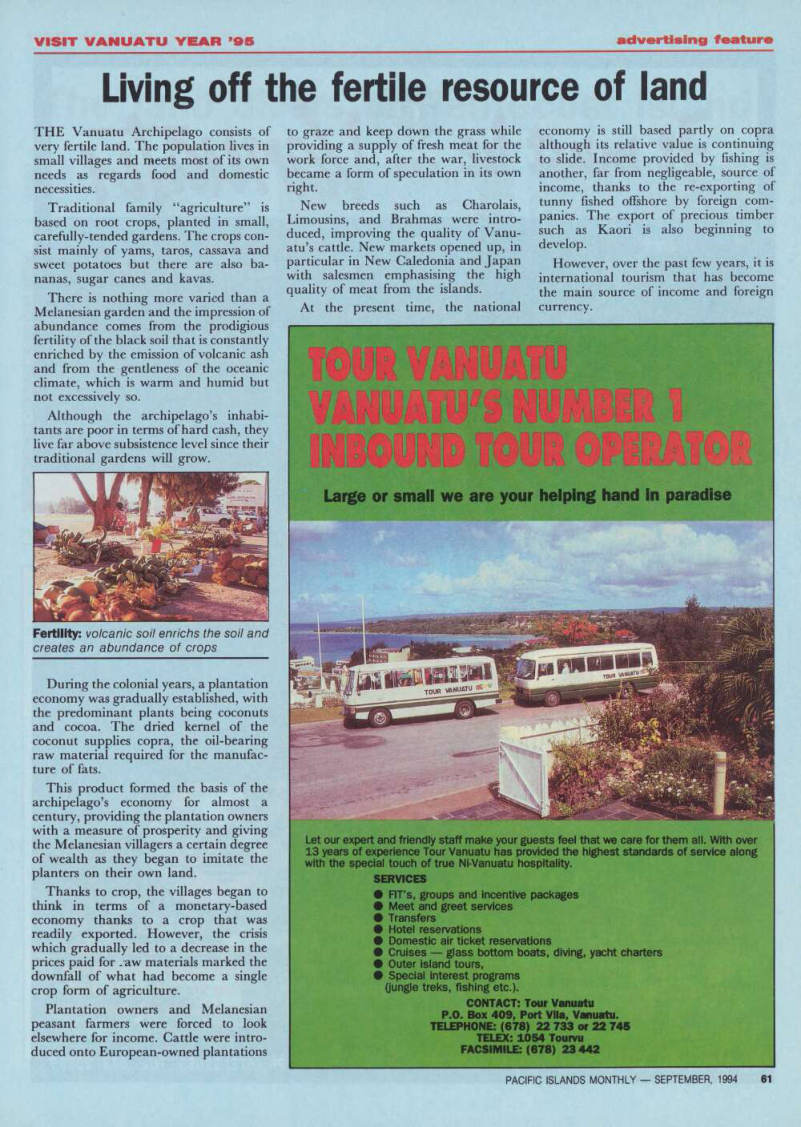
There is nothing more varied than a Melanesian garden and the impression of abundance comes from the prodigious fertility of the black soil that is constantly enriched by the emission of volcanic ash and from the gentleness of the oceanic climate, which is warm and humid but not excessively so.
Although the archipelago’s inhabi
tants are poor in terms of hard cash, they live far above subsistence level since their traditional gardens will grow.
During the colonial years, a plantation economy was gradually established, with the predominant plants being coconuts and cocoa. The dried kernel of the coconut supplies copra, the oil-bearing raw material required for the manufac ture of fats.
This product formed the basis of the archipelago’s economy for almost a century, providing the plantation owners with a measure of prosperity and giving the Melanesian villagers a certain degree of wealth as they began to imitate the planters on their own land.
Thanks to crop, the villages began to think in terms of a monetary-based economy thanks to a crop that was readily exported. However, the crisis which gradually led to a decrease in the prices paid for /aw materials marked the downfall of what had become a single crop form of agriculture.
Plantation owners and Melanesian peasant farmers were forced to look elsewhere for income. Cattle were intro duced onto European-owned plantations
to graze and keep down the grass while providing a supply of fresh meat for the work force and, after the war, livestock became a form of speculation in its own
right.
New breeds such as Charolais, Limousins, and Brahmas were intro duced, improving the quality of Vanu atu’s cattle. New markets opened up, in particular in New Caledonia and Japan with salesmen emphasising the high quality of meat from the islands.
At the present time, the national
economy is still based partly on copra although its relative value is continuing to slide. Income provided by fishing is another, far from negligeable, source of income, thanks to the re-exporting of tunny fished offshore by foreign com panies. The export of precious timber such as Kaori is also beginning to develop.
However, over the past few years, it is international tourism that has become the main source of income and foreign currency.
Fertility: volcanic soil enrichs the soil and creates an abundance of crops