Heroes honoured
p. 53 · Read in the full issue
Guam
War veterans get warm welcome in Guam celebrations
By Barbara Ray
ON July 21, Guam welcomed 1500 US Fveterans and their families once again to its shores. The people of Guam saluted the veterans during the golden anniver sary celebration just as they had fifty years ago when these same men stormed
ashore, ending the three-year occupation
by the Japanese during World War li.
From the moment they stepped off the plane, the veterans were treated like
royalty. Five days of festivities, including
many dedications, memorials, and re unions greeted the men. Even the Chamoru nation, an activist group which had vowed to protest the military land takings, quietly backed away at the urging of government officials and public sentiment.
The group agreed to a compromise. In exchange for calling off the protest, they would be allowed to plead their case to a small group of veterans, who, it was hoped, would take the message back to Washington. The group explained to the veterans that self-determination was still elusive fifty years after these same men liberated the island in the name of
democracy.
Many veterans expressed surprise at
the news, while others saw the situation as bleak, acknowledging that a previous
letter-writing campaign had produced
little.
However, recent news from Washing ton garners guarded optimism from those involved in Commonwealth talks. The Clinton Administration has signalled a
willingness to discuss the “mutual consent” clause, which for years has been a stumbling lock in nego tiations. The clause gives Guam a mutual voice in the approval of any laws that effect it. Past administrations had determined this clause unconstitutional.
But events in Washington were put on the back burner for a few days as Guam concentrated on what it loves to do best, celebrate.
Even torrential rains could not dampen spirits at the marathon parade on the
21st. Five hours of floats, military bands,
Boy Scouts, and past Liberation Day
Queens greeted cheering crowds num
bering in the thousands lining Marine Drive.
By the sunset, the grandstands housing
island dignitaries and veterans had emptied, but the crowds on the street held firm. The trucks pulling the floats simply turned on their lights. Darkness just made for a smooth transition to a grand finale of fireworks.
The July 21 festivities had begun on a more somber note, however. Shortly after sunrise, a Navy ceremony at sea was held with a 21-gun salute followed by the missing man formation flying aloft. On land, a ceremony dedicating a memorial to the Third Marinee Division at Asan beach held sway. It was on this beach that the Marines had landed in the dawn hours of July 21, 1994. Further south, at Agat beach, Marines of the 9th division along with the 77th Army division landed amid heavy resistance.
The recapture of Guam would take its toll, with nearly 7,000 American men killed or wounded and roughly 17,000
Japanese falling victim.
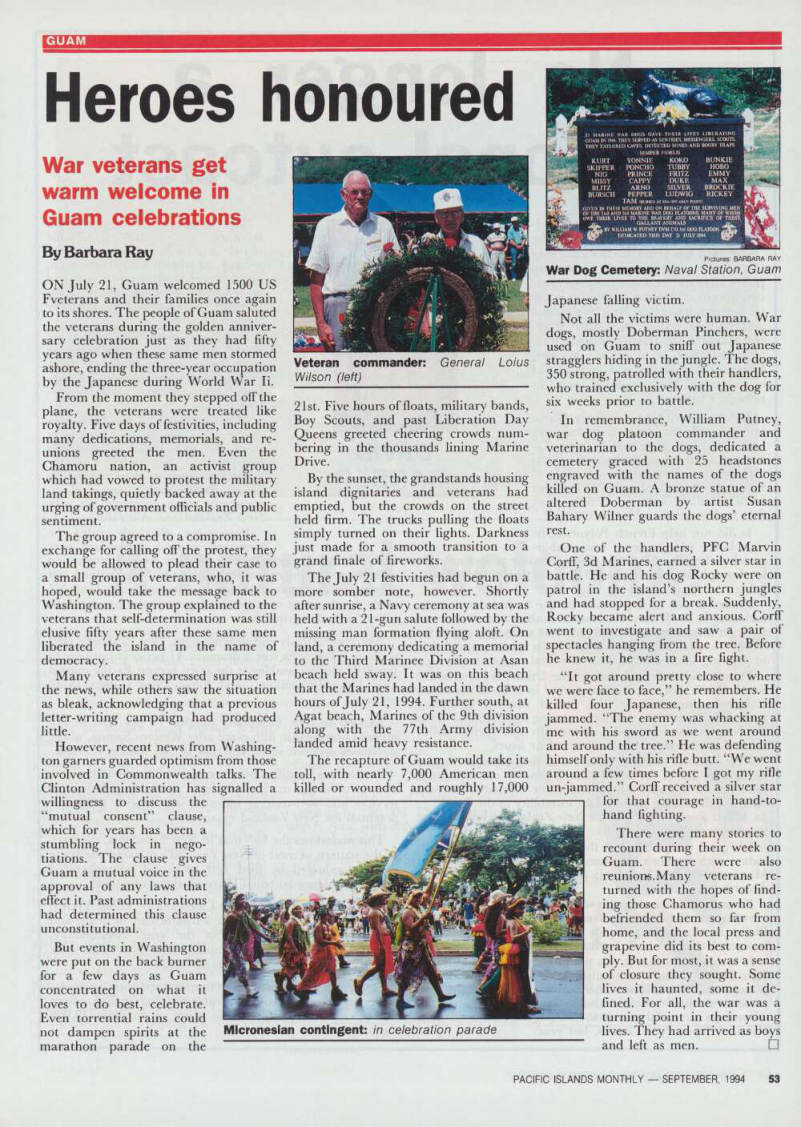
Not all the victims were human. War dogs, mostly Doberman Pinchers, were used on Guam to sniff out Japanese stragglers hiding in the jungle. The dogs, 350 strong, patrolled with their handlers, who trained exclusively with the dog for six weeks prior to battle.
In remembrance, William Putney, war dog platoon commander and veterinarian to the dogs, dedicated a cemetery graced with 25 headstones engraved with the names of the dogs killed on Guam. A bronze statue of an altered Doberman by artist Susan
Bahary Wilner guards the dogs’ eternal
rest.
One of the handlers, PFC Marvin Corff, 3d Marines, earned a silver star in battle. He and his dog Rocky were on patrol in the island’s northern jungles and had stopped for a break. Suddenly, Rocky became alert and anxious. Corff went to investigate and saw a pair of spectacles hanging from the tree. Before he knew it, he was in a fire fight.
“It got around pretty close to where we were face to face,” he remembers. He killed four Japanese, then his rifle jammed. “The enemy was whacking at me with his sword as we went around and around the tree.” He was defending himself only with his rifle butt. “We went around a few times before I got my rifle un-jammed.” Corff received a silver star
for that courage in hand-to
hand fighting.
There were many stories to recount during their week on Guam. There were also reunions. Many veterans re turned with the hopes of find ing those Chamorus who had befriended them so far from home, and the local press and grapevine did its best to com ply. But for most, it was a sense of closure they sought. Some lives it haunted, some it de fined. For all, the war was a turning point in their young lives. They had arrived as boys and left as men. □
Veteran commander: General Loius Wilson (left)
Micronesian contingent: in celebration parade
Pictures: BARBARA RAY War Dog Cemetery: Naval Station, Guam