Korman’s challenge
p. 14 · Read in the full issue
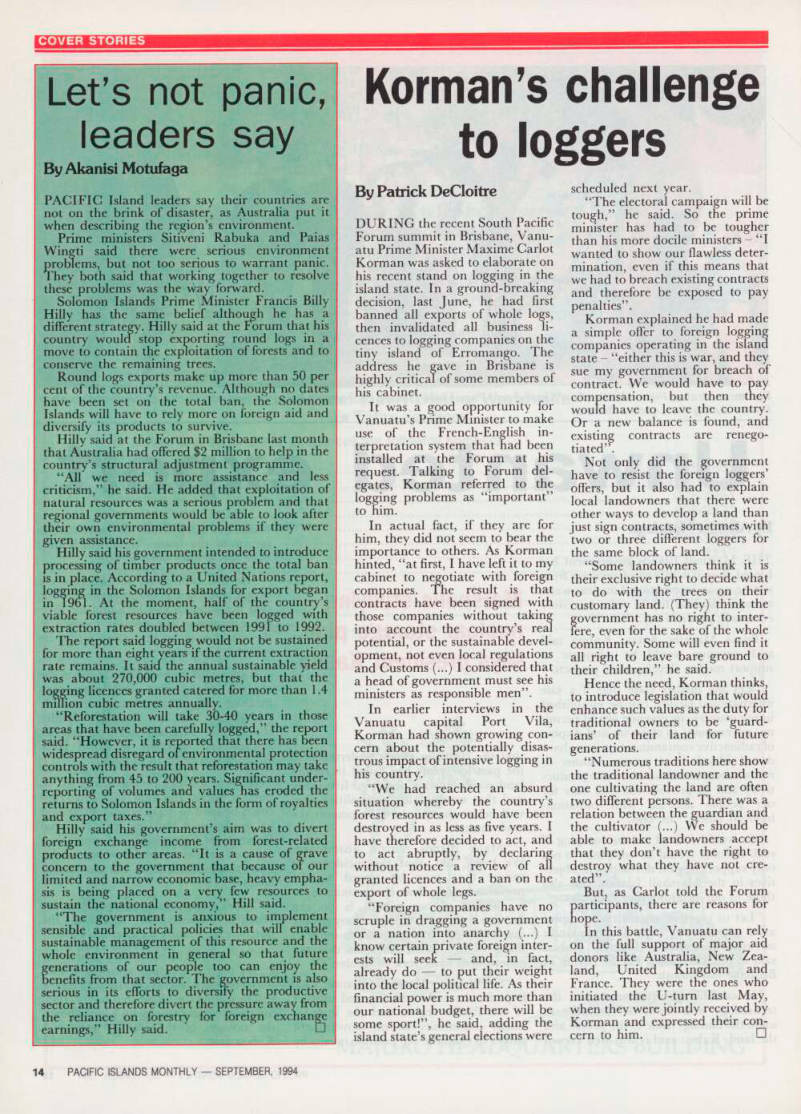
to loggers
By Patrick DeCloitre
DURING the recent South Pacific Forum summit in Brisbane, Vanu atu Prime Minister Maxime Carlot Korman was asked to elaborate on his recent stand on logging in the island state. In a ground-breaking decision, last June, he had first banned all exports of whole logs, then invalidated all business li cences to logging companies on the tiny island of Erromango. The address he gave in Brisbane is highly critical of some members of his cabinet.
It was a good opportunity for Vanuatu’s Prime Minister to make use of the French-English in terpretation system that had been installed at the Forum at his request. Talking to Forum del egates, Korman referred to the logging problems as “important” to him.
In actual fact, if they are for him, they did not seem to bear the importance to others. As Korman hinted, “at first, I have left it to my cabinet to negotiate with foreign companies. The result is that contracts have been signed with those companies without taking into account the country’s real potential, or the sustainable devel opment, not even local regulations and Customs (...) I considered that a head of government must see his ministers as responsible men”.
In earlier interviews in the Vanuatu capital Port Vila, Korman had shown growing con cern about the potentially disas trous impact of intensive logging in his country.
“We had reached an absurd situation whereby the country’s forest resources would have been destroyed in as less as five years. I have therefore decided to act, and to act abruptly, by declaring without notice a review of all granted licences and a ban on the export of whole legs.
“Foreign companies have no scruple in dragging a government or a nation into anarchy (...) I know certain private foreign inter ests will seek and, in fact, already do to put their weight into the local political life. As their financial power is much more than our national budget, there will be some sport!”, he said, adding the island state’s general elections were
scheduled next year.
“The electoral campaign will be tough,” he said. So the prime minister has had to be tougher than his more docile ministers - “I wanted to show our flawless deter mination, even if this means that we had to breach existing contracts and therefore be exposed to pay
penalties”.
Korman explained he had made
a simple offer to foreign logging
companies operating in the island state - “either this is war, and they sue my government for breach of contract. We would have to pay
compensation, but then they
would have to leave the country.
Or a new balance is found, and existing contracts are renego tiated”.
Not only did the government have to resist the foreign loggers’ offers, but it also had to explain local landowners that there were other ways to develop a land than just sign contracts, sometimes with two or three different loggers for the same block of land.
“Some landowners think it is their exclusive right to decide what to do with the trees on their customary land. (They) think the government has no right to inter fere, even for the sake of the whole community. Some will even find it all right to leave bare ground to their children,” he said.
Hence the need, Korman thinks, to introduce legislation that would enhance such values as the duty for traditional owners to be ‘guard ians’ of their land for future
generations.
“Numerous traditions here show the traditional landowner and the one cultivating the land are often two different persons. There was a relation between the guardian and the cultivator (...) We should be able to make landowners accept that they don’t have the right to destroy what they have not cre ated”.
But, as Carlot told the Forum participants, there are reasons for nope.
In this battle, Vanuatu can rely on the full support of major aid donors like Australia, New Zea land, United Kingdom and France. They were the ones who initiated the U-turn last May,
when they were jointly received by
Korman and expressed their con cern to him. □