The Forum
pp. 9-10 · Read in the full issue
Cover Stories
Managing resources, SPARTECA changes; Tabai stays in post
By Akanisi Motufaga
THIS year’s South Pacific Forum was certainly one with a difference. Apart from having a specific theme, Australian Prime Minister Paul Keating said it was also an attempt to revert to the original aim which the founders had in mind.
However, there were indications that some countries left the Forum disap pointed and Fiji was no exception. As an official put it, Fiji lost in its bid for the post of secretary-general for the Forum Secretariat, it did not get much out of the SPARTECA changes and the agreement to work towards a common code of conduct for the logging industry.
“The code of conduct does not really apply to Fiji because its logging problems
are not as severe as other countries like Vanuatu, Papua New Guinea or the Solomons,” the official pointed out.
Although Fiji Prime Minister Sitiveni Rabuka said the Forum in Brisbane was more effective compared to the previous two, he could not confirm whether the changes to SPARTECA would be in favour of Fiji.
Fiji was also disappointed and angry with the way former Kiribati president leremia Tabai was re-appointed as secretary-general to the Suva-based Fo rum Secretariat.
Fiji may have been the only country that left disappointed as the Solomon Islands delegation left with an offer of $2 million from the Australian Government to help conserve its forests.
This year’s 25th Forum focussed on the theme of Managing Our Resources with great emphasis on environment issues such as fishing, nuclear dumping and logging as well as regional airline services.
According to a United Nations report,
environment issues are the regional governments’ main challenge. It said 70 per cent of Pacific Islanders living in rural areas and outer islands depend on the environment and ecosystem for their livelihood.
“Any destruction to the environment will, therefore, have a wide and signifi cant impact on the welfare and survival of the large minority of Pacific people,” it said.
The report said deforestation in the Solomon Islands was a fine example of failure to carefully consider environ mental costs.
Australian Minister Gordon Bilney said part of the logging problem was related regional governments being ripped olf by logging companies and the lack of careful monitoring.
Some of these countries, he said, were Vanuatu, Papua New Guinea, Solomon Islands and, to some extent, Fiji.
“In some of these countries, you are looking at a situation where the rate of exploitation is six to eight times higher
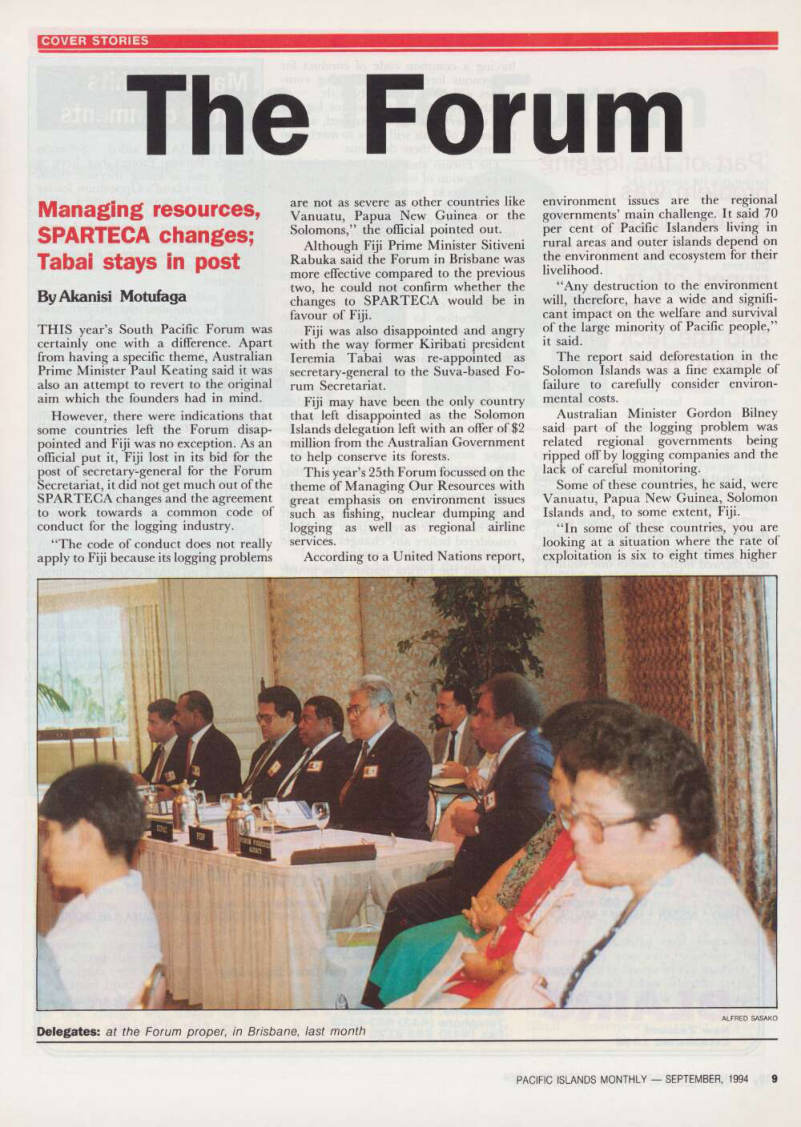
Alfred Sasako
Delegates: at the Forum proper, in Brisbane, last month
‘Part of the logging problem was related to regional governments being ripped off by logging companies and the lack of careful monitoring’
than what is sustainable in forestry,” said Bilney, Australia’s Minister for Pacific Island Affairs.
“The countries are simply not getting the prices for the exports that they ought to. I was reading some figures recently that showed in the case of one country’s logs that were being sold for around $3.50 per cubic metre were returning only $2.70 to that country,” the minister said.
Bilney stressed that Australia would not adopt a ‘big brother’ attitude; rather
it would help regional countries through
advice and technical assistance to use their resources in a sustainable way to last for the next generations.
As a result of these discussions, an agreement was drawn up between Aus tralia, New Zealand, Fiji, Vanuatu, Solomon Islands and Papua New Guinea where: (a) these governments will work towards
having a common code of conduct for indigenous forests which logging com panies will have to comply with; (b) the urgent need to monitor logging and timber exports was stressed, and (c) senior officials will have to meet soon to implement these decisions.
The Forum also agreed to strengthen its promotion of sustainable exploitation of fish stocks within the region and welcomed the United Nations Conven tion of the Law of the Sea which would build and strengthen the current regional ties.
In its communique, the Forum said global warming and the rise in sea level were the most serious threats to the region. It welcomed the negotiations for a convention to ban the imports to hazardous and radioactive wastes into Forum Island countries and to control the transboundary movement and man agement of such waste within the South
Pacific region.
The communique said Forum leaders agreed to look into rationalising air services to operate on a likely sub regional basis in a move to arrest airline losses.
Bilney said at a Press conference that losses for regional airlines ran into millions. The communique said issues such as frequency, operation costs airfares and safety regulations would be considered before any changes are made to the current airline structure.
It said the Forum leaders also noted: (a) that finance and trade ministers in the region should meet to discuss and devise proper policies, broaden the Forum island countries economic base, improve the balance of payments and look into fiscal public sector mismanage ment; (b) that the usage of land, in terms of the indigenous peoples’ relation to their land, varied from country to country, and (c) that officials would meet later this year at Hawaii to form an agenda and proposal aimed at promoting trade and investment between the United States and Pacific Island states. □