Hawaii
p. 60 · Read in the full issue
Yachting
Mahalo Hawaii
By Sally Andrew
AT sunset, Fellowship was two miles oil the beach at Kalapana. Lava was {lowing into the sea and great clouds of steam laced with hydrochloric acid were rising into the air! We sailed as close as we dared, nervous that our rigging and sails (and probably our lungs) would disintegrate in the chemical vapours let off by the interaction of sea and lava.
What an evening! High up the moun tain side 1 could see the orange ring of the bubbling caldera. Plowing lava traced an intermittent path down to the sea, a glowing orange line that often disappeared underground into lava tubes and behind obstructions. The hillside was aglow with the scattered fires of Pcle ancient goddess of the volcano.
As we approached Ka Lac (South Point), the wind freshened to 40 knots and started shrieking in the rigging. Our GPS and dead reckoning indicated we were well offshore, but the lights of a car on shore made me nervous. They weren’t marked on our chart.
We had made our Hawaiian landfall at Hilo, customs port for the “Big Island” of Hawaii and the best place to leave a boat and land cruise for a few days. Car rentals are cheap so we drove right round the island to the waterfalls of the Hamakua coast, the grassy plains of Paniolo/Cowboy country and Hawaii Volcanoes National Park. Hawaii holds a store of wonders and the active volcanic eruption at Kilauea was one of several natural phenomena that we witnessed while cruising in Hawaii.
Hilo is the only harbour on the windward side of the Big Island. On the leeward side, there are several anchor ages but they can be roily if a swell is up.
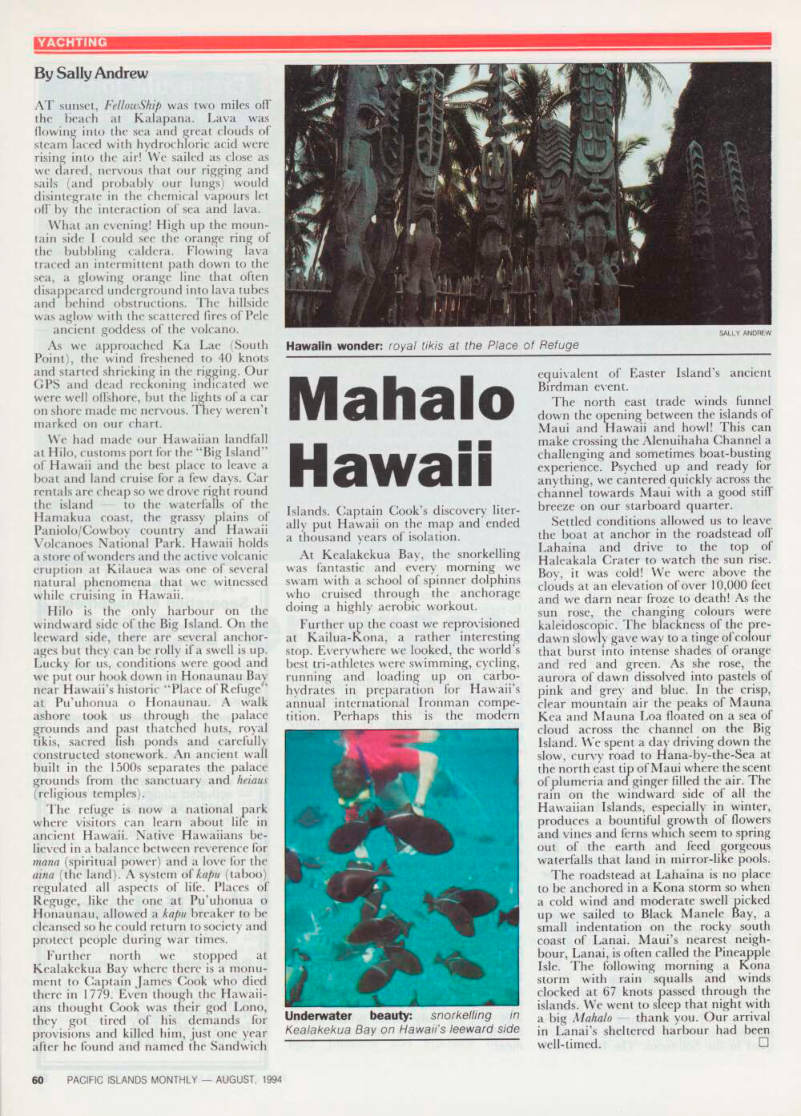
Lucky for us, conditions were good and we put our hook down in Honaunau Bay near Hawaii’s historic “Place of Refuge” at Pu’uhonua o Honaunau. A walk ashore took us through the palace grounds and past thatched huts, royal tikis, sacred fish ponds and carefully constructed stonework. An ancient wall built in the 1500 s separates the palace grounds from the sanctuary and heiaus
(religious temples).
The refuge is now a national park where visitors can learn about life in ancient Hawaii. Native Hawaiians be lieved in a balance between reverence for mana (spiritual power) and a love for the aina (the land). A system o l'kapu (taboo) regulated all aspects of life. Places of Rcgugc, like the one at Pu’uhonua o Honaunau, allowed a kapu breaker to be cleansed so he could return to society and protect people during war times.
Lurther north we stopped at Kealakekua Bay where there is a monu ment to Captain James Cook who died there in 1779. Even though the Hawaii ans thought Cook was their god Lono, they got tired of his demands for provisions and killed him, just one year after he found and named the Sandwich
Islands. Captain Cook’s discovery liter ally put Hawaii on the map and ended a thousand years of isolation.
At Kealakekua Bay, the snorkelling was fantastic and every morning we swam with a school of spinner dolphins who cruised through the anchorage doing a highly aerobic workout.
Lurther up the coast we reprovisioned at Kailua-Kona, a rather interesting stop. Everywhere we looked, the world’s best tri-athletes were swimming, cycling, running and loading up on carbo hydrates in preparation for Hawaii’s annual international Ironman compe tition. Perhaps this is the modern
equivalent of Easter Island’s ancient Birdman event.
The north east trade winds funnel down the opening between the islands of Maui and Hawaii and howl! This can make crossing the Alenuihaha Channel a
challenging and sometimes boat-busting
experience. Psyched up and ready for
anything, we cantered quickly across the channel towards Maui with a good stiff breeze on our starboard quarter.
Settled conditions allowed us to leave the boat at anchor in the roadstead of!
Lahaina and drive to the top of Haleakala Crater to watch the sun rise.
Boy, it was cold! We were above the clouds at an elevation of over 10,000 feet and we darn near froze to death! As the sun rose, the changing colours were kaleidoscopic. The blackness of the pre dawn slowly gave way to a tinge of colour that burst into intense shades of orange and red and green. As she rose, the aurora of dawn dissolved into pastels of pink and grey and blue. In the crisp, clear mountain air the peaks of Mauna Kea and Mauna Loa floated on a sea of cloud across the channel on the Big Island. We spent a day driving down the slow, curvy road to Hana-by-the-Sea at the north east tip of Maui where the scent of plumeria and ginger filled the air. The rain on the windward side of all the Hawaiian Islands, especially in winter, produces a bountiful growth of flowers and vines and ferns which seem to spring out of the earth and feed gorgeous waterfalls that land in mirror-like pools.
The roadstead at Lahaina is no place to be anchored in a Kona storm so when a cold wind and moderate swell picked up we sailed to Black Manele Bay, a small indentation on the rocky south coast of Lanai. Maui’s nearest neigh bour, Lanai, is often called the Pineapple Isle. The following morning a Kona storm with rain squalls and winds clocked at 67 knots passed through the islands. We went to sleep that night with a big Mahalo thank you. Our arrival in Lanai’s sheltered harbour had been well-timed. D
Sally Andrew
Hawaiin wonder: royal tikis at the Place of Refuge
Underwater beauty: snorkelling in Kealakekua Bay on Hawaii’s leeward side