Aid under scrutiny
p. 56 · Read in the full issue
Books
By Bill Morton
AS we approach the mid point of the 19905, there is a greater consensus on what the most important issues are which face the region. There is the problem of achieving economic growth which will provide for the requirements of a grow ing population. There is the need to ensure that the exploitation of resources does not result in the wrecking of precious environments. And there is the need to ensure that political and social change is smooth and harmonious.
What is the role of the bigger, richer
and more “developed” nations such as Australia in tackling these issues? One clear role is as a provider of overseas aid, now euphemistically known as “over seas development assistance”.
Reliance on overseas aid is a fact of life for most Pacific island countries. The continued receipt of aid will be a vital factor in their
development equations during
the rest of the 19905.
Australia’s efforts in the over seas aid arena have attracted particular attention over the last month. First there was the release of the 1994/95 budget which revealed that funding for official development assistance has once again decreased as a proportion of GNP, prompting accusations that the low level of assistance will adversely affect the govern ment’s trade and foreign rela tions. Then there was a barrage of criticism from Papua New
Guinea’s Deputy Prime Minister and Foreign Minister Sir Julius Chan who maintained that Australia’s decision to phase out budgetary aid in favour of programme and project aid would affect
PNG’s independence and sovereignty.
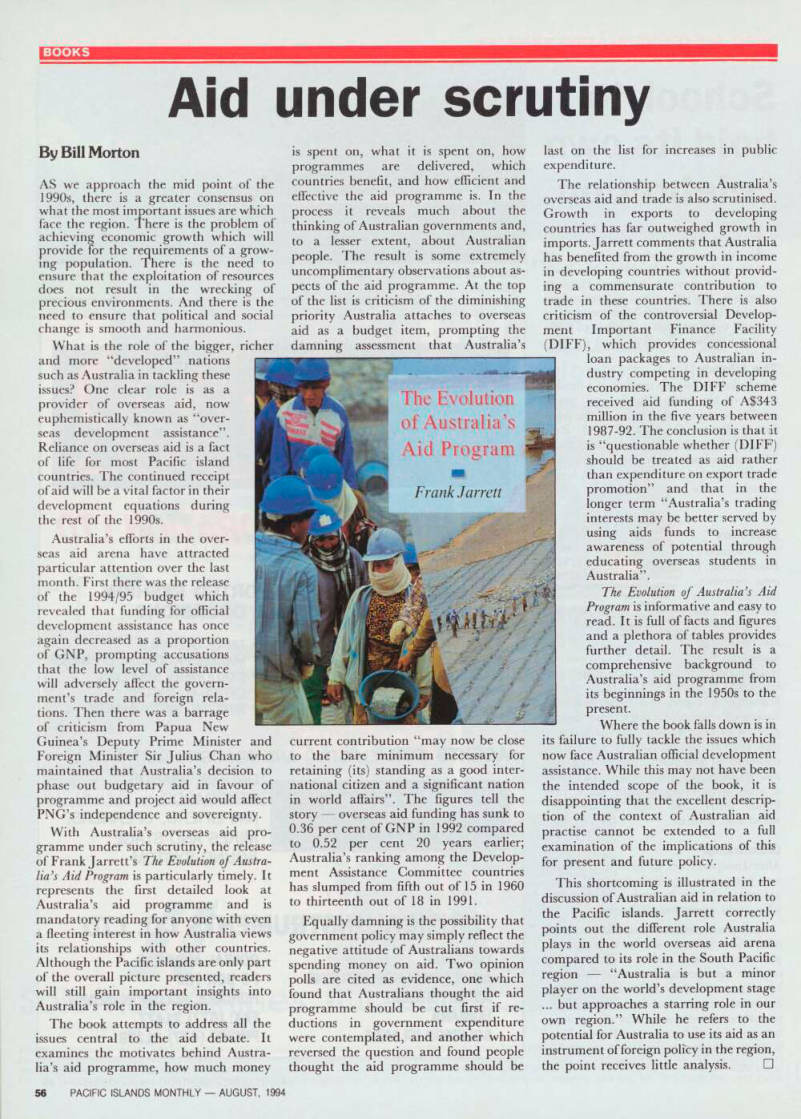
With Australia’s overseas aid pro gramme under such scrutiny, the release of Frank Jarrett’s The Evolution of Austra lia’s Aid Program is particularly timely. It represents the first detailed look at Australia’s aid programme and is mandatory reading for anyone with even a fleeting interest in how Australia views its relationships with other countries.
Although the Pacific islands are only part of the overall picture presented, readers
will still gain important insights into
Australia’s role in the region.
The book attempts to address all the issues central to the aid debate. It examines the motivates behind Austra lia’s aid programme, how much money
is spent on, what it is spent on, how programmes are delivered, which countries benefit, and how efficient and effective the aid programme is. In the process it reveals much about the thinking of Australian governments and, to a lesser extent, about Australian people. The result is some extremely uncomplimentary observations about as pects of the aid programme. At the top of the list is criticism of the diminishing priority Australia attaches to overseas aid as a budget item, prompting the damning assessment that Australia’s
current contribution “may now be close to the bare minimum necessary for retaining (its) standing as a good inter national citizen and a significant nation in world affairs”. The figures tell the story overseas aid funding has sunk to 0.36 per cent of GNP in 1992 compared to 0.52 per cent 20 years earlier; Australia’s ranking among the Develop ment Assistance Committee countries has slumped from fifth out of 15 in 1960 to thirteenth out of 18 in 1991.
Equally damning is the possibility that
government policy may simply reflect the negative attitude of Australians towards spending money on aid. Two opinion polls are cited as evidence, one which found that Australians thought the aid programme should be cut first if re ductions in government expenditure were contemplated, and another which reversed the question and found people thought the aid programme should be
last on the list for increases in public expenditure.
The relationship between Australia’s overseas aid and trade is also scrutinised.
Growth in exports to developing countries has far outweighed growth in imports. Jarrett comments that Australia has benefited from the growth in income in developing countries without provid ing a commensurate contribution to trade in these countries. There is also criticism of the controversial Develop ment Important Finance Facility (DIFF), which provides concessional
loan packages to Australian in
dustry competing in developing
economies. The DIFF scheme received aid funding of A 5343 million in the five years between 1987-92. The conclusion is that it
is “questionable whether (DIFF)
should be treated as aid rather than expenditure on export trade promotion” and that in the
longer term “Australia’s trading
interests may be better served by using aids funds to increase
awareness of potential through
educating overseas students in Australia”.
The Evolution of Australia’s Aid Program is informative and easy to read. It is full of facts and figures and a plethora of tables provides further detail. The result is a
comprehensive background to
Australia’s aid programme from its beginnings in the 1950 s to the present.
Where the book falls down is in
its failure to fully tackle the issues which now face Australian official development assistance. While this may not have been the intended scope of the book, it is disappointing that the excellent descrip tion of the context of Australian aid practise cannot be extended to a full examination of the implications of this for present and future policy.
This shortcoming is illustrated in the discussion of Australian aid in relation to the Pacific islands. Jarrett correctly points out the different role Australia plays in the world overseas aid arena compared to its role in the South Pacific region “Australia is but a minor player on the world’s development stage ... but approaches a starring role in our own region.” While he refers to the potential for Australia to use its aid as an instrument of foreign policy in the region, the point receives little analysis. □