A natural attraction
p. 49 · Read in the full issue
Visit Solomon Islands Year ’95
advertising feature
THE Solomon Islands is located in the South Western Pacific about 1796 kilometres from Australia. It comprises an archipelago of about 1000 islands stretching some 1400 kilometres from Bougainville in the North West and to Vanuatu in the South East. ... square kilometres and liesTcUveen five to 12 degrees south of the equator The British colonised the islands and declared it a protectorate in 1893. In 1976 the Solomons became self-governing and
became fully independent in July 1978.
The British monarch remains head of state and is represented by a governorral F fhese islands were once t ie site o some of the most fierce bait cs o tic Second World War. But today the sound of gunfire has long been Silenced and all that remains are relics of that war which
theTacific.
is basically an agricultural country which accounts for about 60 per cent of the Gross Domestic Product. Tourism remains undeveloped but the islands are gearing up for Visit South Pacific Year
1995 (Vspy ’95).
The various provinces are putting together their own programmes to coincide with the year and the event is
being co-ordinated by the Solomon Islands Tourist Authority (SITA). Al though the programme has been delayed in getting off the ground, much of the programme that is being put together are events that are already in place and will be used as the main attraction for visitors. With its many natural attrac tions unique to the area and with the help of SITA the islands will be focussing on the diving spots in the islands. Home
to one of the worlds longest lagoons at Uepi, which is located at the edge of
Marovo Lagoon, the newly
opened Uepi Resort has
opened the door for not only divers but all other visitors to enjoy the natural attractions of the area.
Further down from here is Munda, an historic site
with wreckages, remnants of World War II and in this same area Rendova Lagoon, origin of the headhunters.
Nearby is Agnes Lodge where David Kera will share with the visitor the culture and traditions of these people.
From the provincial capital of the Western Province Gizo, is Gizo Hotel which offers magnificent tropical sea food; Saraghi Beach; and the volcanic
island of Simbo where the diving is breathtaking. The Solomon Islands is working on marketing these natural attractions for VSPY ’95.
The cultures, traditions and peoples of the Solomon Islands, are quite diverse.
Many still retain this identity and live in their traditional homes. They grow their own food such as taro, yams, pana and other introduced cash crops. Traditional craftsmen still practice their craft and
produce beautiful pottery and wood carvings. The greatest attraction about these islands cultural heri tage is that it is part of their everyday life.
Cultural groups perform at hotels offering exciting performances with presen tations such as the pan pipists. Besides the richness
of its cultural heritage, historically the islands played a vital role during World War II as some of the most fierce battles fought with Japanese troops were fought here. Honiara on the island of Guadal canal is of immense historic interest as it was here that the United States allied forces were based and sunken Japanese ships and plane wrecks are reminders of this once fierce battle ground. □
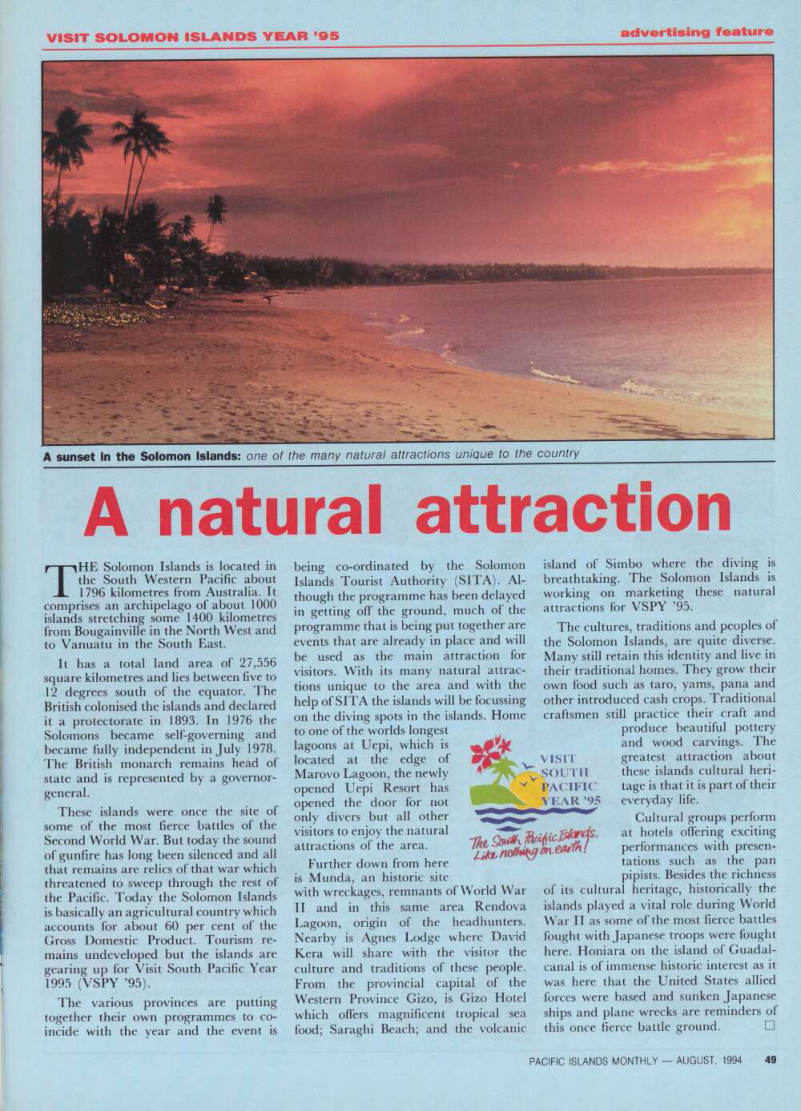
A sunset in the Solomon islands: one of the many natural attractions unique to the country