A stinking bird, and
p. 37 · Read in the full issue
Nature
A stinking bird, and the downside of western education
By David North
THE natural resources of the islands have many enemies created by the West global warming, overlogging, and rapacious mining practices but a California professor suggests another one, wide-spread education of the island young.
And to underline his point, he tells a long story about his adventures with a particular New Guinean bird, one that stinks to high heaven within minutes of its death. Jared Diamond, an evolution ary biologist at the University of Califor nia at Los Angeles, has a specialised approach to the resources of the rain forest. Whenever he has a chance he flies to PNG, the Solomons or Irian Jaya to study birds, in the hopes of learning more about them and of finding natural substances in the birds that would be helpful to modern medicine worldwide.
Like many others, he is convinced that the immense biological diversity of the island rain forests holds out the hope for miracle drugs, like another penicillin, and other compounds useful to mankind.
Further, he senses that the best way to find these potentially valuable com pounds is to identify living species using these chemicals as tools in their day-to day lives. Dr Diamond located a New Guinea bird, for example, that simply opens its mouth and insects fly in, creating a no-effort lunch for the bird in question. It is the Papuan frogmouth, a raven-sized creature.
The frogmouth presumably has, over time, evolved a technique for exuding a substance of some kind that attracts the insects; that substance once copied in laboratories by chemists might make a major contribution to ecologically-safe techniques to control pests which deprive farmers of their crops.
So where does education come into the picture? Dr Diamond is an ethnobiologist, a university scientist who has learned that the best way to find out what is going on among the birds of the rain forest is to talk with tribal hunters men who have lived with, used, and observed the birds, and other wildlife, since childhood. (It was such a hunter who told Dr Diamond the story of the
Papuan frogmouth).
The tribal hunters have spent their entire lives in the jungle. Dr Diamond, and his Western-educated peers, on the other hand, get to visit the rain forests only a few weeks or months at a time, and only a few times in the course of their careers. Even though they are trained observers these scientists cannot possibly know as much about the birds as the hunters who have spept decades in the rainforests. Dr Diamond, writing in the American scientific publication Natural History (February 199 J), describes how an Irian Jaya tribe, the Ketengbans, became so knowledgeable “Tradition ally the Ketengbans acquired this know-
ledge by spending much of their time in the forest, from childhood on. When I asked Robert Uropka (a tribal hunter) how lacking binoculars and the sight of one eye, he had come to know so much about (these birds) that live in the treetops, he told me that as children he and his playmates used to climb trees, build blinds in the canopy, and observe and hunt up there. But all of that is changing, he explained, as he pointed to his eight-year-old-son. Children go to school now, and only at vacation times can they live in the forest. The results, as I have seen elsewhere in New Guinea, are adult New Guineans who know scarcely more about birds than do most American inner-city dwellers.”
Diamond offered two other examples of island birds remarkable character istics, long known to the tribal hunters, but only recently reported by Western science.
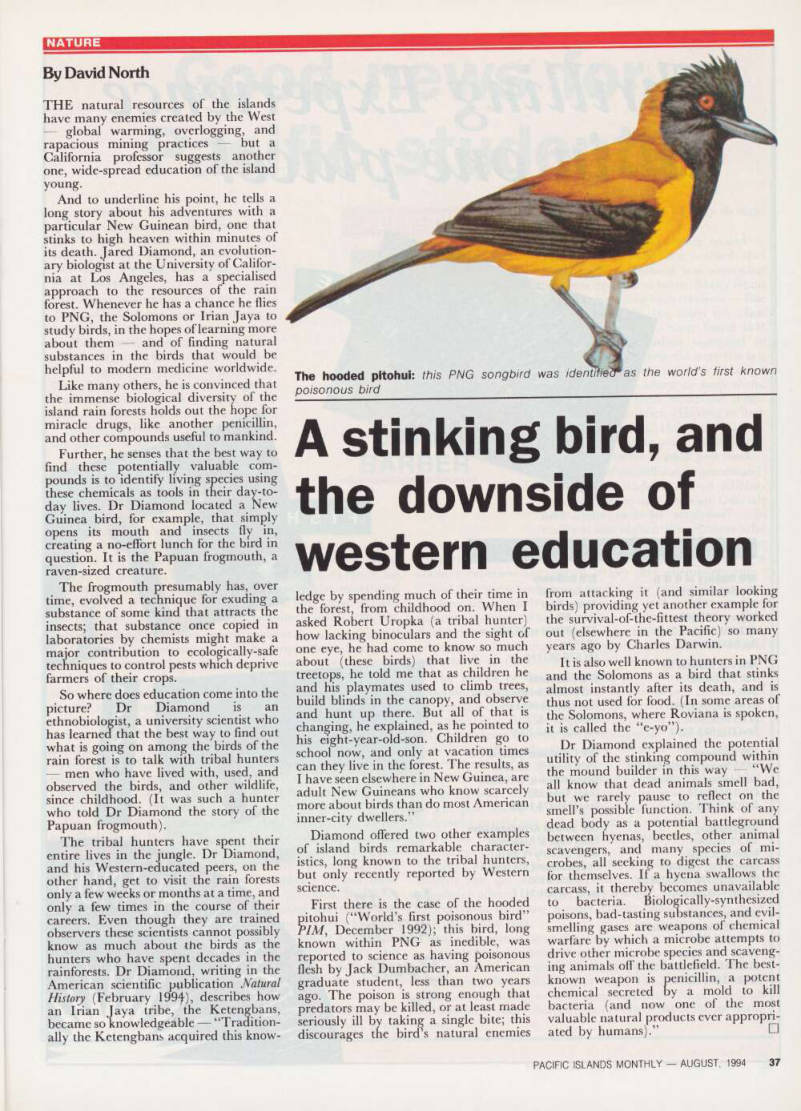
First there is the case of the hooded pitohui (“World’s first poisonous bird”
PIM, December 1992); this bird, long known within PNG as inedible, was reported to science as having poisonous flesh by Jack Dumbacher, an American graduate student, less than two years ago. The poison is strong enough that predators may be killed, or at least made seriously ill by taking a single bite; this discourages the bird’s natural enemies
from attacking it (and similar looking birds) providing yet another example for the survival-of-the-fittest theory worked out (elsewhere in the Pacific) so many years ago by Charles Darwin.
It is also well known to hunters in PNG and the Solomons as a bird that stinks almost instantly after its death, and is thus not used for food. (In some areas of the Solomons, where Roviana is spoken, it is called the “e-yo”).
Dr Diamond explained the potential utility of the stinking compound within the mound builder in this way “We all know that dead animals smell bad, but we rarely pause to reflect on the smell’s possible function. Think of any dead body as a potential battleground between hyenas, beetles, other animal scavengers, and many species of mi crobes, all seeking to digest the carcass for themselves. If a hyena swallows the carcass, it thereby becomes unavailable to bacteria. Biologically-synthesized poisons, bad-tasting substances, and evil smelling gases are weapons of chemical warfare by which a microbe attempts to drive other microbe species and scaveng ing animals off the battlefield. The best known weapon is penicillin, a potent chemical secreted by a mold to kill bacteria (and now one of the most valuable natural products ever appropri ated by humans).” D
The hooded pitohui: this PNG songbird was identified as the world’s first known poisonous bird