Golf courses-money and controversy
pp. 8-11 · Read in the full issue
Cover Story
By David North
THE islands want the tourists’ money.
Japanese tourists have money and want
to play golf.
Hence, more and more of the islands
are building golf courses, and facing
related controversies in fact, golf course opponents label the proposed courses as environmental disasters. These trends, so far, are more pronounced in the North Pacific than in the South
Pacific. Usually speaking in long-term
language, the critics, such as the Global
Anti-Golf Movement (GAG’M), charge
that new golf courses consume too much land, agricultural chemicals, and irri
gation water, often displace indigenous
people, and bring too few benefits to the host nations.
Many of these arguments are shouldered aside by the golf course developers, and their political allies, in a focus on what appears to be substantial short-term benefits profits, jobs and taxes. These controversies can be par ticularly sharp in Micronesia, where land and fresh water are both scarce.
Fueling these fires is the golf mania in
Japan, a densely populated mountainous
chain ofislands, where there is little room for golf courses. There are said to be 13 million golfers in Japan, but many of them never play on a normal golf course, and must content themselves to the use of golfing ranges sometimes three storeys high. (It must be difficult to follow the flight of the ball you just hit when there are people over your head and beneath your feet hitting balls at the same time.) The Japanese enthusiasm for golf would simply be a domestic Japanese phenomenon if it were not for Japanese
prosperity. Millions of Japanese golfers
nave more than enough money to travel abroad. In fact, they often find that they can have a golfing holiday more cheaply by flying to the islands or to the US Mainland than they could staying at home and doing their golfing on Japan ese courses, at Japanese prices.
With this in mind we review the environmental battle over golf courses, the enormous difference in the fees paid for 18 holes of golf (from as much as US$5OO in Japan to as little as $3.41 in the Solomons) and the state of golf courses throughout the islands.
The ecology of golf courses
Golf was invented in Scotland, where the cool climate and frequent rains make it possible to maintain fairways and greens with relatively modest amounts of arti ficial fertilisers and pesticides. But when these same grasses are moved into the
tropics they become hard-to-sustain
exotics, requiring substantial chemical inputs. According to GAG’M, to make an island golf course look like its forefathers in Scotland, one must use more chemicals than any form of pro ductive agriculture; in fact, it is estimated that 1500 kilograms of chemicals must be used each year to keep a course green.
Gen Morita, a Japanese environmentalist who is one of GAG’M’s founders, claims that in addition to the fertilisers courses often use zeolite for soil improvements. This, he says, consists mainly of silicic-acid, aluminium oxide
and iron oxide, all potential cancer causing agents. Golf course professionals
reply that they are rapidly moving
toward the use of more and more organic
fertilisers and pest-control techniques,
and moving away from the chemicals used in the past.
The critics of the golf courses also contend that they consume inordinate amounts of irrigation water. In Malay sia, for example, where GAG’M seems to be particularly strong, the government is paying more than $7.5 million to run a pipeline from a mainland area to the island of Redang, the location of a golf course. Meanwhile, the resident poor of the same mainland area are said to be experiencing an outbreak of cholera caused by, among other things, an inadequate supply of clean water. What ever the facts of the Malaysia situation,
Lining up a shot: critics say golf courses consume too much land
the sheer cost of the irrigation water for a golf course on a Pacific island without adequate rainfall is obvious. For example, neither Nauru nor Wake Island has any natural source of fresh water other than catching rain, yet both have golf courses. Water from desalinisation plants must be used when the collected rain water is gone, at considerable expense to the residents of Nauru and the
UIS Defense Department, respectively.
Three specific examples of Pacific island environmental controversies are noteworthy. In Guam, developers pro posed to build a major facility, the Guam International Country Club, right on top of the underground pool of fresh water,
the aquifer, that provides
all the drinking water for the island’s 100,000 inhabi tants. Environmentalists
protested that potential
chemical seepage from the
course, despite a protective
layer of plastic under the turf, would endanger the
water supply.
On Saipan, a contro versy arose about the Dan Dan golf course, now under construction, because it would endanger flora and fauna in the adjacent wild life reserve. More tellingly, on the Hawaiian island of Oahu, native Hawaiian farmers scratching out a living from the forest, are
fighting efforts by devel
opers to evict them from their houses of wood and corrugated metal, to clear the land for a golf course.
Their plight was high
lighted in a recent article in the American environ mental magazine, World- Watch.
“The trouble with so many of you on the Main
land is that you cannot see the danger of these golf courses,” Donna Wong, who (despite her best efforts) lives by a golf course on Oahu, told me over the telephone. I had to admit that I had never viewed golf courses in the way she and GAG’M did. Living on the well watered and somewhat over-populated East Coast of the US, I had viewed golf as a dull game, played by the elite (but a better activity for them than watching television, drinking too much, or rigging
the stock market.) Golf courses always seemed to me to be a better use of land than the likely alternatives more
housing developments or more shopping
malls. She sighed and said these views were all too common.
The economics of golf
courses Wong then started talking about the remarkable economics of golf courses, Japanese style. She and other authorities
made the following points
if you want to buy a membership in a Japanese golf course, and thus have
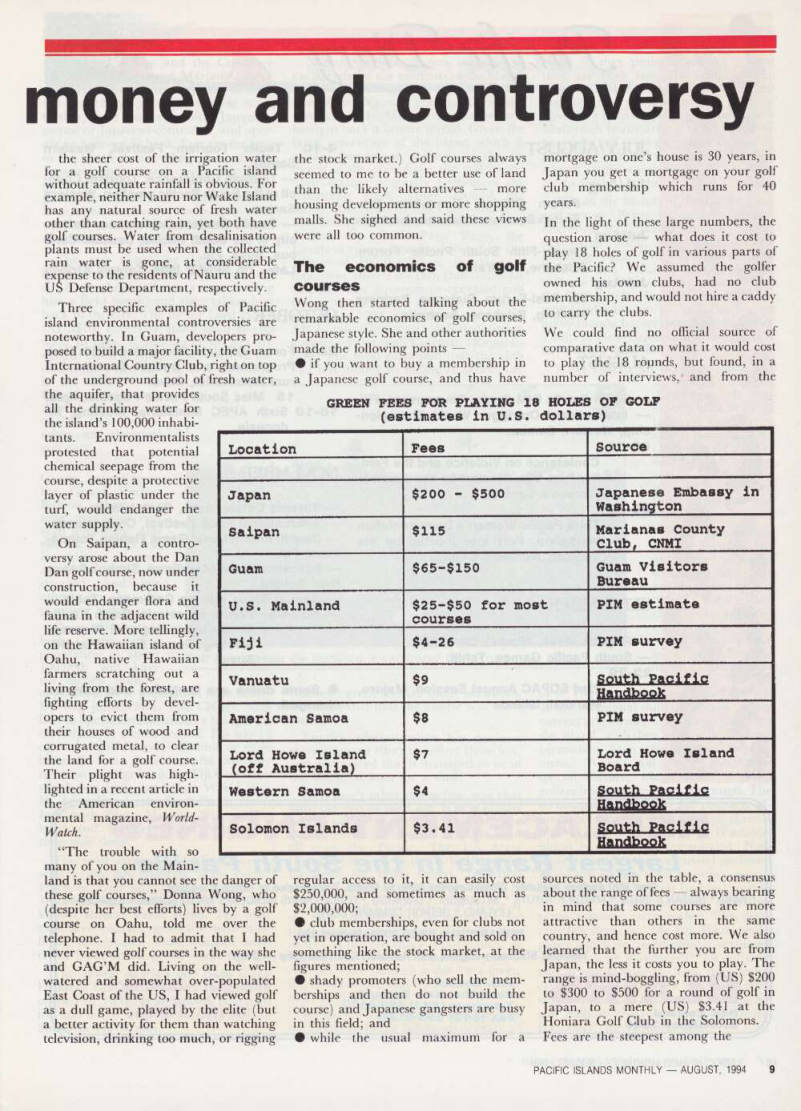
GREEN FEES FOR PLAYING 18 HOLES OF GOLF (estimates in U.S. dollars)
regular access to it, it can easily cost $250,000, and sometimes as much as $2,000,000; • club memberships, even for clubs not yet in operation, are bought and sold on something like the stock market, at the figures mentioned; • shady promoters (who sell the mem berships and then do not build the course) and Japanese gangsters are busy in this field; and • while the usual maximum for a
mortgage on one’s house is 30 years, in Japan you get a mortgage on your golf club membership which runs for 40 years.
In the light of these large numbers, the question arose what does it cost to play 18 holes of golf in various parts of the Pacific? We assumed the golfer owned his own clubs, had no club membership, and would not hire a caddy to carry the clubs.
We could find no official source of comparative data on what it would cost to play the 18 ropnds, but found, in a number of interviews,’ and from the
sources noted in the table, a consensus about the range of fees always bearing in mind that some courses are more attractive than others in the same country, and hence cost more. We also learned that the further you are from Japan, the less it costs you to play. The range is mind-boggling, from (US) $2OO to $3OO to $5OO for a round of golf in Japan, to a mere (US) $3.41 at the Honiara Golf Club in the Solomons.
Fees are the steepest among the
Location Fees Source Japan $200 - $500 Japanese Embassy in Washington Saipan $115 Marianas County Club, CNMI Guam $65-$150 Guam Visitors Bureau U.S. Mainland $25-$50 for most courses PIM estimate Fiji $4-26 PIM survey Vanuatu $9 South Pacific Handbook American Samoa $8 PIM survey Lord Howe Island (off Australia) $7 Lord Howe Island Board Western Samoa $4 South Pacific Handbook Solomon Islands $3.41 South Pacific Handbook
islands in Guam and the Common wealth of the Northern Mariana Islands (CNMI), which cater to Japanese tour ists and charge at near-Japanese rates; further, these courses are often Japanese owned or Japanese-controlled, and oper ate on a for-profit basis. Fees are the least in the South Pacific where there are few Japanese golfers, and courses are often government-owned, and sometimes government-subsidised. Many courses have higher fees on the weekends than on week days. Week day fees are shown in the table.
The fees noted for Japan usually involve transporting the golfer from the city to the club in a bus or a train, feeding him a light lunch, and then taking him back to the city. The fee for Lord Howe (AUSSIO) covers as many holes as you want to play. If additional services are needed (such as equipment rental, or use of a caddy) fees are higher than shown
in the table; in the US the fee range shown usually in cludes two people using an electrical
golf cart.
Currently on
Guam, according to the Guam Visitors Bureau, there are nine operating civ ilian golf clubs, and two for the military.
In addition, six more are being con structed, and five others are in the
planning stage.
Once all 20 are built, Guam, with a population of about 100,000, will have the highest number
of golf courses to population ratio of any US flag jurisdiction. The CNMI, with four in operation and another being built on Saipan, is a close second. Fiji has 14 operative golf courses with nine or more holes. Of these the oldest and probably the most prestigeful, is the Fiji Golf Club which was built just before World War 11. According to the South Pacific Hand book, both Prime Minister Sitiveni Ra buka and President Ratu Mara play their golf there.
The most expensive of Fiji’s courses, with a (US) 526 green fee, is the Pacific Harbour Golf and Country Club; its 18-hole course was designed by the well known Robert Trent Jones. The least expensive courses, generally with nine holes, are located some distance from either Suva or the prime resort district.
The newest of Fiji’s golf clubs is the Dcnarau Golf and Racquet club, which opened in 1993. It is located near two five-star hotels, the Regent of Fiji and the Sheraton Fiji Resort.
Nauru’s golf course, now used almost exclusively by the residents of the island, was built during the days of British
Phosphate. Nauru’s golf team recently
travelled to the Micronesian Games and brought back a bronze medal. Given the large percentage of the island which is virtual moonscape, because of the re moval of the phosphate, the golf course must occupy a goodly portion of the remaining green fringe around the island. American Samoa’s only course is noteworthy for several reasons. About a dozen miles from Pago Pago, the Lavalava course is on land leased by the
village of Illiilli. (Then, speaking of
repetition, there’s the Dan Dan course on
Saipan.) The government-operated golf
course was a minor issue in the rough election of 1992, when former governor AP Lutali (Democrat) defeated sitting governor Peter Tali Coleman (Republi can). The local press said that the club had lost money by failing to collect the
(modest) green fees on many occasions, and suggested that the course was over staffed.
Lutali’s administration has made a more vigorous effort to collect those fees, and announced that it managed to be in the black, at least for a time.
Lavalava's other distinction was that until the end of the Cold War it played host to tall, eavesdropping radio towers, that listened to air-borne messages from all over the Pacific. The US State Department used to pay a little rent to Lavalava for those towers, but that source of funds has now departed.
Lord Howe’s nine-hole golf course is the only one we know of in the Pacific that uses an honour system for collecting its fees. If the pro shack is not staffed, as it often is not, one is supposed to push a AUSftlO note through a slot for a green fee; it costs tw ice that if you want to rent a set of clubs as well.
We do not know if the golf courses in the Cooks or in the Solomons operate at
night they probably do not but
they are both near the islands’ main airports, and the GAG’M people would say that this promises trouble. One of GAG’M’s criticisms of a golf course in a Malaysian resort area is that the course has night golf to gain more income and that the very powerful lighting
system confuses incoming pilots as they
try to land at night.
Not all the islands in the Pacific have golf courses. Palau, for instance, though interested in Japanese tourists, has no courses in being, but several in the planning stage. Travel literature from Kiribati and Tuvalu, both land-poor, indicate no course in either nation. Also, the South Pacific Handbook, though it has useful information on golf courses on many islands, has no links listed for either Tahiti or New Caledonia, both of which have ample land for such facilities.
Wake Islands’ six-hole golf course has
a couple of dubious distinctions. It was clearly built at great taxpayer expense by the American mili tary, with the dirt (as well as the chemi
cals) presumably
brought in by ships
from hawaii or the Mainland.
Wake Islands’ Air Force Station has only the slimmest workload, and one might argue that it should have been closed years ago. The golf course, however, continues to operate as a perk for the dozen Americans and maybe the 200
or so Thai workers on the island, as well as the occasional military tourist. (Only current and former US military may visit the island, and then only with advance permission from the Defense Depart ment.) Wake’s golf course also has a special feature, which tends to keep golfers from straying into the rough. The terrain surrounding the golf course is off limits because, the military says, there is plenty of left-over World War II ammu nition lying around unexploded. Now there’s a serious environmental problem! ■ As this edition went to press, compe tition on the Fiji circuit had just started in which cabinet ministers, including prime minister, participated. This drew criticism from the The Fiji Times, news paper which, in an editorial, questioned why they were playing golf “on our time and at our expense”? “One thing is for certain Fiji will never fix its problems while its decision-makers are looking for golf balls in the jungle around Pacific Harbour,” the editorial said. □
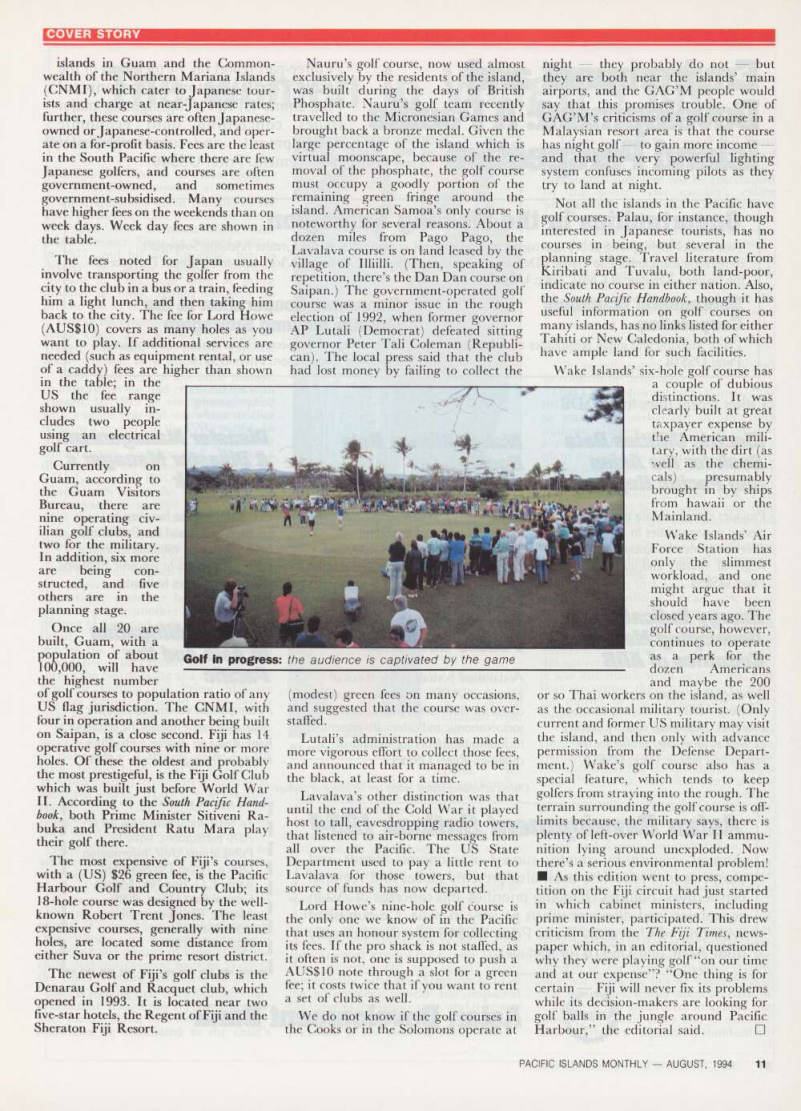
Golf in progress: the audience is captivated by the game